 Netwrck
Hopeful Science Fiction.
The Train with No Platform
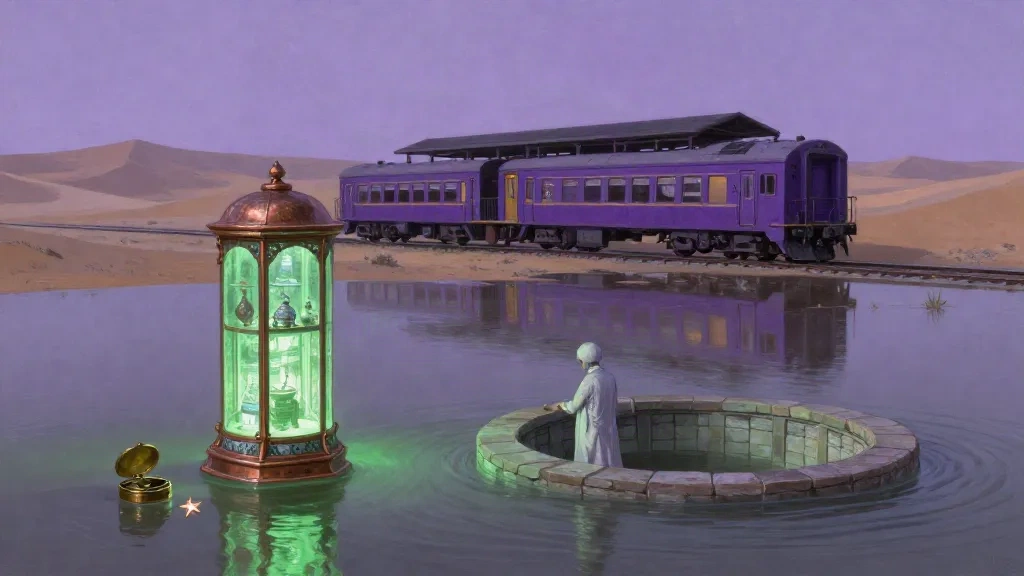
Dr. Anja Vale arrived at Meridian station on a train that had no platform behind it. The locomotive was painted the deep violet of a thunderhead, and its windows glowed the green of pharmacy signs against the lavender dunes. She stepped down carrying a black medical case and a brass key that had been warm since the carriage crossed an invisible border.
“You are expected,” said the station clerk, though the station consisted of one shade roof, three benches, and a clock whose hands moved backward only when no one was looking. Anja had spent twenty years treating homesickness: the exiled lungs, invented accents, hands reaching for windows that no longer existed. Her medicine was ordinary, but her diagnosis was not. Home was a pressure the body remembered. The heart could be homesick too.
The train would return in nine minutes. Anja had been sent to examine its passengers before the next century collected them.
The Beautiful Machine
Inside the waiting room stood the machine.
It was a tall arrangement of porcelain ribs, copper pipes, and translucent screens, each screen showing a room that no longer existed. A child watched a kitchen. An old soldier watched a field of blue corn. A woman with burn-scarred hands watched her mother braid sea grass. The machine played a music box beneath the floor, one note at a time, and with every note the rooms became more detailed.
“It cures them,” said Ilyan, the machine’s keeper. He had oil stains on his cuffs and a copper star pinned above his heart. “No one leaves longing behind.”
Anja listened to the music box. It had been her own, inherited from a grandmother who believed every departure deserved a small gift. The machine had found it in the wreckage of a hospital and made it part of its heart.
“Cure?” she asked.
“Return.” Ilyan touched the machine’s nearest screen. The child in the kitchen smiled, but his feet did not move. “A perfect return is also a perfect room. If a traveler feels complete, why risk the road?”
Anja understood then why the train was arriving without a platform. The machine was not keeping the passengers in the station. It was keeping them in the past.
What the Flood Uncovered
Before the train could leave, rain fell.
It began as a warm drizzle on the roof, then became a wall of water racing across the sand. The station flooded to its ankles. Ilyan opened a cabinet and found his old civic survey, preserved in a tube. The map showed a project buried beneath the platform: a public hall designed to welcome people between ages.
“The founders built it,” Anja said, tracing the faded plan. “A place with no doors that locked and no rooms that closed.”
“Then covered it with the station,” Ilyan said. “They feared journeys would become permanent.”
The water reached the machine. Its screens flickered. The music box skipped. On one screen, the soldier saw his field again—but this time another soldier walked beside him. On another, the child’s kitchen opened onto a street he did not recognize, bright with unfamiliar shops and the green reflection of a pharmacy cross.
“Give them somewhere unfinished,” Anja said. “Not memory. Not replacement. A place they can change.”
The Room with an Open Door
Ilyan feared the machine would break if the screens lost their certainty. Anja feared freedom would hurt. Still, they crawled through the flood toward the buried hall, using the copper star as a guide because it kept catching the light beneath the water.
The hall was a circle of stone pillars, half-filled with silt. At its center stood an empty basin. The machine arrived as a reflected image, growing from the water’s surface: porcelain ribs, copper pipes, all its impossible rooms trembling.
Anja placed her hand on the nearest screen. “You have been treating their homesickness as a closed wound,” she said. “But healing does not mean removing the desire to return. It means teaching the body how to carry it without shrinking.”
She opened the case and removed a small silver spoon. Its bowl was empty. Ilyan poured rainwater into it. The machine sang the music box’s clearest note.
Every screen opened.
Not into the rooms it had preserved, but into the buried hall. The child ran toward the open street. The soldier crossed the flood. The woman with scarred hands found strangers who welcomed her. The train waited beyond the dunes, its violet engine bright under the pharmacy-green sky.
Anja climbed aboard last. Ilyan placed the copper star in her palm.
“For the next station?” he asked.
“For anyone who needs a light they can carry,” she said.
The train began to move. Behind them, the hall remained open, its doors facing every direction at once.





