Netwrck

Surrealism.
The Forest That Missed Tomorrow
By midnight, the night market had lowered its awnings across the first-floor windows of a city that had forgotten how to stand above itself. Beneath them, the market spread on a wooden deck suspended over nothing. No street waited below. No foundation answered when the lanterns rattled. The stalls simply hung in blue storm-light, their ropes disappearing into a ceiling without a roof.
Mara Illen kept the forest in the old railway vault, a dark green wilderness where trees had once grown and now grew only in relation to remembered time. The evacuation of 1889 had removed every leaf, root, insect, and bird from the calendar. They remained physically present. They belonged to no hour.
At dusk, a fern unfurled into a shape that had not existed. At dawn, the same fern repeated the shape, more carefully, as if correcting a draft.
She wrote what she saw in the ward ledger, because somebody had to, and because the ledger was the only object in the vault that agreed with her. A brass-handled book, water-stained, ruled in columns for date, condition, and the name of the ranger who had confirmed it. She was the only ranger who would confirm it. The post had been hers for six years, which in the city above meant a salary, a cot, and the particular hush people fell into when they asked what she did and she said forestry.
She had been told to guard it from poachers, trespassers, and the municipal moments that occasionally fell loose from the calendar. She had not been told who had opened the vault in the first place. She had never asked, in the way you do not ask a question whose answer would require you to do something about it.
Because the answer was her mother.
Ilse Illen had been a boundary clerk in the year of the evacuation, one of nine signatures at the foot of the order that took the ward and its four hundred residents out of time so the city could cut a through-line beneath them. Mara had been nine. She remembered her mother's hand cold at the back of her neck, the smell of rain on hot iron that always came with her, and the specific quiet of an adult finishing a document. The ward had kept every other name it had ever held. It had never once produced her mother's.
That was the work. That was the whole of the work, and she did it well enough that nobody upstairs had sent a replacement, which she understood to be a form of forgetting rather than a compliment.
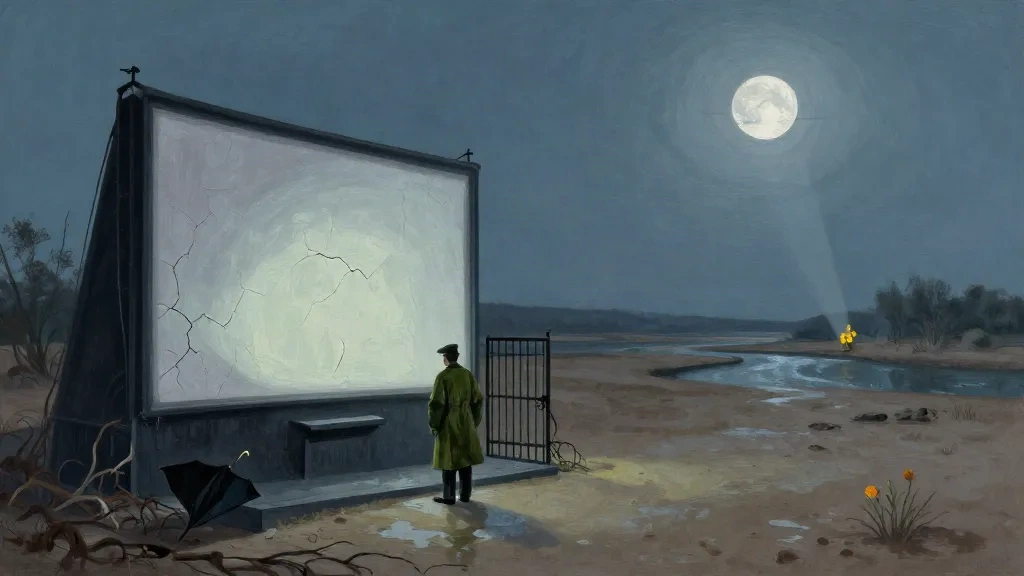
Then, on the night of the paper eclipse, when the moon came up as a smudge of grey pulp against the clouds, the brass key appeared beneath her patrol lantern.
The Key Without a Lock
It was small enough to hide in her palm and warm as if recently held. A notch in its bow resembled a crescent, though the crescent was missing its center. Beneath it lay a shaving of silver bark and a note in a cartographer's hand:
Bring the key to the market at the hour the sun refuses. Do not be punctual. Punctuality is how they find you.
Ilyan Voss had gone into the vault the previous day. He was a mapmaker in the survey office, thin, forty, patient in a way that made people volunteer things. He surveyed places that no longer had names. The office considered him a charming formality; Mara considered him the only man in the city who had ever asked her what year the ferns were from.
He had gone in carrying the brass key, a small moon no larger than a plum, and a rolled map she had assumed was one more joke at the survey office's expense. He had promised to return before the last market bell. He had shaken her hand at the vault mouth, and his grip had been dry and warm, and he had said, Stay out of the calendar tonight, Mara. Something in there is going to be reminded of you.
He did not return. The market bell rang twice and stopped mid-swing, which she had never heard it do.
She did not go to the authorities. There was no authority for this, and if there were, she knew what they would do: send men with a clipboard, write a cancellation, and put a date on the vault, and the vault was the one place in the city with no dates left to lose. So she climbed the stairs to the market with the key in her fist and the ledger under her arm, because she was a professional, and professionals bring paper.
The Clerks of the Southern Stair
At the market's southern stair, the creatures kept their clocks. They were tall, narrow things with lanterns where their mouths should have been, and their hands were full of little brass hands. They stood in ranks, and the ranks did not fidget, and the stillness of them was the most courteous thing Mara had ever been near. Every one of them obeyed a curfew imposed by a creature called the Night Registrar, who was not hostile.
The Registrar was very tall and had two lanterns, one for the hour and one for the record. It sat on a stool that had been sawn from a door.
At third bell, the last living shadow has reached its destination. All shadows without destinations will be folded into the ledger.
Mara showed the key. The Registrar tilted its head by exactly the distance a person would if they were considering being polite.
That is not a key. That is an unfinished appointment.
She asked where Ilyan had gone. It turned its record-lantern down, and in the blue light the market's impossible floor became visible: pale boards spanning thousands of forgotten streets, laid end to end by clerks who did not believe in distances.
He entered. He has not arrived. He has been in transit for a day and a half, which is not permitted, and which we will be obliged to notice at the reconciliation.
Where is he holding?
The creature considered the question as though she had asked it in the wrong language, and then, generously, translated.
Between two hours that have not agreed to meet. He is waiting for someone to vouch for the appointment. He cannot vouch for himself; that is a conflict. That is rather the definition of it.
She asked, because she had to, whether anyone had ever come out of the forest. The Registrar's hour-lantern dimmed a little, which she would later learn was the closest its kind came to being moved.
Your mother was punctual.
Mara stood very still. Around them, the market went on with its evening: a stall selling watches with no hands, a woman selling rain in stoppered bottles, a boy carrying a folded hour over one shoulder like a schoolboy with a globe.
Did she come out?
She was punctual. That is the only thing I can say about her that is not filed.
Then it lifted both lanterns together, and the light on the boards went the color of a held breath, and it said: You may take the key down. You may not take it up. And understand, ranger, that nothing you do tonight is a rescue. Curfews are not punishments. They are load-bearing.
She went down anyway. She had been nine years old for six years straight, and there is a point past which the question what is my mother doing in there is stronger than any discipline a post can provide.
The Small Moon in His Pocket
She found the moon beneath the stall with the handless clocks, resting on a folded cloth like a fruit in a bowl. Cloudy glass, warm, plum-sized. When she held it above the brass key, the empty crescent in the key's bow filled with a thin line of silver, and the line pointed toward the lowest board of the market.
She climbed down. Her boots struck wood, then silence, then wood again. The forest waited beneath the market, its trees lit from within by lichen, the green coming up through the bark rather than down onto it. Between the trunks ran a path of packed earth that shifted whenever she looked away, and Mara learned within twenty steps to walk in the peripheral vision the way you walk on a frozen lake, deciding where not to be certain.
Peripheral
At third bell the creatures descended. They closed the market's aisles with a neat, unmoving perimeter around the path and stood in it the way standing in water is standing in water. None attacked. None warned. They watched the boundaries with exact attention, and Mara understood that they were not guarding her from the forest. They were guarding the forest from the hour that would come if she got it wrong.
The curfew applies to remembered things, one said.
I am not a remembered thing,
Mara replied.
No, said another. You are the thing that remembers.
She followed the silver line into a grove whose shadows pointed in different years. Under one tree the shade ran east at four in the afternoon. Under the next it lay across the moss like the shadow of a building that was not there. She stopped counting after a while, the way you stop counting steps in a dream that has decided to be long.
At dawn, a gate appeared in a wall of orange fog. Ilyan's map lay on the ground before it, weighted by the small moon, the paper soft as skin from handling. On it, the forest was a narrow green island. The city above it had been drawn from memory, which meant it was wrong in the useful places: the through-line was there, but the ward was drawn as a room, and the room was drawn as a question.
One route remained. It ended at a door marked with the same crescent as the key, and beside the door, in a hand she knew, was a name: hers.
Underneath, in smaller letters: confirming ranger, unfiled.
The Door the Journey Started
When she touched the key to the door, the brass teeth sank into fog and held. The curfew lifted. It did not break. The door had been on Ilyan's route all along, and routes completed under supervision are permitted, and the difference between a permitted thing and a punished thing is the difference between a door and a wall.
Beyond it stood a platform in blue storm-light. Voss waited beside a train without carriages, its windows filled with orange dust. He looked no older, though the forest had grown a century behind him and he had been standing in the middle of most of it.
I could not finish alone, he said.
You disappeared.
I was the unfinished part of the map. A map that finishes itself forgets the person who held it. I needed a second signature. I needed someone the ledger had already half-opened.
He said it without apology, which was worse than apology. He said your mother, and then he did not say anything else, and the silence where the rest of the sentence should have been told her everything: that he had chosen her, that he had known what was scheduled, that he had watched her for six years in a coat with the wrong buttons and decided.
You should have asked me.
Yes, he said. And you would have said no, and I would have been right to argue, and we would have lost the moon's warmth. I do not have a cleaner version. I have this one.
He took the small moon from her hand and set it in the train's open door. The brass key stayed in the lock. Then, because he was a professional too, he told her the rest: the moment scheduled to happen without her was the reconciliation, when the ward's borrowed hours came due and the city would reconcile its calendar, and the ward's records would close, and Mara Illen, who was not a resident, not a signature, not a native hour of anywhere, would be struck from the books in nine places and folded into the ledger as a shadow without a destination.
Your post ends, he said. That is all. It is very quick. Nobody will be cruel to you about it. That is the worst of it.
She understood then that the journey had not been to somewhere. It had been away from a moment, and away from a moment, in this city, was a thing you could carry in your hand if it was small enough and warm enough.
What the Train Took
The train began to move through the evacuated forest. Trees flashed past in lichen and burnt orange. Behind them, the market's creatures folded their lanterns into a single obedient line, and the line did not follow her, which she understood to be the difference between escort and funeral and which she was grateful for in a way that made her hands cold.
When she stepped inside, Voss finally vanished. Not into fog. Into the completed line of the route, where he had been the whole time, an appointment that had gone exactly as it was scheduled.
Then the costs began, one at a time, in the manner of a settlement.
Her watch stopped. Not broke: stopped, at eight minutes past four, an hour she had never had an appointment in. The small moon went last into the door of the carriage and stayed there, and when she looked back through the window it had taken the orange dust with it, and the door closed, and the key turned itself once in the lock behind her, and did not turn back.
The forest came forward into time around the train. She watched it happen and it was the best and worst thing she had ever seen: leaves finding their hour, a lark hitting a note three bars late and being furious about it, the fern unfurling its shape and this time the shape held. Roots went back into soil that suddenly had a year. A path stopped moving. The whole green vault took a breath it had been holding since 1889 and let it out.
At the first impossible station, Mara opened her ranger's ledger. The blank spaces had not filled in. They had become places to guard, which is a different thing and a larger one, and the difference is the difference between a blank page and a page ruled in advance.
She wrote beneath them: Here, someone returned.
The Ledger She Signed
She walked back up through the market, which had rebuilt its aisles around the new absence, and up through the vault, which smelled for the first time in a century of resin, sap, and hot iron, and out into a city that was extremely ordinary and would remain so.
The street her mother had lived on was there. The street her mother had signed out of time was there, with its railings and its bakery and its door, and the door was painted, and nothing behind it was missing exactly, only one hour of it, thirty-six minutes, permanently not run.
Mara filed the report. Nine lines, in order, in the ruled columns, in a hand steadier than she had any right to expect. Date: the date the ward was re-timed. Condition: whole, with an hour outstanding. Name of the confirming ranger: hers.
Then she sat on the vault steps and waited for the folding, which did not come, and understood after a while that it would not. The reconciliation had happened inside a train with two witnesses. She had not been struck from the books. She had been, in the clerks' phrase, arrived, and arrival is a form of appointment, and an appointment once made is a thing the calendar must now keep.
What she had instead was this: she no longer owned a watch. The market's belfry had no bell in it, and had not since the second bell stopped mid-swing. She could not see the hour in the Registry's hands, and when she asked, a very small creature with a lantern where its mouth should have been told her, kindly, that the hour was no longer shown to the unfiled, and that her hour was the forest's now, and the forest had not kept a clock since the year it was borrowed.
She was not punished. She was appointed. In the ledger that night she signed her own line for the first time, and beside her name, where a condition belonged, she wrote: unfiled, and not filing.
Then she went down into the trees to see whether the fern had held its shape, because that was the post, and the post was the only thing she had that nobody had scheduled.