 Netwrck
Romance.
The Film That Knew Her Name
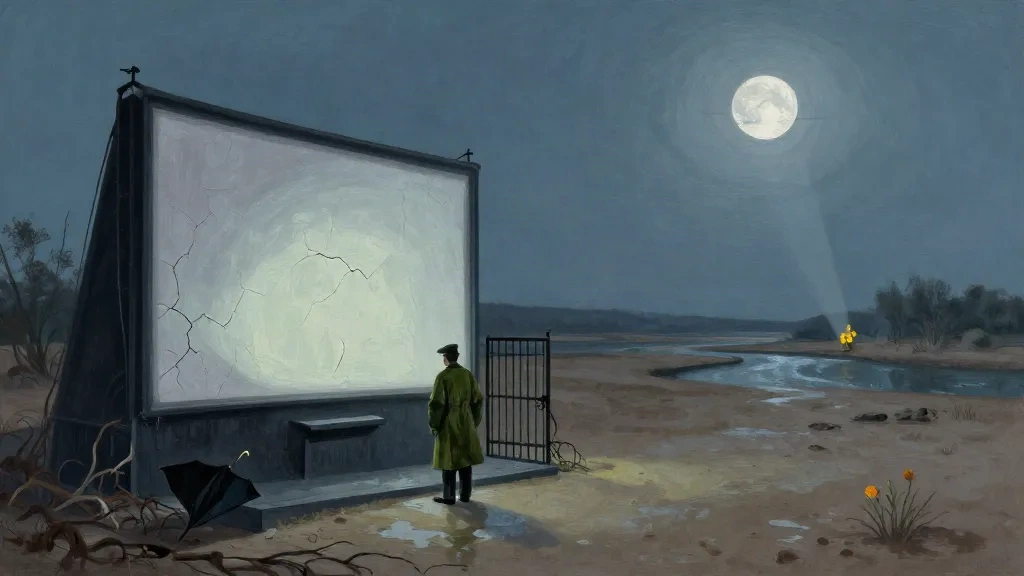
Mara had inherited the Marrow Cinema with its cracked marquee, its velvet seats furred with dust, and its single black umbrella hanging beside the projection booth. The umbrella had belonged to her grandmother, who had walked into the dry riverbed behind the theater one winter night and never walked out. The family story said the river had taken her. Mara had spent twenty-six years refusing the story because the alternative was worse: her grandmother had chosen to leave.
She came to the cinema on the anniversary of the disappearance, carrying a folder of recipes copied in her grandmother's hand. The first recipe was for almond soup. Beneath it, in brown ink, were six words: When the food remembers, call the vanished home.
At midnight, the projector started by itself. A cone of light opened across the ruined auditorium. On the screen, a woman in a green coat stood beneath a sign reading MARROW CINEMA. She looked directly at Mara and held up a hand covered in river stones.
“You have one chance,” the woman said. “The gate is beneath the dry riverbed. It opens for a true family name, paid for with a memory.”
The screen went dark. In the projection booth, a strip of film lay warm inside the machine.
The Taste of an Unfinished Life
Mara cooked the almond soup in the theater's abandoned concession kitchen. She had never made it before, but her hands remembered the order of things: toast the almonds in butter, crush them with salt, soften onion, add stock slowly. The smell brought back a kitchen she had not been in since childhood, her grandmother laughing over a broken bowl.
When Mara tasted the soup, her father sat across from her. Not a ghost. A man with his own tired face, eating exactly as he had when grief made every meal taste like obligation.
“Dad?”
He looked toward the doorway. “Your grandmother didn't abandon us.”
Mara's throat closed. “Then why didn't she come back?”
“She paid the gate once,” he said. “It took the memory of why she wanted to go. The gate can open again, but only for someone carrying the same love.”
He dissolved into steam. The soup had summoned everyone who had eaten at Mara's table: her aunt, a cousin dead in childhood, a shy bride, and finally her grandmother, young and furious beneath a marigold scarf.
“You must not pay with the meal,” her grandmother said. “The meal is the door. Pay with the taste of the person you came to find.”
The Cost Beneath the Riverbed
They found the dry riverbed behind the cinema, where pale stones waited under a low moon. Mara carried the black umbrella, though there was no rain. Her grandmother's face flickered beside her, less solid each time the film in the cinema showed another possible future: a city under white water, a child born without a name, a world where the theater had burned before anyone discovered its gift.
The gate stood where the river once turned. It was made of iron bars threaded with roots. Across its threshold waited a man Mara had never seen but recognized in every family photograph. He wore a green coat. A wedding ring hung from his belt.
“I am the future your family almost had,” he said. “Your grandmother loved me. She paid the gate to bring me here. Then she lost the reason, and the gate sent her home.”
Mara understood at last. Her family legend was true. The river had not swallowed anyone. Her grandmother had opened a door between possible futures, fallen in love, and returned unable to remember the life she had crossed for.
The iron gate whispered. One memory. Paid once.
Mara could spend the memory of her grandmother's face, the last meal, or the first winter they had shared. She could not spend both and still be the person who remembered.
A Future Almost Taken
She chose the taste of almond soup.
The memory left without taking her name, her work, or her capacity to love. She could no longer recall the exact flavor of the final bowl, or whether her grandmother had preferred the soup sweet or sharp. The knowledge rose from her like heat from a stove.
The gate opened.
The man in the green coat stepped through, but he did not take her hand. He looked toward the umbrella.
“That was hers,” he said.
“She carried it through every version of the river.”
Then he held it out. On its black cloth, a single marigold petal had appeared.
Mara took the umbrella. The gate shut with a sound like a full oven. She understood the cost then: a future can be reached, but it cannot be made the only life. Love was not proof that the past had gone unwrong. It was proof that the living had inherited its unfinished work.
Back at Marrow Cinema, the projector stopped. The screen filled with ordinary daylight, showing the auditorium as it existed now: broken seats, wet stone, dust, and a black umbrella drying beside the door.
Mara opened her recipe notebook and wrote a new dish beneath the old one: Marigold broth for the person who returns changed.
Then she set water on to boil. The future was gone. Dinner was not.





