 Netwrck
Hopeful Science Fiction.
Winter Platform Seven
At the end of winter, the station grew a platform no timetable admitted. Frost silvered the rails, and beneath the arched roof the departure board displayed impossible destinations: APRIL FIELDS, LAST THUNDER, THE YEAR OF RED PEARs, all the places that had vanished from maps.
Mara Venn arrived with a satchel of pencils, three blank atlases, and a moth wing sealed between the pages of her oldest map. She had spent forty years drawing coastlines that no longer existed. Now, at seventy-two, she wanted to draw something that had never existed at all: a place where lost things could rest.
Her maps opened doors. Not on the station walls, but on the maps themselves. One careful line, one invented threshold, and the paper became a passage. She had used that gift to visit drowned villages, vanished gardens, and the quiet house where her daughter had lived before the fever. Every place she drew disappeared when she left.
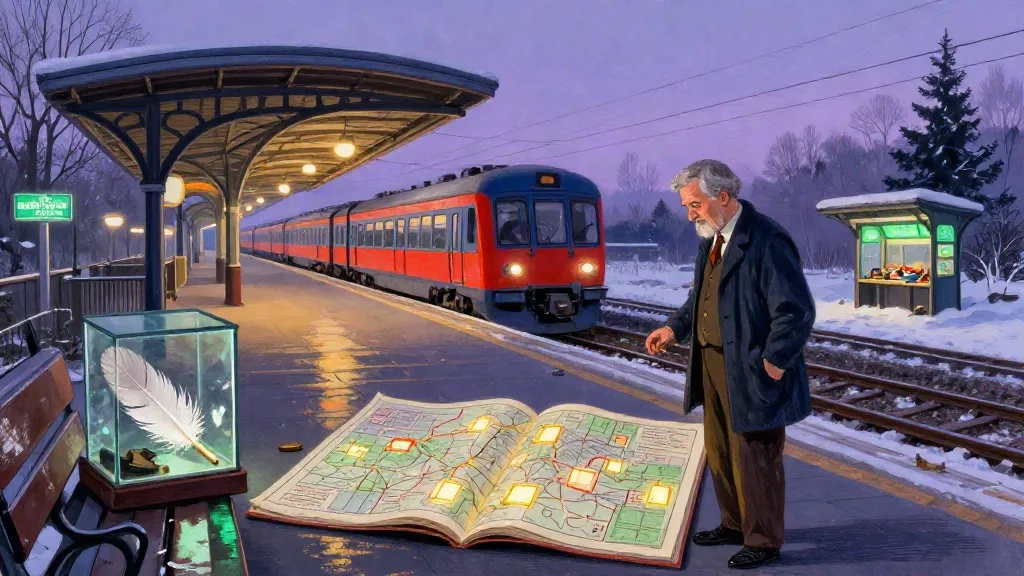
On Platform Seven, a white feather lay beside a pool of rainwater. It glowed with the green of a pharmacy sign.
The Market Under the Lamps
Between platforms four and seven, a market assembled itself each evening. Stalls stood beneath lavender lanterns, their goods displayed on wet asphalt. A woman sold tickets to remembered summers. A boy offered the sound of his mother's laughter in a glass bottle. At one stall, a brass scale weighed confessions against apologies.
The most expensive stall occupied the far end, where a quiet vendor displayed objects that were always true. A broken compass pointed toward the place you most needed to return. A sealed envelope contained the exact words your father had meant to speak. A small glass jar held the last honest minute of any day.
Mara set down the moth wing. The vendor examined it without touching it.
“That belonged to the observatory at Bellwether,” he said. “It flew there when the observatory was still warm.”
“Can it rest?” Mara asked.
“Only if you pay the right price.”
He named a truth: the name Mara had given her daughter in the hospital, before the child was born. Mara touched the feather in her coat pocket. She had never told anyone. The market had found her deepest currency.
At the next stall, a woman was trying to bury a lost city. She had brought its fountain, its bakery bell, and a crooked statue of a sailor, but the soil refused them. The city kept reappearing in the snow.
“Places need a boundary,” the woman said. “Without one, they spill.”
Mara understood then. Her lost places had not vanished. They were pressing against the edges of the world.
A Door Without a Map
She bought one thing from the vendor: a map of the station as it would look after everyone had forgotten it. The paper was warm beneath her fingers. In one corner, a blank rectangle waited for a name.
At midnight, the train arrived without a locomotive. Its windows shone like winter constellations. Passengers boarded carrying summer fruit, autumn leaves, and bundles of spring rain. The conductor looked at Mara.
“You have drawn doors for places that no longer exist,” he said. “Can you draw one for a place that has not yet?”
“Only if I know what it is for.”
“Then ask them.”
Inside, the lost things were waiting. They filled the carriages without crowding: names on vanished station signs, keys from demolished houses, a child's red balloon, the shadow of a dog buried beside a road no traveler used. The moth wing fluttered from Mara's map. The white feather lifted from her pocket.
They led her to the final car, where a child sat beside a window. The child held a paper boat in both hands.
“Is this where things rest?” Mara asked.
“This is where they decide.”
Mara placed the map on the floor. The blank rectangle began to glow. She drew a small building beside it, then a shelter, then rooms with wide windows. She drew hooks for keys, basins for feathers, shelves for wings and fragments of forgotten songs. She drew no locks.
The market's brass scale chimed. The vendor's voice came through the walls: One true thing.
Mara looked at the child and the paper boat. Then she wrote the name of her daughter inside the rectangle.
The Place That Remembered Forward
When she woke, the station was quiet. Lavender dawn light lay across the wet asphalt, and the green pharmacy glow from the market stalls had faded. The train stood on Platform Seven, its doors open.
Every lost thing had found a place. The keys hung in the shelter's small rooms. The fountain bubbled beside a garden of impossible trees. Names rested in wooden boxes, no longer hidden. The red balloon floated beneath a roof that had never existed.
Mara's maps remained blank except for one final drawing: a station with seven platforms, a garden on the roof, and a sign pointing toward spring. She framed it. On the back she wrote, in small, careful letters, Here is where you may remain.
When the conductor asked what she would call it, Mara looked through the glass. The white feather had settled beside her atlas, and the moth wing rested safely inside a glass case.
“The Station of Returning Things,” she said.
Then she boarded—not to search for a vanished place, but to bring home the next lost thing she found.





