 Netwrck
Hopeful Science Fiction.
The Market of Unclaimed Things
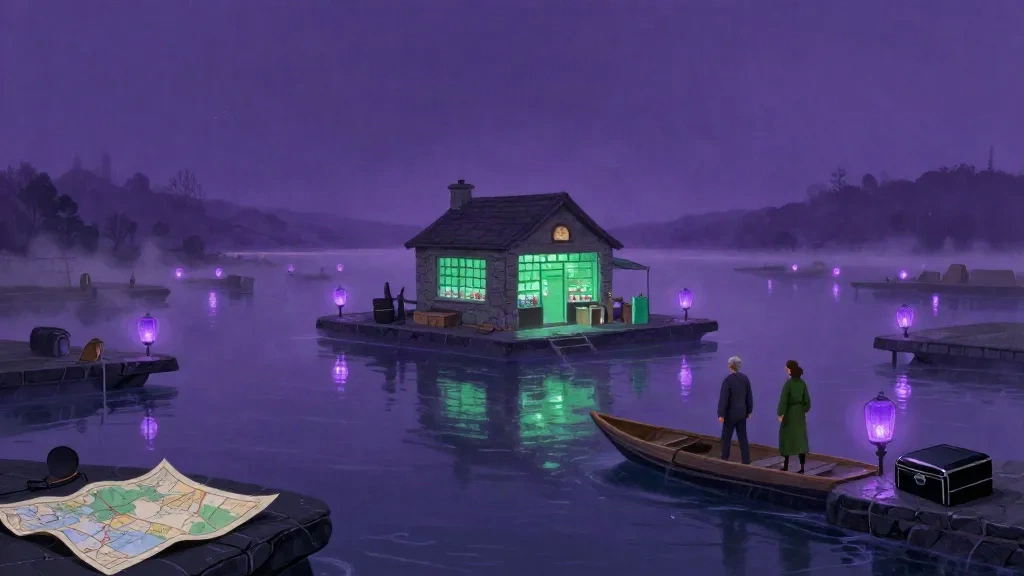
By the time Orin Vale reached the market, the rain had turned the floating platforms into islands of wet asphalt. Lanterns floated beneath the boards, their lavender light trembling underfoot. Stalls sold memories without owners: a glove remembering a hand, a staircase repeating one child's descending footsteps, an argument paused before its final insult. Each memory had been cut loose by loss and sold for use in the city above.
Orin carried two objects beneath his coat. A folded map, softened along its creases, and a music box with a black pearl lid. He had been an actor for forty-two years, though only a few people still called him that. Now he played small roles at the municipal theater and received letters from strangers who remembered his face from films they claimed not to have seen.
The map led to a stall at the market's edge. A woman in a green pharmacy-sign coat studied it as he approached.
You are late, she said.
For what?
For remembering.
The Promise in the House
Her name was Ilyra, and the house she had found belonged to his grandmother.
Not the house itself. The room inside it.
When Orin was a boy, his grandmother had placed the music box in his hands and told him to carry it to the eastern gate. She made him promise to return it before the city lost its last tram. She died before he could ask why the box mattered. The map had arrived three days earlier, folded under his door, bearing a street that no longer existed.
They took a skiff across the black water. The house stood on a raft of stone, its windows glowing pale green. Orin recognized the wallpaper from childhood, though the pattern had changed: stars where flowers had been, flowers where stars had been.
He entered alone.
The first room was his old dressing room. Costume racks stood empty except for one coat. The second was his grandmother's kitchen, warm with the smell of burnt sugar. The third was a theater filled with an audience of silhouettes.
Each room remembered him leaving. He felt the departures again: the door, the street, the years after. His ability had always been a curse disguised as a profession. He could step into any room he had left, but never stay in the one where he was most needed.
What the House Grows
At the end of the corridor, a door waited beneath a pharmacy cross.
Orin pushed it open. His grandmother sat at a table, younger than he remembered, holding the black music box.
“You came back,” she said.
The room expanded. A window appeared, then a stairwell, then another kitchen crowded with people who looked almost like him.
Orin understood then: the house grew from lies. His grandmother had never been in this room. She had never sent him to the eastern gate. The promise belonged to a story she performed for children, and he had carried it as if it were true.
“I kept it,” he said.
The house shuddered. Another room formed behind her, filled with newspaper headlines about a vanished city.
“You kept the wrong thing,” she said.
“I kept my word.”
“No. You kept the performance.”
The music box began to play without being touched. Its melody was a half-step from the one he remembered, and in the gap he heard the truth: his grandmother had made the promise to his mother, who had died young. She had promised to bring the box to the gate so the child would remember the way home. The house had built a false version because a promise without context was only another room with no door.
A Different Ending
Orin opened the box. Inside lay no mechanism, only a small piece of green glass and a photograph of his mother standing outside the eastern gate.
He placed the photograph on the table.
“I cannot return what I never received,” he said. “But I can carry her where she went.”
He stepped into the room his mother had left when she was six years old. It was warm, narrow, smelling of rain. He stayed.
Behind him, the house stopped growing. The false rooms folded into walls, then vanished. His grandmother's image became transparent, but the photograph remained.
At sunrise, Orin walked out carrying the box and the map. Ilyra was waiting on the raft, her green coat bright against the lavender mist.
“The market closes at noon,” she said.
“Then we have time.”
He unfolded the map. New streets appeared where the old ones had been erased. One led toward the eastern gate. He set out with Ilyra beside him, carrying no proof that the past had been restored, only the knowledge that a promise could change when the truth was finally admitted.
Somewhere below the water, the music box played a complete note.





