 Netwrck
Hopeful Science Fiction.
The House With One Extra Door
Elias Vale had spent sixty-eight years leaving rooms.
He had learned to do it young, in Los Angeles, by walking off a film set in the middle of a scene and letting somebody else explain to the director where he had gone. He had left a hospital room in Prague with the machines still beeping. He had left a dressing room containing three mirrors and no reflection, and never told anyone which of the three had been his. He had left kitchens while onions burned, parlors while arguments sharpened their knives, and once a train compartment while a woman leaned close and said, with terrible gentleness, that he was afraid of staying.
He had never disputed it. A man who could not be in a room twice had at least never been asked to decide anything.
His grandmother had a word for him, and the word was not coward.
“You are the punctual man, Elias,” she used to say, her thimble clicking against the needle. “Everything leaves you on time. Nothing ever arrives.”
Now he lived on the fourth floor of the Meridian Apartments, where memory ran downhill into tomorrow. The residents could not recall yesterday. They woke knowing which elevator would break in March, which neighbor would leave a bowl of soup outside their door on Thursdays, which rain in November would taste of iron. They kept calendars dense with future appointments and framed photographs of faces they had not yet met, and they spoke of the past the way other people spoke of weather: politely, and without belief.
Everyone in the building could arrive in a room that had not happened yet. Elias was the single exception. He could re-enter any room he had ever left, and the talent had made him, in the end, a man with an enormous number of returns and no particular place to return to.
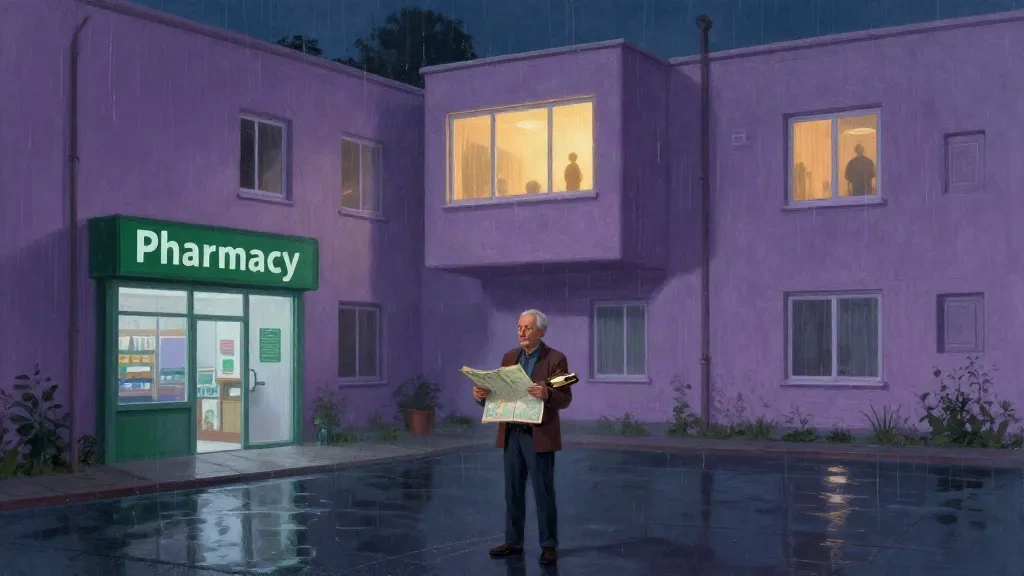
His room was painted the color of a lavender bruise. On the wall hung a folded map gone soft along its creases. On the windowsill sat a music box with a painted lid and one tiny silver key, and it had never once played all the way through. On its last bar the melody reached up, took the shape of an ending, and stopped one note short of it.
The map showed the Meridian as it would stand in 2091. A new wing filled the courtyard. Six rooms were marked out in green ink, each with a name inside it, and one of those names was Mara Venn, projectionist, departed the building in 2038.
His grandmother had been Ilma. She had sewn seams in a shop two streets from the river and smelled permanently of cloves. She had believed in appointments the way other people believe in weather—totally, and against evidence. When Elias was seven she had put the music box in his two hands and traced the line of his own street with one finger.
“If I ever disappear,” she said, “you will find me.”
Three weeks later she was gone from the apartment, and the box on his windowsill had lost a note.
A Room for Every Lie
He found the first new room in the basement laundry.
He had left that room after arguing with a stranger about a war that had not happened yet, and he had left it badly. The machines were still running. Their porthole windows showed a city under wet asphalt and a sky the color of a pharmacy sign. Behind the dryers, where a wall had been, a door stood.
Inside, six people sat around a table. Each wore a paper name tag.
“You lied,” said a woman in green gloves.
The room shuddered. A wall grew down out of the ceiling and divided the space between them, thin as paper.
Elias stood very still and let the house explain itself. The house fed on falsehood. Every lie laid down a room, and the liar was sealed inside the rooms they had made, in a house that was always running out of space and never running out of appetite.
He unfolded the map. A seventh door had appeared on it in green ink, and the name inside that door was his own.
Then, because he was sixty-eight and honest in exactly one direction, he did the arithmetic.
He had told lies his whole life. Small ones, useful ones. He had lied to directors and to cousins and once to a customs officer. But a lie only builds a room if someone hears it. The house had never once grown for any of those. In sixty-eight years it had built exactly one structure, and it had been building it slowly, patiently, for six decades and one year: a room around a promise he had made to a seven-year-old boy and had never gone back on.
Not a lie. Something worse. A lie would have been finished. A promise is a room the house can keep extending.
The Concierge of Tomorrow's Mail
At the desk in the lobby sat Niko Venn, who sorted tomorrow's mail into bins by hour of delivery. He was Mara's grandson. He did not know that yet. The letter telling him so was in the bin marked nine a.m., and at nine a.m. he would read it, and the day after that he would burn it, and he would spend the rest of his life unable to explain why.
“Where is Mara?” Elias asked.
Niko frowned. “Who is Mara?”
Elias set the music box on the desk. The lid lifted before he touched the key. A thin melody came out, rising toward the ending and stopping just short of it, and the young man's whole face changed, though he could not have said why.
“My mother used to hum that,” he whispered.
Then Elias made a decision he would spend a long time being unable to excuse, which is the only honest way to describe a decision you are still making at seventy.
He had a true thing and it had only confused the boy. The door on the map bore his name, and the door on the map was made of falsehood, and the house had never once been moved by the truth. So he lied. He said: your grandmother is in the basement, behind the dryers, and she has been waiting there since 2038.
“That is not possible,” said Niko.
“She said it was.”
The map that night gained three doors. Elias watched them come, green ink welling up along the fibers like sap, and he understood that he was now the man who built them. A lie is only a tool, and the difference between a bridge and a trap is not the shape of it but who you have agreed to be inside.
He kept going anyway. There was a woman in the laundry who had been sealed into a room for thirty years, and sixty-one years is not a number you get to be polite about.
Arriving After the Goodbye
Beyond the door with his name on it was a kitchen washed in lavender light. Rain ticked against the windows. Across the courtyard a green pharmacy sign lit the shelves and the wet asphalt beyond them, and the clock on the wall read 2091, three days before the building came down.
Mara Venn sat at the table, young, laughing at something out of frame.
“You are late,” she said.
In the doorway behind her stood his grandmother, sixty years older than the last time, carrying a suitcase.
“You found the room I left,” Ilma said, crossing to the table and setting the music box down beside his elbow. “I asked you to find the person I was becoming.”
Then she told him the whole of it, quickly, the way she used to, because she had a train of her own to catch in a world that had not happened yet.
The house could not hold anyone who was remembered correctly. It ate the unremembered, the revised, the politely mistaken—it was full of them, six floors of them—but a person known exactly, down to the thimble and the cloves, was a wall it could not push. The residents of the Meridian were safe from it in the most total way available. Every one of them had lost yesterday.
One boy had not. And while the promise stood open, it held her in place, the way a nail holds a board, and kept her from leaving while the house worked at her.
“If you keep it,” she said, “I go. That is the arrangement. You have had sixty-one years of it, Elias. It was a good appointment. Nobody could fault the punctuality.”
“And if I don't?”
“Then I stay, and the house gets me, and you get to keep a grandmother you never once came home to.”
He looked at the clock. He looked at Mara, who was laughing in a room that had not happened, in a building that was still standing, three days from the wrecking crew.
Then he remembered the mechanic of his own talent, which he had spent a lifetime mistaking for cowardice. To leave a room, you had to surrender the certainty of where you belonged. That was the whole trick. That was what the train compartment woman had seen, years ago, and had been kind enough to name out loud.
He began to walk.
The kitchen divided as he moved, walls splitting off the ceiling one after another, crooked rooms branching off left and right, each one with a woman in it and a paper tag and a lie still going. To get out of a room built of falsehood, someone inside it had to be unlieable. His grandmother's promise was the only true thing left in the building, and it was inside him, so he went in first every time.
And each time he came out the other side, one of his own rooms went with him. Not the memory—he kept every memory, that was the cruelty of it—but the ability to arrive. The hospital in Prague. The kitchen with the burning onions. The train compartment. His mother’s house, where he had been eleven and had not yet learned to leave.
He said goodbye to each of them properly, out loud, alone, in the crooked hall, and the house took the door.
The last one was a kitchen in 2049, lavender light, a suitcase, a woman with a thimble. He stopped in front of it for a long time.
“Leave it,” she said from inside. “I am not a room, Elias. I am the person you were going to be too late.”
So he left it, and it closed, and that was the last of the returns he had.
When the walls stopped moving, he was standing in a hallway with a folded map in one hand and a music box in the other, and no room in the world left behind him that he could enter again.
Behind him the kitchen light went on for a while, and then a woman with a suitcase walked out of it, up the stairs, past the laundry, and out of the front door of the Meridian Apartments at four o'clock in the afternoon, where the sidewalk was wet and real and entirely in the wrong century, and she said goodbye to each person she passed, by name, out loud, which was the one exit the house had never once managed to seal.
What the House Kept
Niko was asleep under his coat at the concierge desk. The music box rested against his ear. Across the courtyard the false rooms came down without noise, leaving damp plaster and one green-lit doorway that no longer led anywhere.
He opened his eyes.
“My name is Mara Venn,” he said. “I remember being born.”
By morning six residents had gathered in the lobby, and none of them was celebrating. That is the part nobody tells you about a cure: it returns you your own life, and your own life is full of people who died while you were cheerfully planning to meet them.
The child who would lose her hearing sat on the arm of the sofa crying with the specific shock of a person remembering music. The nurse who had denied her age for nineteen years held the map and found the line where her name was written and could not decide whether to be glad. A man named Tobias stood with his eyes shut, sorting the rooms in his house that he had been living in without having furnished.
Elias told them what he had spent, since they would learn it eventually and he would rather they learned it from him. The six names in green ink. The woman in the laundry, thirty years inside one sentence. The promise, kept.
The nurse folded the map along a new crease. “Then it was a trade,” she said.
“It was a trade,” Elias agreed. “I just want it entered correctly. I am not the villain of this and I am not the hero. I am the man who was late.”
Niko found him at the door with his coat on.
“Did my mother hum it?”
Elias could have told him the truth, and the truth was that the melody had gone into the boy like a key into a lock, and what opened was not memory but appetite: Niko Venn had walked out of a sealed room wearing an old woman’s hunger for a thing he had never had. The truth would have been a stone dropped into him.
“She hummed it better than you do,” Elias said.
He watched the map in the nurse's hands for a twitch, for green ink welling along the crease. Nothing came. The house ate lies that asked it to move something, and that one had cost Elias the only thing left to pay with, and it had cost Niko nothing at all.
Mercy, it turned out, was the one currency the building could not counterfeit.
The demolition still happened, in 2091, on schedule. A building that had held six futures in green ink did not get to keep them simply because the people inside it had woken up. They moved out into a century they could not see the end of, which is the ordinary condition of everybody alive, and which the Meridian had promised to abolish, and which nobody had yet found a way to be happy about.
The Appointment
He was seventy-four in the year the walls came down, and eighty-one when the lot was sold, and every ninth of Rainmonth after that he climbed the four flights to a fourth-floor hallway in a building that had never contained him.
He climbed them slowly. He was not the punctual man anymore. He was an ordinary man with a pension and a good coat, and he arrived on whatever floor the stairs happened to leave him on.
The wall at the end of the hall was blank plaster, warm to the touch, with a rectangle of paint slightly cleaner than the rest. He knocked on it anyway, out of habit and then out of something else, and then he sat down on the floor with his back against it, the way a man sits outside a house he has decided not to go into.
He set the music box on the carpet beside his knee. He had carried it for seventy-four years through three apartments, one border, and a war that he had argued about once in a laundry with a stranger who was right.
He did not open the lid. He had learned that some doors you can only knock on from the outside.
After a while a young woman with green gloves came up the last flight, carrying shopping, and stopped when she saw him sitting in the corridor. She did not know him. She was not afraid of him either, which was the other half of the gift: in a building where everyone was afraid of everyone, an old man on the floor with a music box was only a small sad fact, and she gave it the same attention it deserved, which was a moment.
“They say there is a room on this floor that only shows up if you lie,” she said. “Have you tried?”
“I found it,” Elias said. “I would not recommend it.”
He gave her the music box, because he was eighty-one and it had been hers first, and because a woman in green gloves who has spent her life in rooms of other people's making ought to be handed something that opens by itself.
She lifted the lid without touching the key, and the melody went out into the corridor, all the way, every note, the ending it had been reaching for since 2038 arriving at last and finding that it was not sad, which had been the whole doubt.
The music was not sad. It was an appointment kept.
And on the other side of the warm blank wall, something that had been holding a place for sixty-eight years finally sat down.





