 Netwrck
Hopeful Science Fiction.
The Citizens of Vesperly
At noon, the lavender shadows of Vesperly voted beneath the awnings.
They stretched from wet asphalt to shopfronts, each one perfectly shaped and many steps behind its owner. A baker’s shadow carried a rolling pin. A tram driver’s shadow held a punch card. On the corner outside Saint Orra Pharmacy, the green cross of the sign fell across a small girl’s coat, and her shadow raised a solemn hand.
Mara Orlov saw all of them from her second-floor window. She was a seamstress of distances: given two people who had grown far apart, she could stitch the missing span between them with silver thread.
She could mend a quarrel across a kitchen table. She had closed the gap between two ferry captains after their families drowned in the same storm. Once, she stitched a narrow bridge from a jailed astronomer to the balcony where his daughter watched the stars.
What she could not do was open the door between the living city and the Necropolis below it.
Every dusk, Vesperly’s shadows descended the old stairways to cast their votes in the Undercity. The living could not follow. Every morning, the shadows returned with decisions their owners had never seen.
Mara wanted a door. Not a loophole, not a spell disguised as architecture, but a door with hinges on both sides. It would open only when the living who crossed and the dead who sheltered below agreed to the crossing.
She had the iron frame already. She lacked the language of consent.
The Agreement in the Dead Air
Under the pharmacy, Mara found a village agreement written on birch bark in narrow black letters. The village had vanished during the Flood of Glass, but its treaty remained in the Undercity’s oldest archive.
No living clerk could read it. Priests claimed it was sacred geometry. Technicians called it a cipher keyed to a vanished alphabet. Mara tried every reader in her workshop and heard only dead air.
Then a shadow leaned over her shoulder.
It was thin as folded cloth and smelled faintly of rain on stone.
“You are sewing the wrong seam,” it said.
Mara recognized the voice of Tomas Vale, a city surveyor who had disappeared eleven years earlier. His shadow had kept working after his death, filing routes, repairing drains, whispering instructions to engineers who could see nothing.
“I need the treaty’s meaning,” Mara said.
“The dead can read it.”
“Then you can read it.”
Tomas’s shadow spread across the birch bark. Letters rose beneath it like bubbles through dark water. The agreement said that no village beneath the hill could be joined to the city until every resident had been offered a return, and no returning voice could be compelled to answer.
At the bottom was a second condition, hidden in the grain.
The door must remember the dead as full members of the agreement.
That changed everything.
What the Shadows Refused
Mara tested the dead on her neighbors. A widow’s shadow approved the door because it opened toward the cemetery. A child’s shadow refused because no child had been buried there for decades. A laborer’s shadow demanded a minimum wage, three stairs, and a guarantee that its owner could not command it.
The shadows were not echoes. They were citizens, with histories the living preferred to forget.
When Mara announced the door, the living council panicked. Merchants feared the dead would reclaim their buildings. Families feared their ancestors would reopen old cases. The dead themselves refused to approve a door built from borrowed memory.
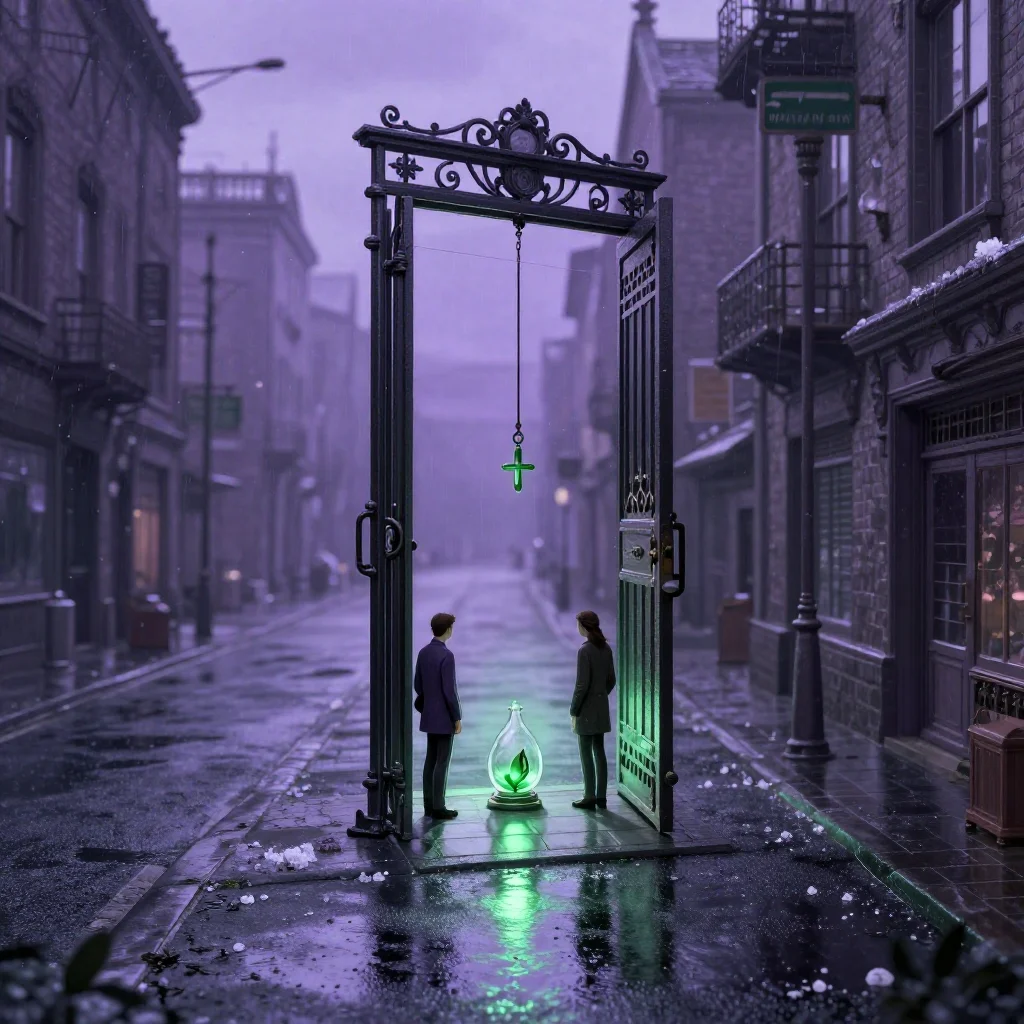
So Mara made a new frame. She lined it with salt from the jar her mother had used to preserve summer fruit, then placed a glass seed in its center. The seed contained no plant. It held one seed-shaped absence, proof that something could begin without being owned.
She offered no promises. She offered a process: one witness from each side, one spoken refusal, one freely shared memory. The door would open only if neither side could proceed without the other’s consent.
On the final night, the dead filled the square. Their shadows stood behind the living, not leading them, not replacing them. Tomas carried the birch treaty to the threshold.
A Door Made of Two Yeses
At first the frame refused to move. The living wanted certainty. The dead wanted safety. Between them lay years of silence.
Then the pharmacist, an old woman named Sen, stepped forward. Her shadow held a green cross.
“I consent to enter the Undercity,” she said. “I do not consent to be sent there. If I cross, I cross in my own time.”
Tomas’s shadow touched the glass seed.
“I consent to the door,” it said. “I do not consent to the city speaking for me.”
Other voices followed. Not a chorus of approval, but a sequence of precise permissions. A yes to a stair. A yes to a lamp. A no to inheritance without witnesses.
The salt crystals brightened. The glass seed split without breaking, releasing a thin green light like a pharmacy sign reflected in rain.
The door opened.
It was narrow, exactly wide enough for one person and one shadow.
For the first time in years, the living could hear the dead speak without losing their own voices. And the dead could cross upward, into lavender daylight, without being mistaken for messages, omens, or obligations.
Mara hung a new sign on the frame, though the door needed no label: two brass handles, one on each side, connected by the same thread.
By morning, no one had conquered the Undercity. No treaty had been rewritten. A queue had formed instead—citizens and shadows, taking turns, asking permission.
Some entered. Some returned. Some simply stood together in the doorway, learning the shape of a choice neither had made alone.





