 Netwrck
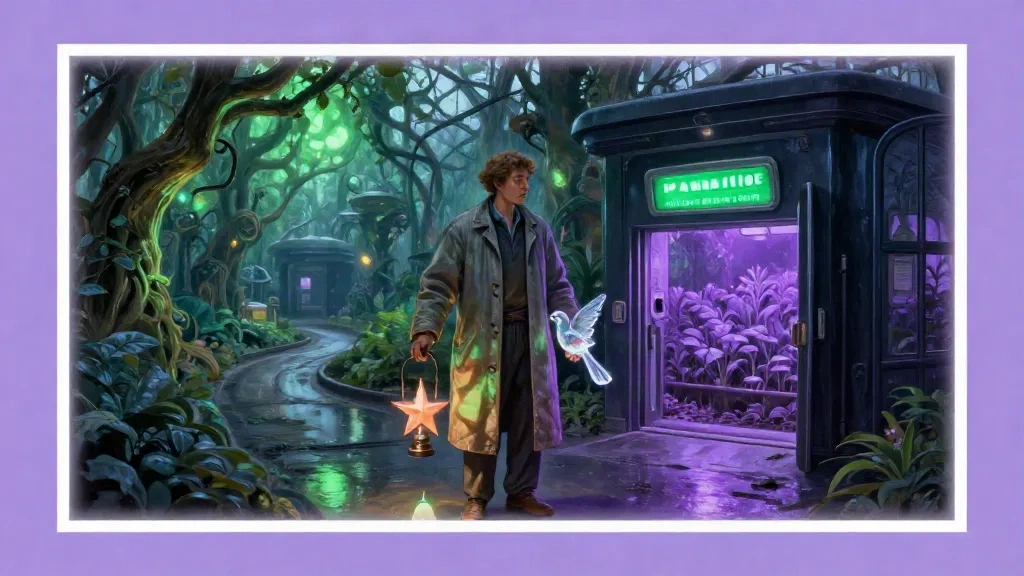
Hopeful Science Fiction.
The Seed Below the Lamps
Every night, Sora hung her lanterns along the paths people avoided.
They climbed the service ladders, trembled beneath pipes slick with condensation, and leaned beside the dark hydroponic vaults. Their little flames were green as pharmacy signs, and their reflections lay on wet asphalt sealed beneath the orbital greenhouse's outer skin.
The greenhouse curved around a seed the size of a village. No one knew whether it was sleeping or remembering. Its bark shone lavender beneath the work lights, and every pulse released a scent: pine resin after lightning, salt marshes, leaves crushed by winter.
On the western rim, the old forest beds grew only in the seed's dreams. Branches rose from black soil without roots. Sapling shadows crossed the corridors at noon, though there was no noon beyond the station windows.
Sora repaired the lamps there. She was a lantern maker, though the best ones no longer needed flame. Her light came from captured sunrise, from the warm disagreement between two metals, from a seed of phosphor sewn inside each glass shell.
Under her coat she carried a copper star and a glass bird. The star had belonged to her mother. The bird had appeared inside a broken navigation beacon, wings folded around a message nobody could read.
At the border, both objects would have to be surrendered.
The Bell Under the Floor
The border was not a wall. It was a line of lavender light painted across the final corridor, dividing the greenhouse from the transfer station beyond it.
The customs clerk, a broad man with transparent eyelids, pointed to a sign: UNRECORDED CARRIABLES MUST BE LEFT BEFORE CROSSING.
“The star is metal,” he said. “The bird is glass.”
“The bird is not measurable,” Sora replied.
“Then it cannot be carried.”
She had crossed borders before: between the night market and the hydroponic farms, between the settlement where people remembered their names and the district where names were replaced with numbers. She had learned to cross without surrendering what mattered. The trick was not deception. It was finding a door that had been waiting for a different answer.
Behind the clerk's booth, a small bell hung beneath the floor. It had no rope and no clapper. When Sora stepped near it, it rang once, a clear note swallowed by the machinery.
The clerk stared.
“That bell rings only for decisions no one admits making,” he said.
Below them, the greenhouse shuddered. A dream-branch pierced the floor and withdrew, leaving a curl of green resin.
What the Bird Remembered
Sora set the copper star on the counter. The clerk covered it with a square of black cloth. Immediately, the lights along the abandoned path dimmed.
“You can take one,” he said. “One permitted object. One remembered possession.”
“That is not the rule.”
“It is the rule now.”
The bell rang again.
Sora understood. The border was listening for the decision beneath the decision: not what she owned, but what she was willing to become.
She placed the glass bird beside the covered star. Its wings caught the lavender light. Somewhere in the seed's dream, a flock of birds lifted from an extinct sky.
“I did not choose to carry these things,” she said. “I chose to keep them when carrying them became inconvenient.”
“That is not a decision anyone can hear.”
“It is the one I made.”
The clerk looked toward the floor. The bell gave a third ring.
Beyond the border, the transfer station was dark. The station's doors had sealed years ago, when the first orbital settlements divided into territories that claimed different versions of Earth. But the seed remembered forests belonging to none of them.
Sora took the star back. The clerk flinched as if she had drawn a weapon.
“Then the bird stays,” he said.
She turned the glass bird in her hand. The unread message glowed inside its breast: not words, but coordinates to a place beneath the greenhouse.
A Path No One Had Chosen
Sora stepped across the lavender line carrying both objects.
The border did not flare. It opened like a seam.
Behind her, the clerk shouted that the rule had been broken. Ahead, the transfer station's dead lamps awakened one by one, following the green pulse of the glass bird. At the far end, a narrow passage descended into the seed's roots.
Sora descended with the copper star in one hand and the bird in the other.
At the bottom waited a field of seedlings beneath a violet sky that did not belong to any station. Each seedling bore leaves shaped like the borders people had stopped crossing.
The bell rang above them, then everywhere.
No decision had been surrendered. A path had simply been made where everyone had been afraid to walk.
Sora planted the star, and the glass bird flew toward the first green flame.
By morning, the forest had returned to the border.





