 Netwrck
Hopeful Science Fiction.
The Water's Moving Map
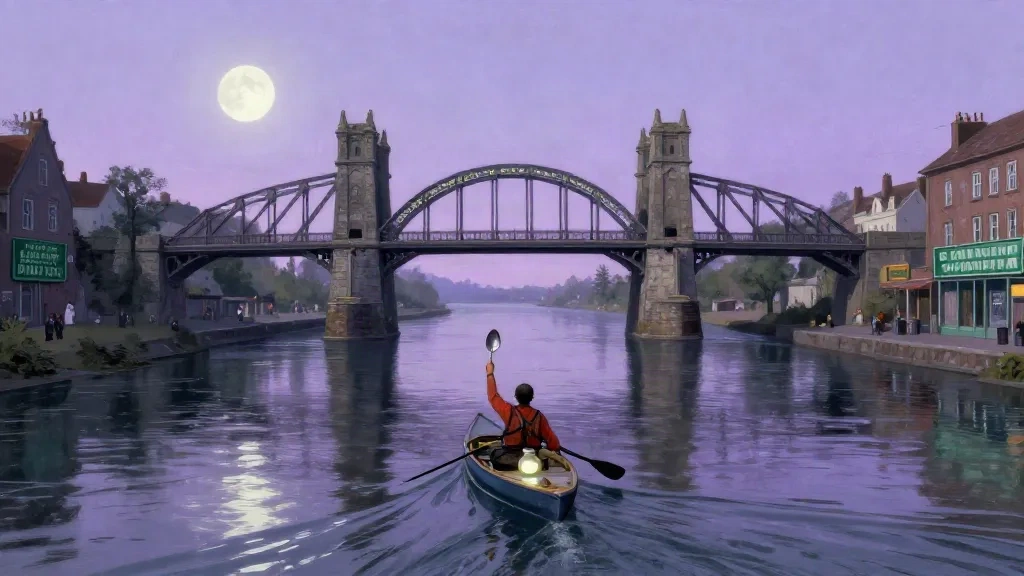
Mara Vale surveyed the border river from a skiff with a silver spoon lashed to its bow. The spoon trembled when the current changed its mind, its bowl swinging toward whatever grief, anger, or homesickness the water had carried furthest that week. She had stopped pretending it was a compass in her second year. A compass points somewhere. The spoon pointed at someone.
She began at the eastern lock, where the town divided itself and pretended the division was geology. Lavender watermarks, thin as a thumbprint, meant a wedding remembered too exactly. Wet-asphalt darkness pooled around the piers of the old military crossing, the old resentments, which were denser and slower than grief and had no smell she could name. Wherever the river ran beside the road, it glowed the green of pharmacy signs: gratitude, bought cheaply with bandages, tea, and the particular attention of people who had decided to stay.
For eleven years Mara had performed a private ritual. At eleven-forty-five each night she left a silver spoon and a salt jar on the western quay. The salt kept nearby feelings from curdling into something a person could be held to. The spoon revealed whether anyone else had arrived to help. Once, a glinted stranger in a mechanic's coat refilled the jar and left without saying a word. Once, two children stirred sugar into it until the whole bank smelled of sweet oranges and somebody's mother shouted from a window about the ants.
Mara recorded none of it officially. In the private atlas she kept under her desk, the ritual was a blue pencil mark. So was the other thing. On the page for the eastern lock she had drawn her father's name, the year he signed the channelization study, and then nothing, because nothing was what she had left.
He had been the county's hydrographer before her. He believed water could be persuaded. He died in the fourth year of the work, on a survey boat, four miles from the quay where his daughter now left salt out for strangers, and the river had spent the following decade going exactly where it liked, which everyone agreed was the most damning possible outcome of his life.
The Report Nobody Would Sign
"You're not going to file the anomaly," Ines said.
Ines ran the pharmacy on Third Street, four blocks from either bank, which made her the only person in town qualified to diagnose the whole population. She leaned on the counter with her arms folded, watching Mara flatten a section of the moving map onto the survey drum with her fingertips.
"My job is to measure."
"Your job is to be believed. Those are not the same thing, and you know which one you're doing, because you make me say it twice."
The file on the desk in Mara's office was three years old and entirely standard. Fixed channel, fixed banks, fixed line on the ground between two countries, a new span to be built in the spring. The commission had been generous about the word fixing. Halvard Reyes, who chaired it and who had never once been wrong in public, put it plainly at the hearing: "A river that changes its mind is not a river, Ms. Vale. It is a debt with a current."
She had logged every reversal. Fourteen in eleven years, each one on a night near the solstice or near a date somebody in town had died. The reversals were not random, and she had stopped pretending they were, and she had also stopped saying so out loud, because the last time she had said so out loud, two engineers from the regional office had sat in her office drinking her coffee and asked her, with great gentleness, whether she had been sleeping.
What she had instead was a map. She drew the water's changes by hand, in ink she had to boil her own pencils down for, and she hung the finished sheets in the office where the public could see them, and every few months somebody would come in and ask her to take one down.
"It makes people nervous," the clerk, Dagny, said, not unkindly, when Mara brought in the latest roll. "You'd think a river was a road."
"A road has shoulders," Mara said. "This doesn't. I don't know what this is. I just know it doesn't stop."
Everyone's Bridge
Rafe Ostlund ran the only ferry that still made sense of the border, and on the afternoon of the turning he was the one who told her the water was wrong, which was not a thing people said about water.
"It's not wrong," he said, when she corrected him on the dock. "It's early."
He had his father's hands and none of his father's charm. Curt Ostlund had signed the right-of-way release that let the military crossing be built in 1951, and had taken the maintenance contract besides, and had done both of those things for money that in this town was still politely called the allowance. The crossing's footings went in behind the Ostlund house, in ground that had been a family plot, and the two headstones that had to be moved were moved, and no one who had been alive to object was left except a woman in a care home ninety miles south who had been six years old at the time and remembered the sound of it.
Rafe, who was forty-one, crossed the river twice a day and had never once mentioned it. On the dock he said only: "You'd better bring the jar. And you'd better bring the big one."
At midnight, the river turned.
It did not rise so much as decide to be elsewhere, sliding beneath the eastern quay, backing up through the market square in a long slow bow, and setting itself flowing north with a sound like several thousand receipts drawn at once from a cash drawer. The lamps on both banks threw their reflections the wrong way. Then, from below, the bridges began to come up.
A stone arch from the eighteenth century lifted beside the grain elevator, wet to its shoulders, its keystone carrying a date and a name nobody in town could pronounce. A steel pedestrian bridge built for a factory shift climbed out of the schoolyard on a hinge of green water and hung there, swaying, patient. From the far bank came the narrow plank on which Mara's mother had crossed every Thursday of the war years with flour in a sack against her chest, refusing, all that time, to speak about the ridge or the men who came back from it. It came up last and came up slowest, and it made no sound at all.
Every bridge carried its record in its timbers. Names surfaced in the grain of the old arch in a long patient line. Departure times came up along the rails of the factory bridge, minute by minute, four o'clock, four twelve, four twenty. In the plank, a set of little pencil numbers that had been a child's private tally of crossings.
The town came out along both banks and the water went hard and quiet, the way it does when everyone in a place is holding still. The green pharmacy light flickered with alarm. Somebody shouted across to ask if the border had moved. Somebody else shouted back that the border was a treaty, not a fence, which was true, and did not help.
And then the water beside Mara's skiff bulged, and the missing bridge came up. The one the flood had taken thirty years ago, the one the county still paid a small yearly sum to a nonexistent structure, the one with the clean stone parapet and the inscription cut deep enough to have survived the river:
All citizens may cross by permission.
By permission. Nobody on either bank could say from whom. The archive in the county seat said the phrasing was a wartime courtesy. Dagny, who had been a girl when the flood came, said the phrasing was a lie they put in stone so nobody would have to feel bad about it later.
A Public Measure of Care
Mara rowed the two hundred meters to the risen arch and looked down through the skiff's boards. The moving map under her had stopped being a map. It was a tangle, purple terror at the edges, black grievance through the middle, and running through both like the green threads in pharmacy glass, thin and bright and not going straight anywhere: willingness.
Then she understood what she had been drawing for eleven years. The river was not carrying the records of bridges. It was carrying the record of every choice anybody had made to build one. Somebody donated the land. Somebody cut the timber and lost a finger to the saw. Somebody signed. Somebody stood in the mud holding a lantern for a stranger. Somebody crossed, and crossed again, and crossed for nothing at all. The bridges were only the visible part. Underneath them the whole town had been accepting obligations for a century and then forgetting, every generation, what it had agreed to.
She took the salt jar up onto the bow. Shaking it, the crystals struck like very small bright bells, and the sound carried a long way on the still water, further than it should have, far enough to reach the far bank where Ines had already stopped watching and was doing something with her sleeves.
She had planned, on and off, for years, to explain. She had a sentence drafted about a private matter that was none of the town's business. She said something else.
"This was for one person at a time," she called, and her voice cracked in the middle of it and she let it. "I want it witnessed. All of you. Put your names on the map."
Nothing moved for long enough that she felt the whole thing fail.
Then Lissa, fourteen, the girl who lived above the ferry office, stepped off the western bank in her school coat and crouched at the edge and wrote her name on the water with one fingertip dipped in the jar. The green came up around the letters and held them. A man carried his daughter down the ramp so she could do the same, and a woman from the grain elevator ran back inside and returned with a second jar, and then a third, and the question of who would go next stopped being a question and became a line.
Ines crossed on the last ferry, dry-footed, and put her jar on the quay like a woman setting down a prescription.
"Worthless on a prescription," she said, seeing Mara's face. "Useless on a map. I'm not doing this for you."
And Rafe Ostlund walked out to the risen stone arch and stood in the water up to his shins, in front of the whole town, and said that his father had signed away the family plot and taken the money and lived in that house for thirty-six years, and that the headstones under the eastern footing had been his grandmother's and his aunt's, and that the woman in the care home in the south was his mother's cousin and was the only person left who could prove what was under there, and that he had crossed this river two thousand mornings without once saying it out loud.
The salt was in the air. The anger in the channel went soft and bloom-dark around him, the way anger does in a warm room, and Mara felt the whole map exhale under the skiff: the sharp edges dissolving, the purple thinning, the black going from soot to something closer to wet ash.
She had wanted that. That was the part she would have to sit with later. She had wanted it for eleven years, and she had told herself each time that the water was dissolving the edges without erasing what the anger knew.
By dawn there was a bridge square out there on moving water, and people were crossing it, and they were carrying things across it: stones, addresses, a ledger from the pharmacy, one cracked span between them that three of the ferry's crew got underneath and pinned with a length of chain and a great deal of swearing.
What the Water Carried Off
By the time the sun was properly up, the river had begun its slow turn back, and the cost of the night had started to arrive on shore.
The first bill was paper. Mara had the salt jar open on the skiff's thwart when she realized what the damp was doing to the roll in her satchel, and she understood too late, because the night had needed both hands. Eleven years of private atlas, the blue pencil mark, her father's line with nothing after it: gone into grey pulp along the fold. She got one page out. She got the page with the flour ledger on it, her mother's handwriting, a line a week for three years, flour, 2 lb, flour, 2 lb, flour, and the blue ink the ration books came in.
The second bill was Rafe Ostlund's, and it was hers to request.
She had thought, in the warm room smell of the dissolving anger, that she was clearing a channel. What she had actually done was dissolve the record along with the grievance, which was the one thing she had promised the water it would never do. The old woman on the western quay who had begun crying over the plank bridge also spoke, that night, about the year her brother did not come back and about a man named Errin who had signed a form in a warm room. The archive in the county seat was thorough enough to have the form and not enough to have the brother. There was now a man in the pharmacy's back room with salt on his hands and a confession that two clerks from the regional office could not use, because a person who has been softened at midnight does not repeat themselves exactly at ten the next morning. They were polite about it. They were very polite about it.
"The words are consistent," one of them said.
"The words are wet," Rafe said. "You can taste it."
The family could not sue. The commission's finding, nine weeks later, in a room with the windows open, was that the water carried a measure of record and no measure of evidence, which was a sentence that cost somebody a great deal to compose and which Mara understood to be the most honest thing anybody in that building had ever put in writing. Halvard Reyes signed it, and signed the closed file beside it, and said the closed file was the bravest thing on the table.
Nothing else improved. The new span got built, on fixed piers, exactly where the plan said, two hundred meters from the risen arch, and it is a very good bridge, and it does not move. The flooded bridge that came up that night is under water again and is now, officially, a seasonal feature. The county still pays for it.
What happened was smaller and did not photograph. Ines put a second spoon on the shelf behind the counter and a sign under it that said borrow, return washed, and by the end of the year there were eleven. The ferry's route got written down. Lissa, who had gone first, told the story wrong for years afterward, claiming she had been the one who started it, and nobody in the town corrected her, and when she died she still believed it.
Mara's hands went rough that autumn, the way they do in people who work in cold water, and she lost feeling in the two fingers she had used to steady the map while she drew it. She wrote the survey notes left-handed after that. She filed every anomaly she had, all fourteen, with dates, times, and the honest annotation mechanism unknown, repeatable, and the commission's clerk filed them without a word, in a folder, in the drawer she had been told to use.
The Border Between Us
By spring the office displayed the moving map above the door: lavender for sorrow, wet asphalt for grievance, pharmacy green for care freely given, and a fifth color she added later in a graphite gray she ground herself, which meant the record of a thing everyone had agreed to stop arguing about. The silver spoon hung beside the official instruments, in a wooden case, under a small brass plate that read instrument, unofficial. The salt jar waited on the western quay every night at eleven-forty-five, and on most nights somebody refilled it, and twice a week a stranger arrived to help.
The ritual was public now. It was not impersonal. Beside every official mark, in other colors, in handwriting that leaned hard to the left, someone had put a name, an apology, a promise kept, a loaf of bread carried across and never mentioned again. Rafe's name was there nine times, in the same careful block capitals, and the ninth one was in his own hand and not in anybody else's.
When the river turned again, which it does, the border moved with it, and the town no longer mistook that for division. The new bridge still stands where the plan put it, and the old stone arch still comes up for a few hours in the dark before it goes under, and the county still pays.
A boundary, Mara had learned, was never a place where two things ended. It was a place where care had not yet been given a public name.





