 Netwrck
Hopeful Science Fiction.
The River’s Other Name
At midnight, the river changed direction.
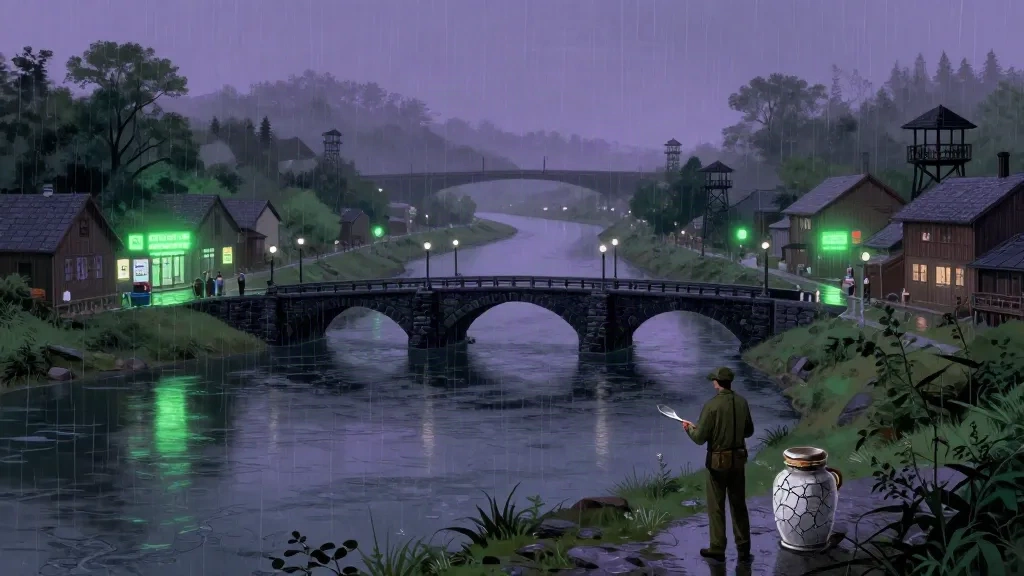
Mara Vale stood on the Vey Bridge with her silver spoon pressed to the iron rail. Beneath her boots, wet asphalt gleamed lavender in the pharmacy-sign glow. Across the border, green crosses trembled in the water’s reflection.
She tapped the spoon twice against the rail. Once for the mother who had lived on this bank. Once for the brother who had lived on the other.
Then she drew a small circle of salt from the jar at her belt and set it where the rail met the stone. The ritual lasted eleven seconds. No one else saw it. That was the point.
Mara’s occupation cards said she was a boundary surveyor. In practice, she mapped emotions onto a moving surface. Hope entered her notebook as a bright wedge. Fear as a blue undertow. Longing as silver threads pulled toward whatever had been lost.
The river flowed east that evening, past shuttered border offices and beneath bridges pointing in the wrong direction. At midnight, she watched the current loosen itself from the earth.
What the Water Carried
The river began walking backward.
Its waves climbed over the pilings and rolled toward the mountains. Dead leaves turned their pale undersides upward. A ferry drifted upriver without engine or pilot.
Then came the records.
First, an architect’s plan floated past, its blue lines intact. Next came a register of bridge tolls, a child’s chalk drawing, a marriage certificate bearing the name Senn. Every bridge ever built had left something in the river: measurements, arguments, blessings, maintenance notes, the small coins dropped into cracks by travelers.
Mara opened her field book. The pages filled themselves.
She wrote: EASTBOUND SPAN, 1891. Lost in flood. Reappear 00:17.
She wrote: THE NARROW BRIDGE. Built by two sisters. Collapsed after the war.
She wrote: THE BRIDGE OF SMALL LIGHTS. No one remembers building it.
With each entry, the water rose. The records struck the Vey Bridge like loose papers thrown at a shuttered office. People emerged from bars and boardinghouses. They stood along both banks, holding lanterns and umbrellas, staring at the impossible current.
“They are not debris,” Mara said.
“Then what are they?” called a boy across the water.
“Instructions.”
The Public Crossing
The salt jar slipped from Mara’s hand and broke.
Salt spread across the asphalt, whitening the lavender surface. She knelt to gather it, but the river had already begun dissolving the circle. Her private boundary—the invisible mark that separated memory from forgetting—was gone.
A border guard raised his rifle. On the opposite bank, an old woman held out a red lantern.
“The bridges are coming back,” the guard shouted. “If they return, the border has failed.”
Mara looked at the records whirling beneath the bridge. She had spent years keeping her maps private because grief made people careless and hope made them stubborn. But a map that no one else could read was only a locked room.
She opened her field book to the blank page.
“No,” she called. “The bridge is not a border. It is a promise someone can cross.”
She drew a line from the Vey Bridge to the green pharmacy sign, then from the pharmacy to the mountain road. The line did not follow the river. It followed the places where people had already met, traded, married, quarreled, and waited.
“Read the names aloud,” she told them. “Read the crossings.”
The old woman began with Senn. The boy shouted the chalk drawing’s impossible inscription: WE MET IN THE MIDDLE. A guard repeated the name of a village erased from every map but remembered by his grandmother.
Under their voices, the river’s records turned toward the light.
A Bridge in the Morning
They worked until dawn.
Children tied the loose pages together with fishing line. Ferrymen used their oars as pontoons. Mara carried the salt jar’s broken pieces in her coat, because even an emptied ritual might become useful somewhere.
When the sky turned pale, the river slowed.
It did not resume its old course. Instead, it divided around a new island of black stone, and on that island stood a bridge no one had built: low, sturdy, wide enough for both directions.
Its planks shone like wet asphalt. Its lanterns burned the green of pharmacy signs.
The first person to cross was Mara.
She carried the silver spoon and the broken jar. On the far bank, the old woman took her hand. Behind them came the guard, the boy, and the rest.
At sunset, Mara opened her book again. The river had changed direction once more, but the new map remained.
She drew one final line: not a border, not a wall, but a place where two shores met and kept moving together.





