 Netwrck
Hopeful Science Fiction.
The Door That Wasn’t There
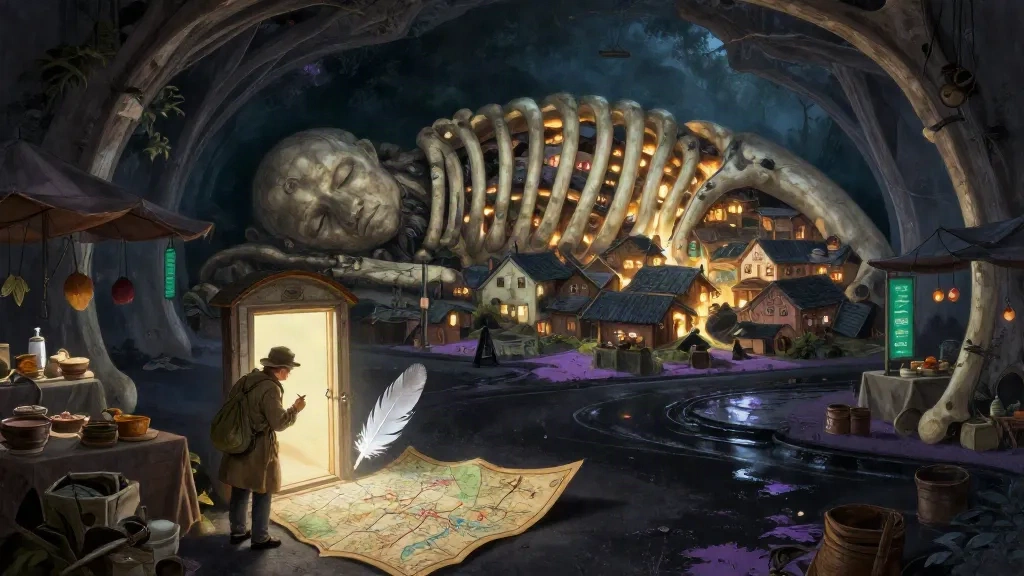
Mara slept beneath the village inside the giant’s ribs, where rain ticked through the bone-roofs and every morning smelled of wet asphalt, lavender soap, and the green glow leaking from the pharmacy sign outside.
She had been a cartographer for fifty-two years. Now her hands rested, though memory had not. She could still draw coastlines, vanished rivers, the borders of counties dissolved by reservoirs. But her gift had narrowed with retirement. Mara could draw a door only on a map of a place that no longer existed.
Every morning she drew one on the blank wall above her cot: a plain rectangle, three hinges, a brass knob polished by absent hands. The wall remained solid. That was the mercy of maps. They admitted the impossible without making anyone walk through it.
Her desire was modest and exact: a place where lost things could rest. Not recovered things. Not explanations. A harbor, she said, for departed keys, abandoned playgrounds, drowned railway stations, the last blue cup from a kitchen demolished thirty years ago.
On the evening the giant turned in his sleep, the whole village shifted. Pharmacy green swept across the walls. A market unfolded between the ribs, its stalls pitched from nowhere.
The Market of Expensive Truths
Here the cheap wares lied freely. A brass key promised a house that had never existed. A child’s shoe claimed its owner was a queen. Bottles held laughter stolen from unhappy marriages.
The expensive things were always true.
Behind the final stall sat a woman wrapped in lavender mourning cloth. Before her rested a white feather, delicate as a comma of snow.
“You drew our market,” the woman said.
Mara looked at the feather.
“A moth wing?” she asked.
The woman nodded. “A white moth. The last one caught by the lantern on Saint Orra’s Hill. It flew toward a summer that failed to arrive.”
Beside the feather lay a map of the market itself. The ink was fresh, but the streets ended at blankness.
“The hill is gone,” Mara said.
“Then it is not on this map. Yet it still needs somewhere to set down.”
Across the stall lay another feather, ordinary and weather-stained. Beneath it: a confession written in a child’s careful capitals. I DID NOT STOP LOVING HER.
The stallholder wanted twelve village memories, a name, and the assurance that when winter came, the giant would wake feeling kind. The feather was true. So was the market’s price.
Mara had no memories the market would accept. Retirement had pared her life to rooms, meals, and the small orange cat who slept on her map case. She had spent decades recording what remained, never what could shelter what had vanished.
Then the first stall began selling rain.
It fell upward through the market, silver and impossible. People seized bottles of it. Names appeared on their tongues. Old promises came due. The truth beneath the stall showed a door opening onto a drowned schoolhouse, its classrooms full of water and empty chairs.
Every true object was summoning the place of its loss.
A Map of What Is Missing
“You have one night,” the lavender woman said. “Buy a door before dawn. True doors cannot be opened by a map of the world as it is.”
Mara bought the confession and the white feather. She paid with her atlas: every place she had surveyed, every border she had corrected, every name she had inked so strangers could arrive.
Her life narrowed to one vanished place: a house on Saint Orra’s Hill, demolished before she was born. On its map she drew a nursery window, a cot, a lantern, and a door.
The door was a true thing, though the room was not. The white moth followed her hand across the paper, wing passing over the threshold. A pale mark appeared on the wall behind the market stall.
Mara opened it.
Beyond was not Saint Orra’s Hill but every unbuilt room the market had opened: a station after the last train, a stage after the final bow, a nursery after its child was carried home. Lost things drifted through the lavender dark. The confession fluttered among them like a clean sheet.
“Rest,” Mara said. “All of you. No price.”
Her atlas began to erase itself. Coastlines lifted from her hands. Borders dissolved. For the first time, she did not try to hold them.
The Map After the House
By dawn, the market had vanished. The giant slept more deeply, and the village stood again beneath the pharmacy’s green sign.
Mara’s wall was blank. Her atlas was blank too. But beside the cot, where maps had hung all her life, rested a small unfinished drawing.
It showed a hall with no walls, a lantern in every window, and a white feather marking the entrance. At the bottom, beneath the vanishing road, Mara drew one door.
This time, the knob turned.
She opened it and found a quiet room crowded with small arrivals: the blue cup, a silver thimble, a ticket whose train had been cancelled, her own shadow cast long ago on the map of a coast she had never visited.
The room did not ask where they had been. It did not ask what they had cost. It simply made room.
Mara set the lantern beside the white feather. The moth wing rested on the threshold, no longer searching for summer.
“Welcome home,” she said.
And the door stayed open, long after she had closed the map.





