 Netwrck
Romance.
The Door Beneath the Ice
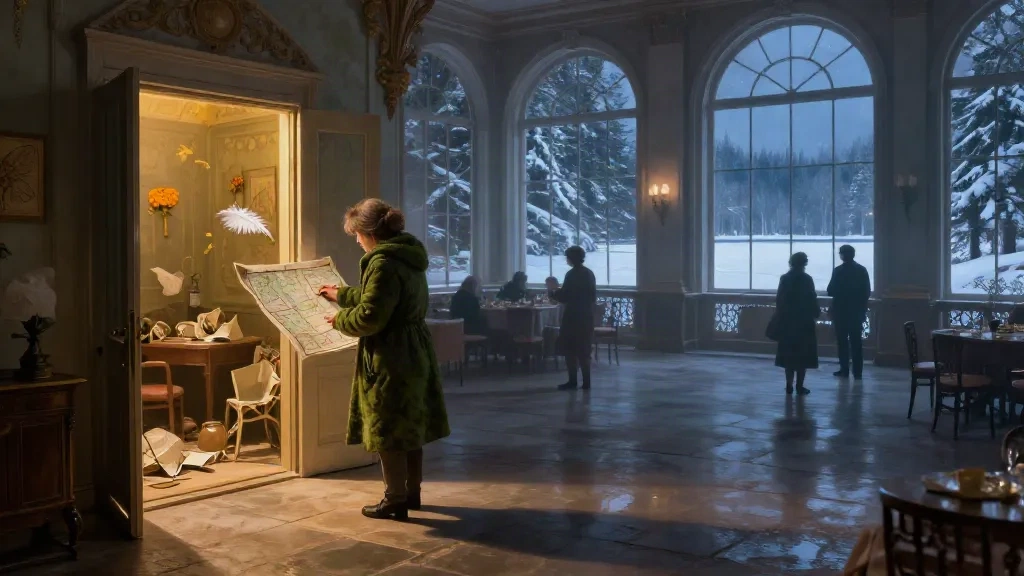
Mara Vale had drawn her last official map from a folding table in the map room of a hotel that no longer appeared on any road. The room smelled of wet stone, printer’s ink, and chimney smoke. Beyond its tall windows, the winter resort of Aster Hollow gathered beneath the mountain like a handful of bright beads on a dark string.
Its shadows had come early that afternoon. They stretched from the pines across the frozen lake, slipping beneath the arriving guests before their skates touched the ice. Mara watched them pass through the lobby doors, each carrying the outline of a person not yet present.
She had spent forty years making places legible: coastlines, tram lines, vanished footpaths, the borders of countries whose names children no longer knew. Now her hands were stiff, her employer had closed, and her suitcase held only charcoal, paper, and a brass compass with no needle.
On the table before her lay a moth wing. It was pale gold, larger than her palm, marked with a marigold eye. Beside it rested a white feather, soft as fresh snow.
Neither belonged to her.
The Market of Expensive Things
The market began when the sun touched the west windows. It assembled itself in the hotel’s old ballroom, beneath chandeliers frosted with ice. Stalls appeared between the dancing shadows. Silver watches, sealed letters, teeth on black velvet, bottled laughter, and rings that remembered fingers they had never touched.
The market had one rule: the expensive things were always true.
Mara found the stall at the back, where a woman in a green shawl displayed a map of a house that burned down before Mara was born. The house was drawn with perfect accuracy, down to the loose tile beside the kitchen door.
“You drew that,” the woman said.
“I never saw it.”
“That is why it is valuable.”
On the map, one door stood open. Beyond it was a white room filled with objects that had lost their people: a child’s red mitten, a ship’s bell, a wedding veil folded around a stone.
Mara understood then what the place had been asking for. She wanted to make a map where lost things could rest, not vanish into stories, not be buried in catalogs or carried forever by the grieving. She wanted rooms with names for what they held. She wanted someone to arrive who remembered the mitten but not the child.
The woman named the price: the moth wing and the white feather.
“They belong to two people who will need them,” Mara said.
“They belong to the map now.”
A Shadow Named Tomas
Before Mara could answer, a shadow detached itself from the ballroom wall. It lengthened into a tall man with a red scarf and a face she knew from a summer forty years earlier.
Tomas Ardin had been the last person she mapped beside. He had loved her quietly, patiently, while she chased the border of a river that changed every spring. Then he had left for the northern forests, and Mara had mistaken relief for courage.
His present shadow carried frost in its hands.
“You came back,” he said.
“I was invited.”
“No.” He looked toward the open door on the map. “You were called.”
The ballroom lights bent toward the stalls. Every object had begun to murmur with its lost name. A key turned in a lock beneath the floor. A bell answered from inside the mountain. The market had been waiting for Mara’s hand; now Tomas’s shadow was fading at its edges.
He had not come to reclaim her. He had come to return something.
From inside his coat he drew the white feather. It was the same feather from her table.
“I found this in the place where your old maps went,” he said. “It had a door drawn on it.”
Mara touched the moth wing. Gold light trembled along its veins.
The market whispered that love was the most expensive truth of all.
A Place for the Lost
She understood the trap. If she paid with the feather and the wing, the lost things would receive their refuge, but Tomas’s shadow would vanish into the map. The truth of his return would be preserved, and the living man would be erased.
Mara drew a door on the blank edge of the market map. It was not a door to a vanished place. It was a door to the resort as it was now: chipped steps, patched coats, steam on the windows, two chairs pulled close to a fire.
Her hand shook, but the line remained true.
“This place does not exist yet,” Tomas said.
“Then it will.”
She placed the moth wing over the white room and the feather across the threshold. The map drank their colors. The wing became a small gold sun. The feather became snow.
The lost mitten unfolded into cloth. The ship’s bell gave one clear note. The veil rose, and the stone beneath it turned into warm earth.
Tomas’s shadow hardened into a man.
He caught Mara before she fell. His face was older than the one she remembered, and his hands were warm.
“I could have drawn a place for us,” he said.
“You did,” Mara answered. “You found the door.”
Outside, the shadows reached the lake and dissolved into snow. The market vanished except for a small green door painted on the ballroom wall. When Mara opened it, she found the old hotel lobby full of damp coats and muddy boots. Every lost thing had found a room. Every room had a window.
And in the brightest window, a marigold moth rested beside a white feather, keeping watch until morning.





