 Netwrck
Speculative Fiction.
The Seed’s Memory
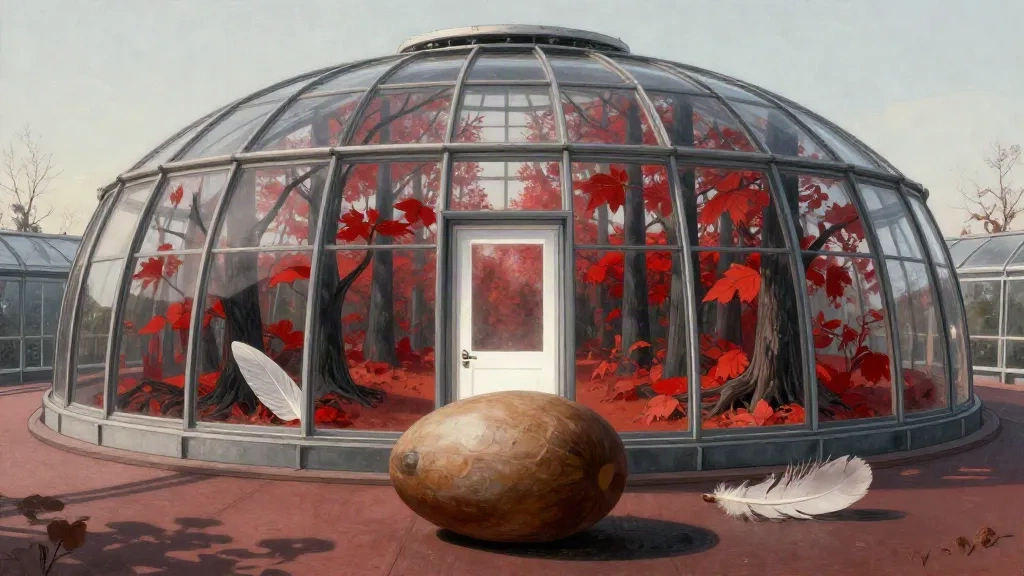
By the time Mara Vale came back to the greenhouse, the red leaves had reached the observation cupola.
The station orbited a blue-white star, but its days were the color of rust. They entered through narrow glass and settled on the railings, on the irrigation pipes, on Mara’s hands whenever she touched the old seed at the greenhouse’s heart. The seed was taller than a person and smooth as a river stone. It remembered forests that had burned before humans had invented names for fire.
Mara had once drawn coastlines for governments. She had drawn borders where no border existed, roads that ended in flooded fields, villages erased by a single careless stroke. Now she drew only places that no longer existed.
Her hands made the doors. First a hinge, then a latch, then the dark interval where a vanished room should open. She kept the maps in charcoal drawers beneath the propagation beds. The market was three levels down, where the station’s gardeners traded spores, water rights, and memories from Earth.
The Market of Tru Things
On the night of the winter eclipse, the market changed its prices.
Previously, the expensive things had been false: forged ancestor stones, bottled laughter, a child’s last word reproduced exactly. Truth was cheap because the station possessed so much of it. But when the greenhouse lights dimmed, a merchant placed a white feather on the counter and announced that the market now accepted only true things.
The feather belonged to a bird that had never existed. Its barbs were broad as fingers. Beside it lay a moth wing, translucent, veined with charcoal, still faintly warm.
“The wing remembers a forest beneath the northern ice,” the merchant said. “The feather remembers the first bird to leave Earth. Both are true. Both are yours if you can name what you will lose.”
Mara named the places she had drawn. The merchant listened without expression. At last he offered the feather for her maps of drowned cities.
She refused. Then he offered the moth wing for one map only: the map of the house where she had been born.
Mara looked at the pale winter light beyond the market’s narrow windows. The house was gone. The street had become a reservoir. Her mother was gone. Yet the map remained, folded beneath a hundred newer maps, because Mara had never been able to erase its door.
“I want a place where lost things can rest,” she said.
The merchant smiled. “Then bring something that has nowhere left to fall.”
A Door Without a Room
Mara climbed to the greenhouse carrying the wing and the feather.
The seed’s leaves trembled when she entered. A soft sound rose through the soil, like roots remembering rain. She placed the wing beneath its lowest branch and the feather beside it. For a moment nothing happened.
Then a white mark appeared on the seed’s skin.
Mara drew it without thinking. A door. She drew a small room behind it, its floor made of black earth, its walls lined with shelves. On the shelves lay every place she had mapped: the vanished forests, the drowned streets, the rooms inside rooms, the doors she had made for people who needed to leave.
She drew them larger than reality. She drew forests tall enough to hold the vanished names of trees. She drew cities without weather. She drew one empty chair beside a window.
Then she opened the door.
Charcoal light breathed out. The greenhouse filled with the smell of wet bark, cold stone, and winter earth. Lost things moved through the opening: a blue door, a bucket of seawater, a bell from a city that had sunk, the last page of a census written in a language no one spoke.
The market’s true things came too.
They entered the station through the ventilation shafts, the docking arms, the cracks in the hull. Every truth that had been sold there followed the wing’s charcoal veins. The station filled with voices. Machines confessed what they had concealed. Officers spoke names they had forbidden themselves to remember. The garden seeds remembered every species that had failed beneath human hands.
Mara understood then why the market had become expensive. Truth did not merely hurt. It took space.
The Resting Place
By dawn, the greenhouse had become a forest without a sky.
Red leaves rustled beneath the pale winter light. Charcoal trunks rose from the planting beds. Among them stood the rooms Mara had drawn, door after door, each sheltering what could not survive outside.
The market merchant came with a ledger. He wanted payment for everything that had entered. Mara gave him no maps. She gave him the map of the place he had never told anyone he came from.
He looked at it for a long time. Then he walked through the door she had made and sat beneath a tree that remembered a forest older than stars.
Mara kept the feather. She placed it in the seed’s split bark, where its white barbs glowed against the dark interior.
Every lost thing needed somewhere to rest, but none needed to be forgotten. That was the difference between a grave and a map. One ended the journey. The other gave it a road home.
At the edge of the greenhouse, Mara drew one final door. Behind it was not a vanished room.
It was a room that had not yet been lost.
She opened it, and the pale winter light entered.





