 Netwrck
Adventure.
The Bell Beneath the Street
Mara Venn kept three bells beneath her father’s workbench, each one small enough to hide inside her palm. They rang for memories she did not yet own.
At dusk, when the familiar street of Lantern Row settled into its evening routines, the bells stirred behind the shuttered cinema. Mara pressed her palm to the wall. A low note traveled through the stone.
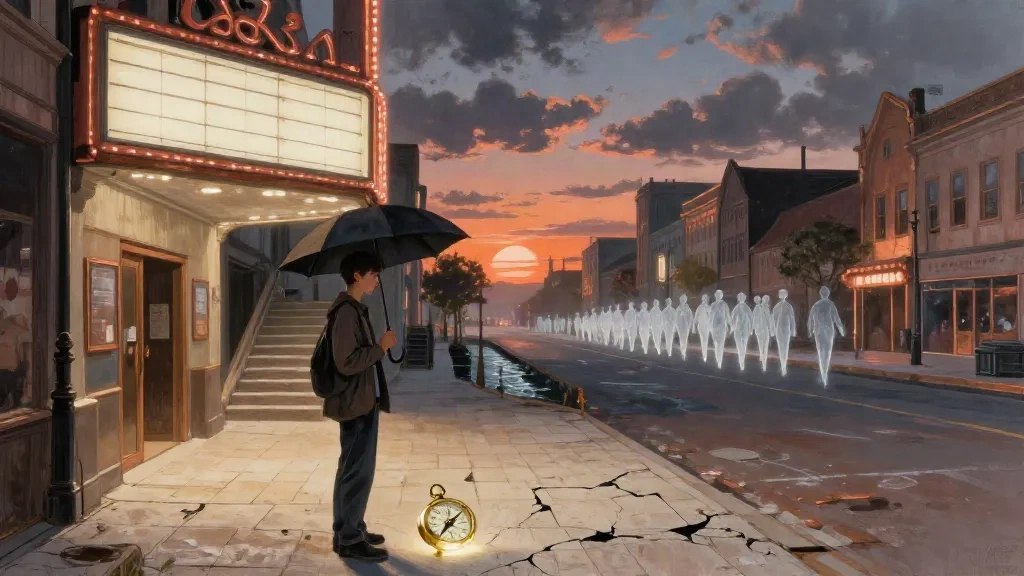
The cinema had been abandoned since before Mara was born. Its marquee still held faded brass letters spelling CINEMA, though the C leaned sideways and the final A was missing. Beneath the marquee waited a black umbrella, furled against a rain that had not begun.
Mara took it. Inside her pocket, the smallest bell rang.
The door opened onto blackness and a smell of warm dust. Far away, a projector flickered.
Futures That Almost Happened
Images gathered on the screen: Lantern Row without the bakery. The river running uphill. A great red tower standing where the schoolyard should be. A funeral procession passing beneath a copper horizon.
In the last row sat a girl in a pale-stone dress. A brass compass rested on her knee.
“You’re late,” the girl said.
Mara looked behind her. The street had vanished.
“I don’t know you.”
“That is why the bells brought you.”
The girl introduced herself as Senn, though Mara suspected the name was borrowed. She said the cinema showed futures that had nearly happened. Some had been prevented by mercy. Others by cruelty. A few had vanished because no one remained alive to remember them.
“The world beneath the street is not another world,” Senn said. “It is the shape of the world we almost had.”
She offered Mara the compass. Its needle trembled between north and a direction that had no name.
Mara wanted the true shape of the place beneath her street, the hidden geography her father had refused to name. She wanted to know why the old drains carried seawater uphill and why her mother sometimes laughed at songs no one else recognized.
She took the compass.
The Holiday Without a Name
Across the empty auditorium, a bell began to toll.
Outside, Lantern Row filled with black-cherry banners. Doors opened. People gathered in the square, their faces washed by a copper horizon that hung above the rooftops.
They had come for the public holiday of a grief that never received a name.
Mara knew the custom. Each year, citizens brought one thing they had lost and laid it in the square: a shoe, a key, a child’s tooth, a letter. No one spoke of the dead. The city celebrated its missing by pretending it had merely misplaced them.
But the cinema could not enter the square. Its future had been sealed away.
“The city forgot us,” Senn whispered.
Mara looked at the screen. The funeral procession had reached the square. Under the copper horizon, a procession of strangers carried her mother’s black umbrella.
Her smallest bell screamed.
The memory had begun without her.
The Name That Held the City
Mara stepped from the theater into the flooded street.
Rain struck the umbrella in soft, heavy drops. The compass spun, then fixed beneath the pavement. Mara followed it past the bakery, past the school, past the place where the river should have run.
Under Lantern Row, she found a staircase descending into pale stone.
At its bottom stood a door covered in names. Thousands had been scratched away, leaving only the first and final letters. Mara pressed her palm to the wood.
Every bell in her pocket rang at once.
On the other side, her mother waited beneath a horizon made of copper. She looked no older than the last day Mara had seen her. She held out the black umbrella.
“You always wanted to know what came before,” her mother said.
Behind them, the square began to disappear, stone by stone.
Mara understood then. The city’s unnamed grief was not a forgotten past. It was the lives removed from every possible future. If she named them, this future might open. If she named only one, the rest would be erased.
So Mara did not choose a name for her mother.
She opened the brass compass and placed it on the door. The needle swung toward the black-cherry sky.
“The true shape,” she said, “is the one that leaves room for choosing.”
She rang her bells.
The sound rose through pale stone, crossed the familiar street, and entered the copper horizon. The missing lives did not return. Their shapes did. They flickered in windows, in distant faces, in places the city had been afraid to keep.
By morning, a new passage had opened beneath Lantern Row, leading to rooms, gardens, rivers, and a city that had never existed. People entered carrying objects they had lost.
Mara left the black umbrella by the door. Its handle was warm in her hand.
Every bell in her shop began to ring—not for what she had lost, but for what the world might still become.





