 Netwrck
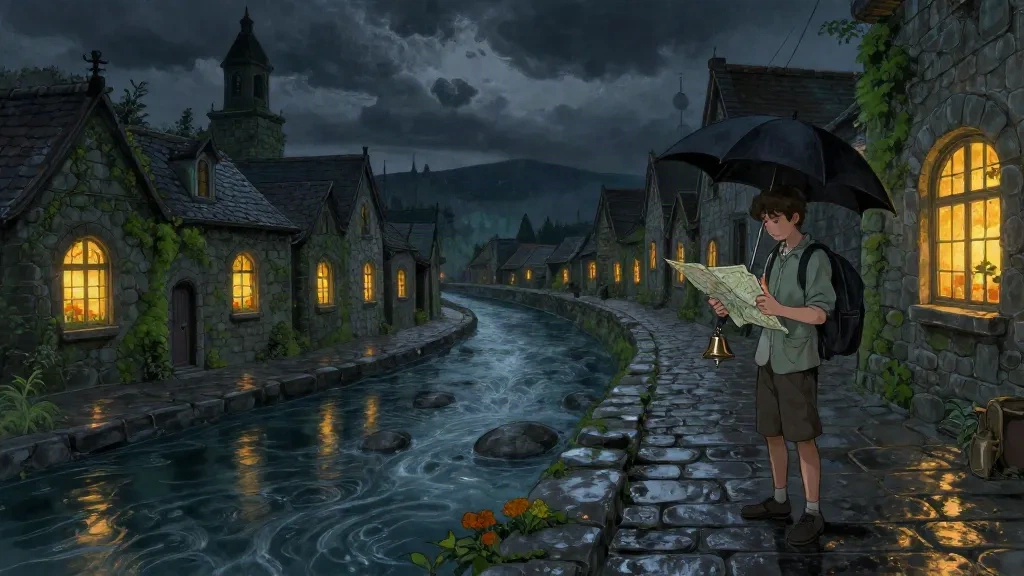
Romance.
The Bell Beneath Number Twelve
Mara Verrow made bells in the narrow workshop behind her father’s chandlery, where the river shone every color the stonework would not. The town of Bellwether divided along its bank: quarries and ironworkers west, houses and orchards east. At noon, the green water flowed south. At midnight, without thunder or warning, it turned north.
Her father’s small black umbrella stood by the door, repaired with silver wire, though they had not owned an umbrella for eleven years. Beside it waited a brass compass from a customer who had died before paying for either.
The bells Mara made were unlike ordinary bells. Rung beside an open door, they sounded for memories their owners had not yet acquired. A child would hear laughter he would remember the following spring. A widow would hear a voice that had not yet forgiven her. Mara could not explain the gift. She could only polish it, tune it, and send the sound where it belonged.
On the eve of the Unspoken Grief, she received the smallest bell she had ever cast. No address was tied to it. Beneath its clapper, someone had scratched a crooked arrow.
An Entire Town Mourns Without Saying Why
By dusk, black umbrellas filled the square. Citizens carried them although the rain had stopped, and the brass compass in Mara’s pocket tugged steadily east.
Once each year, the Unspoken Grief began at sunset. No one named the dead it honored. The custom had outlasted memory, and grief had hardened into parade: black cloth, seed cakes, river lanterns, and speeches that stopped before the essential truth.
“The streets are sealed tonight,” her father said. “Whatever your bell is calling, it should not call you.”
At midnight, the river turned.
Its current struck the quay like a hand reversing a page. Boats strained against their ropes. Reflections lifted from the water and walked ashore. For one breath, the town seemed turned inside out, each person seeing the face of a person they had lost.
Mara rang the tiny bell.
Its note sank through Number Twelve, the cobbled lane where she had grown up, and struck an iron plate buried below. The paving stones opened not upward but inward, revealing a staircase descending into wet darkness.
The Country That Fit Inside Her Shoes
At the first step, the compass swung toward someone climbing behind her.
“I thought bells invited memories,” said Ivo Pell.
He carried no umbrella, though rain began falling inside the tunnel. He was the mapmaker’s son, remembered for spending every holiday drawing borders no government would accept. He had once called Mara’s bells expensive weather. Now he held out his hand as the stones shifted beneath them.
“This is the true shape of the world beneath the familiar street,” Mara said.
The buried city spread across the river’s old bed. Its avenues matched the streets above, but time had run through them in layers. Here, Bellwether was young. There, it was burned. In a flooded garden, moss-green trees reflected leaves that fell upward. A brass sun marked the place where the river had once begun.
At its center waited a field of nameless graves.
That was the grief. Not one family’s loss, but the town’s stolen ability to say what it had lost. Every year the living had mourned without naming, leaving the dead unable to follow them home.
Ivo opened his map. Across it, one road erased itself whenever Mara looked away.
“Your bells know where memory is buried,” he said. “Mine show where it wants to surface.”
The Direction Love Returns
Above them, the holiday crowd gathered at the river’s edge. By morning, the water would flow south again, sealing the buried city beneath its customary course. Unless the dead received names, they would remain folded into the wrong year.
Mara’s father lowered his black umbrella through the opening. Its silver ribs caught a thread of marigold light from a window somewhere in the flood.
Together, she and Ivo rang the small bell over the graves.
The first memory rose: a woman in an orchard, laughing while tying marigolds to her daughter’s sleeves. Then came a boatman, a mason, a child leaning from an upstairs window. Names emerged with them, spoken by the living as if they had always known.
But Ivo’s road remained absent.
“What do you remember of us?” Mara asked.
He glanced at the brass compass. Its needle had stopped pointing north.
“This,” he said, touching the wet map. “You, arguing that a border is a promise someone failed to keep.”
At dawn, the river reversed once more. The buried avenues lifted gently, folding street into street until Mara stood beside Number Twelve. The holiday crowd had gone. On every threshold in Bellwether rested a black umbrella, and Mara’s father’s silver wire shone among them.
The bell now hung in Ivo’s room, where it sounded only when he was near. He sent the brass compass to Mara with no note, because the needle pointed home.
She kept it beneath the counter. Still, on the night the river turned, it always swung toward his door.





