 Netwrck
Hopeful Science Fiction.
The House Inside the Bones
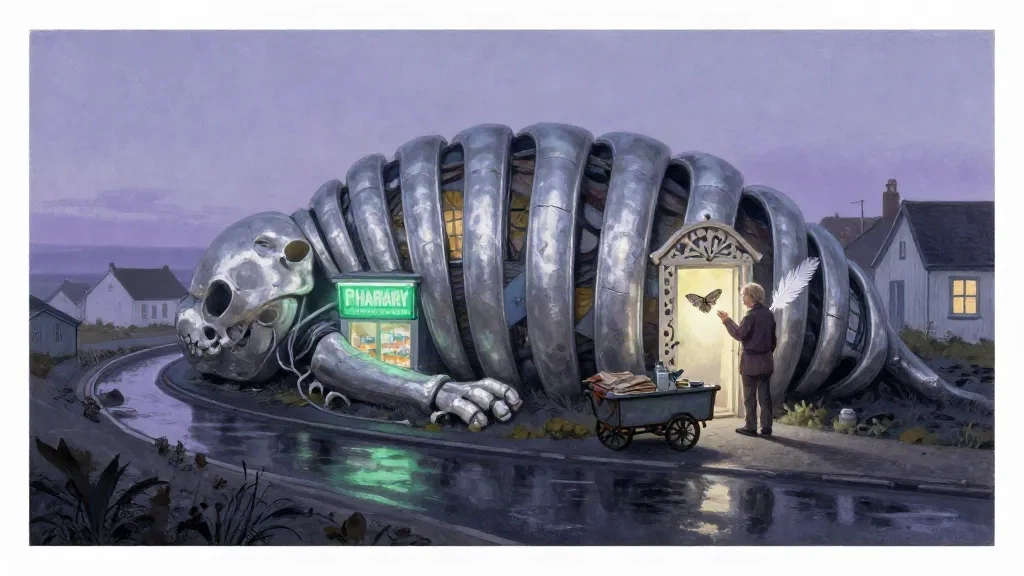
Every morning, Ilya unlocked the blue door in the third rib of the sleeping giant and wheeled her flat cart through the village that had grown inside it.
Rain ticked against the windows. Beyond them, ribs rose like silver bridges above the low houses, their joints clouded with lavender moss. The village stirred around her: fishermen calling across the canal, children shouting from the pharmacy stairs, a tram sliding beneath the green glow of the night dispensary.
Ilya had been a cartographer for fifty-one years. After the coast changed, the border moved, and the river acquired a new mouth, maps had become a dying trade. Retirement meant tea, a narrow room, and rain filling the basin beneath her window.
Then the lost things began to arrive.
A brass key from a house erased by flood. A railway ticket whose station no longer appeared in any register. A child’s red mitten, sent down the canal in a bottle addressed to no one. People brought them to Ilya because word had crossed the tidal flats: She can draw doors only on maps of places that no longer exist.
Ilya did not draw homes. She drew thresholds. One line at a time, she opened ways into a quiet country where lost things might sleep.
The Market of Expensive Truths
The Lantern Market occupied the hollow of the giant’s breastbone, lit by oil lamps and violet dusk.
Ordinary stalls sold repaired watches, bottled thunder, and yesterday’s weather. Deeper inside stood the stalls the villagers called the Honest Row. Everything there was true, which also meant everything was expensive.
A woman bought a diagnosis that remained true for one year. A man paid three years of labor for the memory of his first kiss. The pale merchant at the final stall sold directions to whichever door a traveler was most afraid to open.
“You have a map of my village before the quarry,” Ilya said.
The merchant placed a white feather on the counter. It belonged to no bird she had ever seen.
“I have the road beneath your garden,” he said. “And the name your sister chose for the life she never entered. Both are yours for the right price.”
Every month, he offered the same price. A place where lost things could rest. Not a church or granary or museum, but something gentler: a place without an inventory.
On the morning she carried her newest map—a schoolhouse swallowed by the quarry, complete with thirty-seven chalked names—the merchant touched its corner. The paper became warm.
“The road beneath your garden is cheaper,” he said. “It would make an excellent place of rest.”
That was the complication. Every true thing asked her to surrender another truth.
Thirty-Seven Small Departures
She began with the road. Ilya drew its vanished edges beyond the quarry map, each turn following a memory that hurt to touch. At dusk she touched the white feather to the line.
Nothing opened.
On the stall she sold her childhood home, the same page. Again, nothing.
She offered the sea before the seawall, the forest before the fire, every map that could be surrendered. The honest merchant watched until midnight, then swept the rejected prices into his lockbox.
At dawn, a moth crossed the market. One wing had been torn away. It circled Ilya once and landed on the schoolhouse map, pale wings trembling.
She had a fragment of that wing in a glass jar, a relic of the night her home disappeared. She had thought it worthless because it belonged to no intact creature.
And beside it lay the feather from the Honest Row.
Ilya took out her finest pen. She did not draw the place she had lost. She drew what had passed through it: the neighbor who walked her home in storms, the canal boat that carried bread, the sister who always left one sock behind, the unnamed birds nesting in the gutter.
The map became a shelter, not from loss, but for everything loss had carried away.
The Door No One Owned
That night, the green pharmacy sign shone through the rain as Ilya placed the map inside the final rib.
A door appeared where there had been only bone. Beyond it waited a low white garden beneath an amber sky. Benches curved around a spring. Small objects rested under glass: keys, buttons, lanterns, letters, a whale’s rusted nameplate. The torn moth flew above them, its missing wing repaired in flight.
The white feather drifted onto the threshold.
The market had sold truth, but it had never named the price. Ilya understood then that the feather was the last thing she could lose: memory of the sister’s chosen life. Without it, their silence would become indistinguishable from estrangement.
She did not use the feather.
Instead, Ilya opened her own journal and drew the morning she had followed her sister to the station. She drew the scarf left on the bench, the ticket already punched, the stranger helping with the trunk. All true. All survived.
Her sister’s name appeared on the map, followed by a new road.
At sunrise, the Honest Row was silent. The truthful stalls could not remain where everything had been surrendered. People carried their purchases into the spring garden, leaving the market dim beneath the giant’s ribs.
Ilya kept the cart only to bring the lost things nearer. By evening, there was a brass key on her workbench, warm as a remembered hand.
On its tag she wrote: May this open, not return.





