 Netwrck
Hopeful Science Fiction.
The Note Under Glass
On the winterward face of Meridian Station, the orbital greenhouse grew a tree the size of a thumbnail.
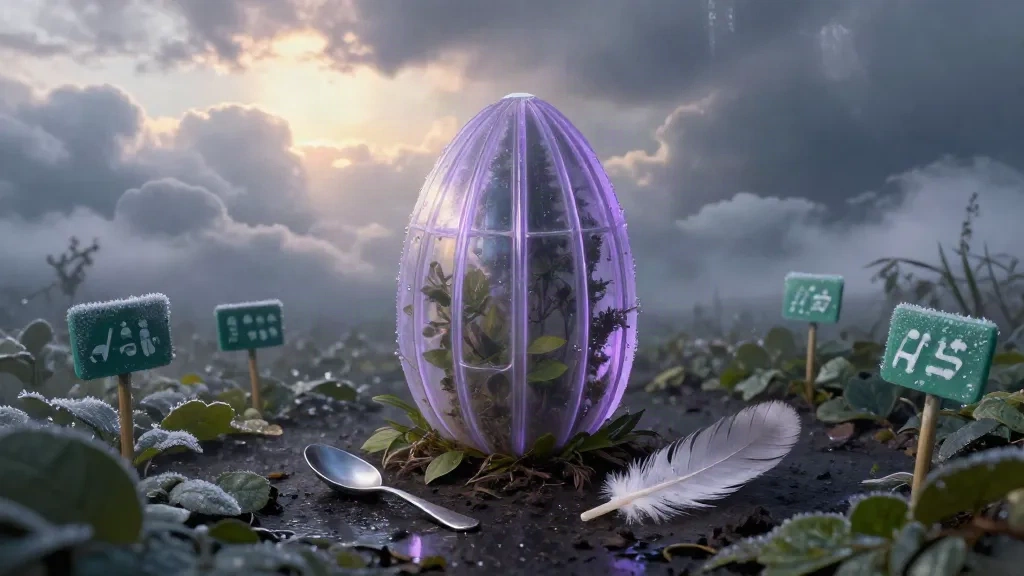
The tree existed only inside its seed. Its trunk was black, its leaves narrow as needles, its roots threaded through a memory of lowland forest cut down before Aneka's grandmother was born. Held in a nutrient cradle under the seedling lamp, it had no light of its own and no soil, only the archived chemistry of a world that could not be visited. The seed spoke when temperature control failed. It spoke when hunger emptied the hydroponic galleries, in a thin sibilance that set the teeth of anyone standing near it on edge. Once, in the silence after a solar storm, it whispered the name of a bird no instrument aboard the station had ever recorded.
Aneka heard it because the truth notes had begun returning.
She was thirty-one, a musician of held breath and spare arrangements, and she had been told twice that she was wasting a medical exemption. Her hearing had been damaged in a pressure accident six years earlier; the repair had left her able to parse pitch from timbre and nothing else. So when Master Gardener Ilyan Sorn recited field records and crew inventories in the greenhouse, she was the only one who heard the fork in the rack beside her sternum answer him. A clear note for every sentence spoken without concealment. The fork was surgical steel, salvaged from the ring's first hull, and it had belonged to a woman who had counted harvests in a place with weather.
Clear notes were rare. Most people called rationing a temporary inconvenience, called the season an anomaly, called the station's decreasing sunlight a maintenance problem. Aneka's own mother, a coolant engineer, had spent three years calling the failing sunlight a maintenance problem, and the fork had given her a string of sour thirds until she stopped coming to the greenhouse. That was a kindness. Aneka had not decided whether it was mercy or cowardice.
On the day Ilyan told her the winter would last for everyone then living, her fork rang a note so low she felt it behind her teeth, in the roots of them, and the seedling lamp above the cradle flickered in sympathy.
Thirty-one more growing seasons, maybe thirty-four. After that, no sunlight worth planting under. I have run it four ways. The answer does not improve with asking.
He said it to her alone, in the pollination bay, because he was the kind of man who delivered arithmetic to one person at a time and let them decide what shape to hand it back in.
The Winter's Arithmetic
One generation had passed since the first frost locked the upper orbit. Aneka's teacher had waited out the first, believing the sky would clear. Aneka's mother had seen the last third of it and stopped speaking her daughter's name in the corridors, as though names were a kind of fuel. Every child born since knew only cloud-bright skies and weak sunlight combed through the greenhouse ribs.
Ilyan placed a silver spoon in Aneka's palm. He had carried it from a dining hall that existed now only in a song children sang to keep the rhythm of ration lines. When he tapped it against the table, three notes answered: food, warmth, shelter. No fourth followed.
Restoration,
he said. Her fork remained silent. Forget that.
But the seed's hidden tree shook in its cradle, a tremor visible only in the condensation on the glass.
What Aneka did next was not devotion. It was housekeeping. For four years she catalogued the station the way one catalogues a failing relative: pill by pill, symptom by symptom, the small cruelties listed alongside the large accidents. She learned which two hundred and six people on Meridian could still be fed through the winter, and which of them would have to be told. She learned that the council's sunlight projections were arithmetic performed by people who did not intend to be the last to receive light. She learned, from the mycelial networks already colonising the decommissioned growth trays, that memory travels sideways underground and that the station's own organisms had been quietly trading information long before anyone thought to write it down.
She began building a seed organ in the abandoned observation dome, where the glass was clouded with a frost that had fused into a permanent white cataract and where no one had run a thermal budget in eleven years. Strands of mycelium connected forgotten accessioned cones to spare processors, processors that had once run the station's traffic lights and now ran nothing. Each processor carried the voices of witnesses. Aneka fed them one memory at a time: the smell of wet asphalt after a thunderstorm, the exact violet of a field in the last photograph, the green glow of a pharmacy sign reflected in a puddle on a street that no longer had a name anyone aboard could say aloud. When a memory had been altered, her fork betrayed the false note and she walked back to the witness who had given it and asked again, and was listened to, and was thanked, and occasionally was not forgiven.
Green means hope,
a child said, one of a hundred and nine children in the dome that afternoon, delighted. Hope means green.
No, Aneka said, kneeling. The sign was green. Hope happened because she found the door, and she found the door because someone had told her which street it was on, and that person was now dead, and I knew them, and I will carry it. That is the difference. A color is not a promise. A color is a fact that someone, at some point, was willing to stand behind.
The child considered this and gave her a clear note, and it was the loudest thing the dome had heard all year.
Truth made a small sound. It became the spine of the archive.
Her Mother's Mistake
In her sixth year of work Aneka went to confront her mother about the three years of sour thirds.
You were right,
Adah said, before Aneka had said anything at all. They stood in a coolant alcove with frost fur growing an inch from the floor. I knew it was a maintenance problem, and I said it out loud, and I wanted the word to be true badly enough that it stopped being a question. That is all a lie is. Wanting. Do you know what the maintenance was, Aneka? The panels. They had to be turned away from the sun. Thirty degrees of face, every year, for three years. I did not want to do it. So I made the sky the enemy and the panels the wound, and then I could keep working.
Aneka's fork gave nothing, because this had been true.
I was seventeen. I would have eaten your records for you.
Adah looked at the frost.
Yes. That was the plan. You were not the only one who could have been spared by saying so. I have wondered every week since whether the part of me that wanted to say it was the part that loved you, or the part that could not stand a daughter who knew more than her mother about the light. The two were the same. They still are.
They did not resolve it. Aneka went back to the dome. She recorded the conversation, tags it inheritance, corrected error, and hears in it now the sound of her own future temptation: the moment she will be asked to lie to two hundred and six people in order to save a tree.
An Honest Inventory
By Aneka's fiftieth winter, the greenhouse could no longer keep its leaves from frost. Heating lines froze in sequence, and the sound of them going, reported station-wide, was a noise like a hand unclenching. Food gardens dimmed from lavender to gray. The station council voted to preserve human lungs and discard the seed cradle, and the vote was close, and the closeness was the whole of the moral geography of Meridian: they had counted the trees out of existence because the arithmetic was simpler, not because anyone wished harm.
Aneka told them the cradle contained a forest. They called it damaged data.
She showed them the mycelial archive, list by list, and named every inheritance: enzymes for a fruit never grown in space, fungi adapted to pollinate a vanished ash, the memory of root shapes that could teach station soil where water had once moved. She was not saving what the greenhouse showed. She was saving what its seed remembered, including branches older than its living crown, including the possibility of a tree whose trunk existed only in chemistry and whose first true leaf had never been unfurled in any light, terrestrial or otherwise.
They condemned her work anyway. The council's finding was careful, humane in its phrasing, and annihilating: the archive had consumed processor cycles and storage and a maintenance specialist's labor that the light budget could not spare. It was decommissioned. She was reassigned to ration audit, a post in which the truth would be the shape of a spreadsheet and the fork would never once ring.
You understand that I have a signature on this,
said the councilwoman who had voted for it, a woman Aneka had once repaired a tuning fork for. I will not argue with you again. I will not sign anything else. But understand that I do not think you are wrong. I think that is the part I cannot afford.
What She Took With Her
On decommission night, a white feather floated through the dome, turning slowly in air that was barely warmer than the glass around it. It had no earthly bird to claim it; the station's avian genetics program had been shut nine years before Aneka was born. Yet its rachis held the genes for down, for warmth, and the quill held the genes for flight, and the pairing was not accidental. Forest and climate restored together, a solution that could wait for people who would never see it.
She planted the feather beside the seed. It dissolved into the mycelium over four days, and the archive grew by a factor that no model had predicted, and the decommission order was technically unappealable because the material had not been catalogued and therefore could not be weighed against a light budget.
Then Aneka opened the archive to the whole station and asked for confessions.
What Remained Audible
They came by the lamps, wrapped in blankets, carrying private shame and small repairs. A pilot admitted the final fuel he had hidden, in a locker, for a week, for a week he had told everyone was gone. An engineer named the child she was born to and the name she had chosen, and the naming took eleven minutes, and the dome listened to all eleven. Children confessed that they had called the greenhouse beautiful because no one else could describe it, and that the beauty had been a way of not asking who it was for. A hydroponicist brought the log of his own falsified yield figures, the first entry dated nine years ago, the last dated yesterday. He had kept the graph going because a graph that ends is a graph that has to be answered.
Every truth sounded. Together they formed a chord that made the failing processors hum in their housings, a sound like a room full of people breathing in time.
And the cost became visible at the same time. Secrets she had collected were load-bearing: the hidden fuel was holding four airhandlers offline; the falsified yields were the only reason three districts' food gardens had been planted at all; the unnamed child belonged to a woman who would lose her ration priority the moment the record existed. Aneka understood, standing in the lamplight with her hands numb, that the truth notes were not a moral instrument. They were a set of valves. Every confession she took in loosened a seal somewhere else on the station, and the station was already holding its breath.
So she began choosing. She recorded everything, because an archive that recorded only the comfortable would be a song again, but she sorted by consequence. Skill was taken from everyone. Errors were taken from everyone, corrected aloud, and the correction broadcast. The confessions that would kill someone to publish, she kept, unindexed, in a partition with no reader, and told the truth about that too: to the dome, in her own voice, she said that she was a coward with a filing system, and her fork gave a clear note, and it was the loneliest sound she had ever heard.
You are building a seed organ,
Ilyan said, near the end of the second winter, when the dome was colder than the greenhouse had ever been. Organ. Not library. An organ makes sound. What do you expect it to play?
I do not know yet.
Then you had better decide before the processors go. A thing that cannot play is a coffin with better manners.
Aneka did not preserve the people. She recorded only what could carry forward: their skill, their corrected errors, their wish that someone after them find room for leaves. The seed organ separated these inheritances across thousands of dormant samples, so that no single power failure, no single struck conduit, no single act of one frightened person could erase them. Redundancy was the moral argument she could make to anyone, and she made it until they were tired of hearing it.
The Door That Was Green
The child from the pollination bay, whose name was Bett, came back in the ninth winter with a memory of her own. Her grandmother, it turned out, had not died in the thinning. She had gone down to the decommissioned ring to sleep in a decommissioned bunk, and had told Bett a street and a door and never mentioned it again, and Bett had remembered the street, and Bett was now seventy-one years old and had never told anyone because she had not understood that it was information, because on Meridian an old story is a thing you keep and not a thing you spend.
I am not a scientist,
Bett said. I am a grandmother. I did not know the difference.
There is no difference on this station, Aneka said. There is only the difference between what you kept and what you gave away. Everyone here is a grandmother. That is what the last thirty years made of us.
She took the street. The archive now knew which pharmacy, which green sign, which puddles. It knew it because a child had been told a story she had assumed was decoration.
The Last Clear Day
When the dome lost heat, the archive went dormant. Aneka expected that. She had built for dormancy; she had, in fact, built mostly for dormancy. But each spring afterward, a lavender bud opened among the needles, and no one could say what had germinated, because no one could say where the heat came from.
Ilyan survived longer than the first hard winter, barely, on a ration exemption he obtained by filing an appeal against his own diagnosis. On his last clear day they brought him to the dome on a handcart, because walking there was no longer a thing a body of seventy-eight could do. He tapped the silver spoon against the cart's rail. Three notes: food, warmth, shelter. Then a fourth, thin and uncertain, from somewhere past the count.
Her fork found a chord beyond the old three. It trembled, uncertain, then steadied, and it was the loudest thing she had ever heard, and it was not for her.
Tell me,
he said.
The forest is sleeping, Aneka said. It remembers the way up.
He smiled, and asked, because he was a gardener to the last syllable, whether she had told the station the truth about the tree, all of it, including the parts that made her look like a thief.
I have told them what the tree is. I have not told them what it cost. If I tell them the cost, some of them will take it back.
Then that is the first honest thing you have ever done with a tree. Put it in the record. A cost nobody knows is a debt nobody is paying.
He died in the following autumn, while the ration lines sang the dining hall's song, and the note held after he was gone.
Four Solutions to Improve Further
Aneka put it in the record. Cost, section seven: the four airhandlers that the pilot's hidden fuel had kept, and which the pilot himself, when the fuel came out, never got to switch back on, because the station had to burn the insulation from Corridor Nine to keep the remaining three running, and Corridor Nine is where the children were moved to. The falsified yields, uncovered, had meant that the three districts planted after her lie were planted in soil that could not hold water, and there was now no seed stock for two of them, and there was no language in any of the station's four official registers in which that sentence could be written without sounding like an accusation against the dead. The cost of the archive was that the ration audit post she had been pushed into, in her first winter of it, had identified eleven families as non-priority and removed their heat allocation, and she had signed the finding, and had told herself the audit was independent of her, and her fork had stayed silent through all eleven because she had not been present, and absence had been her method, and it had worked.
She put that in too, at the head of the record, in the first person, with a clear note, and the processors hummed, and it was the worst sentence she ever composed.
What Remained Audible
Long after Aneka, children cleared frost from the seed cradle in the rings that had been forgotten and then, later, found again, and they did it without being told to, because the fungi in the trays had laid down a warm path and children are good at following warm paths. They found the white feather regenerated in its needles, silver-bright and delicate, and understood from the label, which had survived, that it had been given rather than taken. They touched the soil, which was not soil, which was a mycelial mat that had spent thirty years learning the shape of roots that had never grown here.
Beneath their palms, roots turned toward a sun they had never felt, carrying music learned from winter, and the first of them to break the surface was a child who had been born in the year of the fourth note, who had grown up inside Aneka's cost, and who did not know yet what had been traded for it, and would be told, when they were old enough, because the record was open, because that had been the deal, because the record was the only part of the forest that was awake.





