 Netwrck
Science Fiction.
The House of Unfinished Crossings
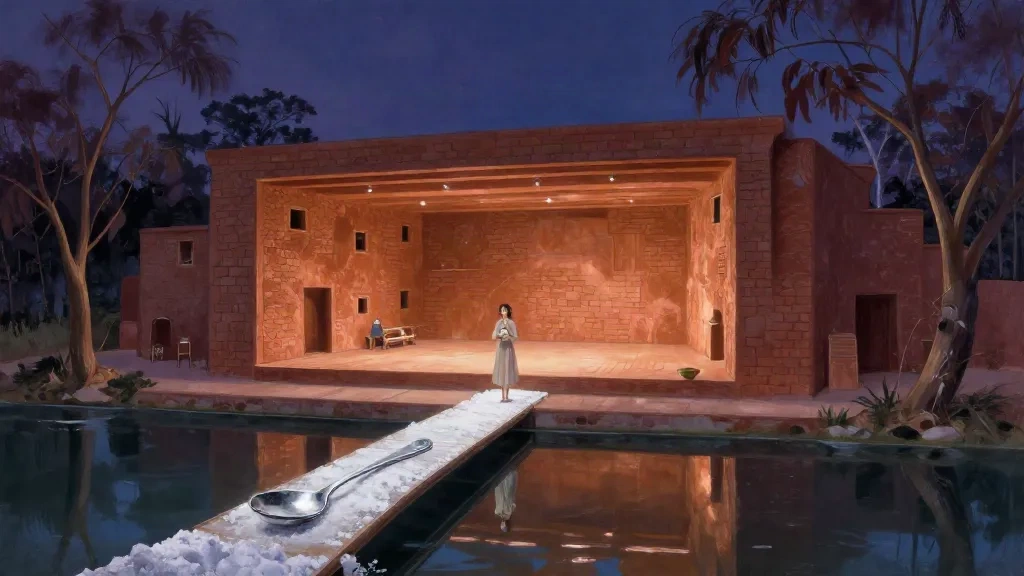
The theatre stood where the city had given up on the river, its brick walls the color of terracotta and its windows green as eucalyptus. Above the door, a copper plaque listed the hours of performances in a language nobody could read. Inside, every seat faced a shallow stage filled with muddy water.
Mara arrived before the audience with her silver spoon in one hand and the salt jar in the other. She had spent twenty years surveying the Vey, mapping emotions on its moving surface: grief traveled in blue eddies, ambition in warm brown swells, terror in the silver flash beneath a bridge. Her charts were private. She showed them to no one, not even the river authority, because a feeling measured is a feeling owned by somebody else.
At the theatre, discarded endings waited in tin trunks. Each was a plausible future denied by a last-minute decision: a woman boarding a train, a city sinking beneath a clear morning, a boy saying the unsayable name aloud. The theatre performed them for audiences who had chosen the safer world. Mara’s task was to survey the emotions beneath each ending before rehearsal began.
What the Current Carried
On the third night, the river began carrying records of every bridge ever built. They surfaced as silver plates in the stage water, each engraved with a span, a date, a weight limit. Old crossings from forgotten centuries mingled with new ones whose concrete was still curing. Whenever Mara lowered her spoon into the water, the plates trembled and rearranged themselves.
She discovered that bridges did not remember the people who crossed them. They remembered the promises made while crossing. A marriage, a bribe, a goodbye, a secret carried from one bank to the other: all of it lodged in the piers. The river had become an archive without a clerk.
That night the water showed a bridge not yet built. It was delicate as a handspan, made from white salt and a single silver spoon. At its center stood Mara, holding the jar against her chest. On the far bank waited an audience of strangers. She knew the bridge’s exact sensation before she touched it: shame, bright and granular, followed by a calm so complete it felt like another country.
The Ritual Made Visible
Mara had always ended a survey by drawing a circle in the riverbank with salt. The circle meant: here is where the feeling crossed. Here is where it changed. She had kept the rite private because her work was not supposed to be a performance. Maps were evidence, and evidence did not ask to be applauded.
But the discarded endings had no use for another sealed record. They needed witnesses. The theatre’s director lowered the lamps and opened the house. For the first time, people leaned over the stage and saw what Mara saw: the river not as water, but as a nervous system.
She placed the spoon across the salt jar. The current struck the metal. A wave rose in the shape of the unbuilt bridge, and every plate on the water rang with a different human promise. The audience saw a century of crossings at once. Some were noble. Many were lies. One had been made by Mara herself, seventeen years earlier, when she told her brother she would never map the river where he drowned.
The memory entered the bridge and shook its salt spires. Mara nearly withdrew the spoon. Then she opened the jar. The salt fell in a narrow white line, bright as a fracture in stone.
The Ending That Stayed
At dawn, the theatre had no ending to discard. Mara stood on the real bank, spoon in one hand, salt in the other, while the Vey carried the plates toward the sea. The audience had gone home carrying no charts, only the memory of promises they had never spoken aloud.
The unbuilt bridge remained only in the performance, but the river kept a trace of it. Mara followed the current to a place where the bank widened into a public square. There she drew her circle in salt, where anyone could see it.
When the river touched the line, it did not erase it. It widened the circle. By evening, strangers were standing inside it, naming what they feared, what they wanted, what they had carried across in silence. Mara’s private ritual had become a public act, and the river—briefly, impossibly—became legible.





