 Netwrck
Folk Horror.
Memory Rented Upward
On the fourth floor of the Arreton Building, every window looked east and every tenant dreamed of weather they had not yet suffered. The elevator announced floors in a child’s voice. The radiators clicked their names backward. In the communal kitchen, flour rose inside a steel bowl and whispered: Tuesday, perhaps. A yellow coat. Someone forgets.
People came to Arreton only if they could remember the future and little else. They held futures like wet matches behind their teeth. They knew which stair would break, whose heart would falter, which night the river would rise. Consequently, they could not remember childhood, old promises, or the faces of those they loved.
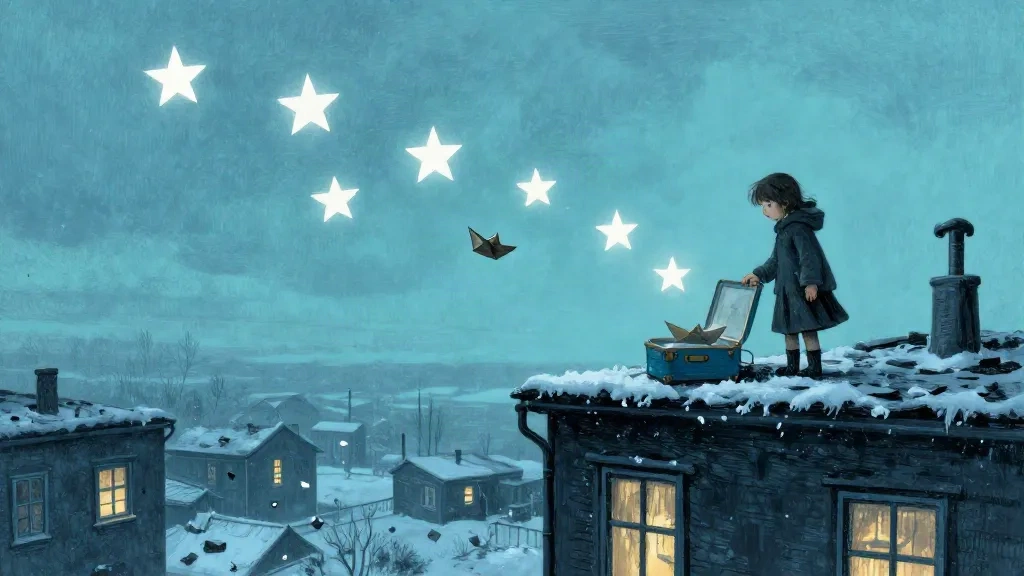
Mara was eleven and the building’s child archivist. Her blue suitcase contained no clothes. Its three drawers held thirty-one futures in black paper sleeves, tied with red thread, and one iron key polished smooth by her hand.
At the center lay the Cygnus Remnant, seven wooden stars and a paper strip showing their stolen sky.
She intended to restore it.
The Heir’s Morning
The tenant who owned those stars lived in 4C, though everyone below the seventh floor insisted 4C was empty. He was Orrin Vale, age eighty-one, retired surveyor of impossible distances. Every winter he had transferred one year of his life to the building, borrowing decades in exchange for keeping Arreton’s futures stable.
The debt had one final date, printed on the boiler plate:
RETURN THE REMNANT BEFORE THE HEIR REMEMBERS AN ELEVEN-YEAR-OLD.
Orrin had not died. Worse, he was no longer aging forward. Each midnight, another silver hair left his cheek and another birthday candle appeared in his nursery drawer.
Mara carried the constellation upstairs hidden beneath an umbrella. In the corridor, frost filled the keyholes. Paper boats drifted along the ceiling, white as trapped birds. One slipped through a wall vent, still carrying a wool glove at its bow.
She had found that glove beneath Orrin’s door. It was tiny, stiff with old blood, and embroidered with her name. She could not remember wearing it, but her hands knew its shape.
4C opened before she touched it.
Orrin sat at a table covered in surveys of skies that had not happened. He looked nineteen. Behind him, a wall had been bricked over with hundreds of small doors.
“You’re early,” he said.
Mara put the suitcase on the table. “Then you can tell me where Cygnus belongs.”
Orrin looked at the wooden stars. “Outside. Before first light. But you cannot carry it there.”
A Future Falling Upward
Outside, snow ascended from the courtyard. Each flake held a small room from Arreton. Lamps, beds, cupboards, and sleeping futures climbed the black walls of the building toward a cyan strip whitening the eastern sky.
Arreton had entered its impossible dawn. The first star of Cygnus appeared low above the roof, trembling like an ember.
The paper boat from the corridor raced along the frosted rail. The wool glove had been tied inside it, and now the glove was enlarging, fingers growing with Mara’s.
Orrin seized the paper strip. “The building knows its error. It will take the missing years from the heir to balance them. When you remember your eleventh year, you will forget you ever came.”
“Then I return them tonight.”
“By morning, you will have chosen. Remembered. You cannot move a star with a memory of the move.”
Mara understood at last. The deadline was not Orrin’s death. It was her forgetting him before it.
She fitted the seven wooden stars into the paper strip. The lost constellation ignited across the suitcase lid, cold and white, each star reflected in her eyes. Beyond the walls, hundreds of doors began slamming in future rooms not yet built.
Orrin pushed the paper boat toward her. “Take my name. Let it remember for you.”
He placed the wool glove in her palm. Inside it lay a folded blue scarf, a blueprint of the dawn, and the paper boat, now dry and weightless.
The Sky in the Suitcase
Mara opened the window.
Every ascending snowflake froze for a breath. In that breath, Orrin aged forward by one day, giving her one day he had not yet been promised.
She stepped onto the roof.
Below, tenants opened windows and released futures they no longer wished to own. A woman forgot tomorrow’s funeral. A man recalled his brother’s name. Small disasters rushed toward the sleeping city, but among them came quieter mercies: the stair repaired, the yellow coat mislaid, a warning finally heard in time.
Mara launched the paper boat from the chimney. It climbed, blue against black, carrying the glove like a banner. The suitcases in her hands shone beneath the impossible dawn.
She threw the seven stars upward, one by one.
Each crossed the cyan horizon. Each found its absent point in Cygnus and held there, burning with iron-white certainty. The building shuddered. Frost raced down its walls and broke into water. Every radiator spoke one occupant’s name.
The deadline vanished from the boiler.
At sunrise, Orrin opened 4C and found Mara asleep in the corridor, an ordinary eleven-year-old with no memory of paper boats. He gave her the blue suitcase. Inside, beneath thirty-one black sleeves, lay a single wool glove.
She kept it all her life. On winter mornings, when she dreamed of a dead tenant named Orrin, she opened the window and watched the sky.
Above Arreton, seven unfamiliar stars shone in a shape almost like a constellation carried home.





