 Netwrck
Speculative Fiction.
The Note Under the Floorboards
On the morning the winter began, Mara Venn found a white feather resting on the harbor stones.
It was dry despite the rain, bright as a scrap of moon. She bent to pick it up and heard a note inside her teeth, low and silver, like a bell struck beneath deep water.
That was how she learned the rest of the rule: whenever someone told the truth, the air made a new sound. Not a word, not a song, but a small pressure behind the ear. Liars made silence. Everyone else made noise.
For years Mara had played in the tavern beneath the lighthouse, filling the pauses when fishermen argued over weather, money, and women they had loved badly. The truth-notes were only in her own hearing. She could repeat them on the flute, and sometimes one of the children would look up as if she had named something secret.
Now the feather had come back with the tide. So had a silver spoon, dented on one side, carrying seawater in its bowl.
“The sea has started collecting,” said Old Pell, who repaired nets and never spoke unless the knots were true. His note trembled through the room.
Mara looked at the feather and the spoon. Both were familiar. Both had belonged to her mother, who had vanished during the winter’s first night and returned once a year to trade fish for stories. Her mother had claimed the sea remembered everything.
“It does,” Mara said.
The note was the clearest she had ever heard.
A House Made of Listening
By winter’s third month, the harbor had frozen except for a narrow seam near the breakwater. The town could not plant, mend boats, or mend itself. Every family burned furniture in stages, keeping the pieces that held a memory.
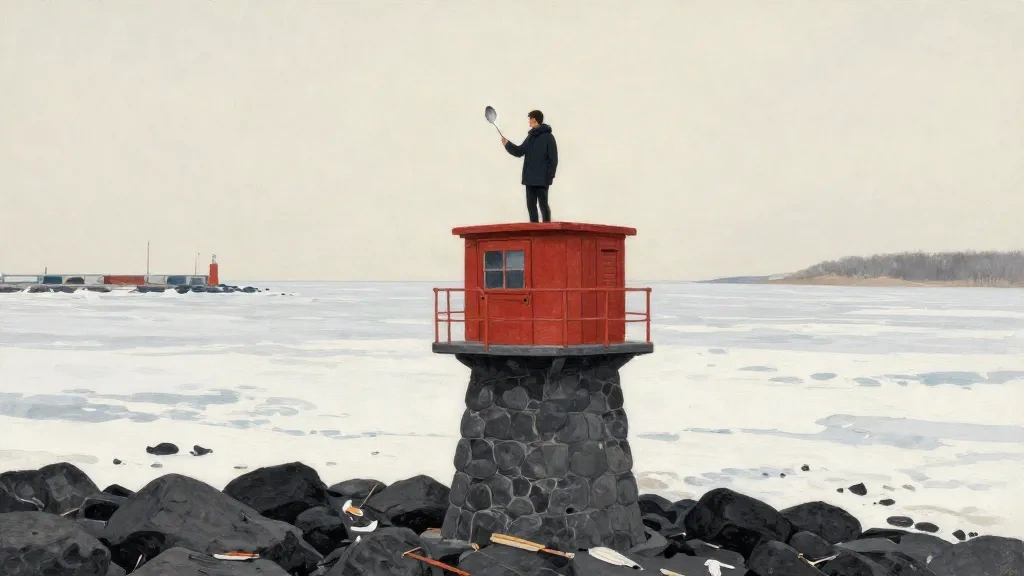
Mara began building a small tower behind the tavern. She used sea stones at its base, old ship ribs for its frame, and panes of glass salvaged from the lighthouse.
She did not build it to survive the sea. She built it to survive a storyteller.
Her mother had returned that morning, standing beyond the tide line with frost in her hair. Mara had asked where she had been. The silence before her mother’s answer had lasted seven years.
“You told me you came from the north,” Mara said.
“I did.”
“You said the winter had taken you.”
“It did.”
“You said the sea was a place.”
Her mother looked toward the tower. “It is.”
Each answer produced a note. Mara caught them in the flute, one by one, and understood the danger. A true answer could be narrow, careful, and still a door. Her mother had not lied about being taken. She had lied about where.
The next tide brought the spoon again. Mara polished it and found a tiny inscription beneath the bowl: BUILD THE ROOM, NOT THE VOICE.
She carved the phrase into the tower’s inner wall.
When Winter Became a Generation
The winter lasted through the births and deaths of an entire generation. Children grew tall beneath its pale light, learning to skate on the flooded square and to read by the orange glow of kelp fires. They called Mara’s tower the Harbormaster, though it guarded no ship. They brought it secrets in exchange for hearing the truth-note of their own.
The harder Mara listened, the more the town changed. Not outward. Inward. The truth-notes had always been there, but the winter made them impossible to ignore. A baker confessed he had poisoned a rival. A mayor admitted the seawall had been built wrong. A girl told her mother she did not forgive her.
Each confession made a new sound. The tower collected them.
One winter morning, Mara climbed to its highest room and found the air vibrating. The notes had become a harmony, immense and close, but there was no ending. The winter had taught the town to speak honestly, yet not to finish a sentence.
Her mother stood below, holding the white feather.
“You want a thing that outlives you,” she said.
Mara’s flute slipped from her hands. “I want a thing that can survive the truth.”
Her mother’s silence was answer enough. Then she said, “No.”
The note struck Mara’s ribs.
The Sea Returns What We Finish
At sunset, Mara opened every window in the tower. She told the town what the spoon had shown her: a room could hold a voice, but it could not choose what the voice meant. A building might survive a person, a generation, even a long winter, but it could not survive being mistaken for the truth.
The crowd below quieted. No note sounded. The lie had been small, and the winter had accepted it.
Mara struck the tower’s bell. Its sound had no truth-note beneath it. It was only bronze, and wind, and the stubborn work of a woman who had tried to make permanence from listening.
The harbor thawed.
Not all at once. The seam opened, the ice withdrew, and the sea returned the spoon to Mara’s hand. On the next tide it brought the feather, silver-white and dry.
She placed both inside the tower, not as relics, but as tools. In autumn, children used the spoon to stir tea. The feather marked pages in the weather ledger. The tower continued to stand, though its purpose had changed.
Years later, when a stranger asked who had built it, Mara told the truth: she had built it badly, and the sea had corrected her.
Two notes sounded—one from the tower, one from the open water. They did not join.
They agreed.





