 Netwrck
Speculative Fiction.
The First Guest
The shadows reached Bellweather Resort eleven days before the first train.
They slid beneath the eaves and along the railings while the mountains were still bright with morning. They pooled under the empty swings, gathered at the padlocked sauna, stood beside the reservoir in the loose shape of people who had not yet decided to arrive. By noon they had learned to hold the outline of a coat. By the third day they held the outline of grief, which is harder, because grief stands differently on everyone.
Iven came up on the first afternoon with a silver spoon in one hand and a tuning fork in the other, and he did not look at the shadows once. He had been a tuner in the low city for twenty-two years, which is a way of saying he had spent two decades being paid to make other people's instruments honest. His hands were good. His hands were also the reason he had left: a chord cannot be tuned by someone who will not admit the string is flat.
At Bellweather he wanted to build something that could survive the storyteller.
Not a song. Songs died when the singer died, and they died badly, in that they kept going. He wanted a machine: a chamber of brass and glass that would hold one true story upright after every person in it had turned to dust and been forgotten by the county.
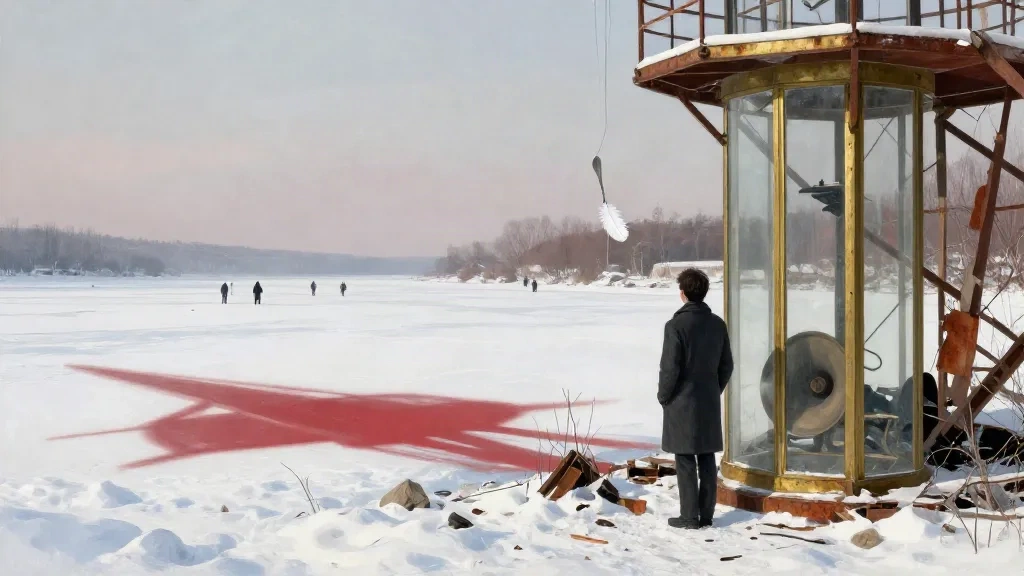
He chose the old bell tower as its shell. Beneath the bells the timber was charcoal-black, and the windows took the pale winter light and gave none of it back. He ran copper wire along the floor and up the legs of the frame. He wired the silver spoon so its bowl would face down, a resonator, and set the tuning fork in a block of salt to keep the metal from contracting. On the wall he pinned a single white feather, because a feather drinks stray current, and he had read that somewhere, and he was willing to believe a thing on no authority at all if it kept the machine from burning.
By sunset he was playing. The tower gave back a thin, sour, beautiful note, and the shadows in the corners lifted their heads like dogs.
Then the first guest stepped through the door and stamped the snow off one boot.
She was perhaps seventy, in red gloves, with a face like folded paper and a leather case at her hip that clinked when she moved.
“I came to tell you the resort is haunted,” she said.
A note sounded inside the tower, clear and high, far above anything the tuning fork could make. Iven did not touch the wire. He had not touched it.
“You believe that?” he said.
“No,” she said. “I believe someone wants you to stop building.”
He looked at her for a moment longer than he needed to. “That is the same sentence with the courage taken out.”
“It usually is. People who want you frightened and people who want you accurate send the same letter.” She set the case down and did not open it. “My name is Yselde Amren. I map.”
“For whom?”
“For the water board, for the forestry, and for a book that will be finished when the basin is.” She glanced at the walls, and away. “I have walked this valley for nine winters. I have drawn the shoreline when it was a village, and the shoreline when it was a meadow, and the shoreline as it is now, which is neither, and moves.”
Then she said, “Your machine is honest,” and Iven felt a small hot pride unclench behind his ribs, which was how he learned to distrust flattery delivered in the passive voice.
The Season Without Morning
By the second week the reservoir had lost its shoreline. The snow climbed the windows and packed the cracks beneath the doors with a dry, sifting sound, like someone pouring salt. Guests came fewer and farther apart, and each one brought a story the way a dog brings a stick, wanting it thrown.
Mrs. Brann, who had cooked the resort's kitchen for thirty years and had a way of standing in a doorway like a person blocking weather, put down a tray of rye and said the resort had been built over a village. Not over a graveyard. A village, whole, with a schoolhouse and a bell of its own, drowned or buried or both, depending on which paper you read.
“They put the foundation down anyway,” she said. “There was a schedule.”
Dov, the ski instructor, told him the mountains moved three inches each night and that the resort measured its runs in the wrong units because of it. Wren, who was nine and stayed with a grandmother who did not come, heard bells ringing under the ice and could not be made to stop describing them.
And the machine began to sing by itself.
Truth passed down the copper and struck the spoon, and the spoon rang in tones that made the shadows come closer, not farther. Iven had believed — he had needed to believe — that a machine could keep a truth without keeping the person who said it. Within ten days he had the arithmetic of it in front of him, and the arithmetic was this: each true thing fed the wire and thinned the shadows by a hand's width, and each true thing cost the valley one more day of winter.
He wrote it in the margin of his tuning book. He did not cross it out.
On the twentieth night the temperature fell so far past winter that the air cracked, and a sound like rifle fire walked along the ridge, and the resort became a sealed white country with no timetable. No train. No message. The post office had no letters in it, which Mrs. Brann said was a first in living memory.
The shadows stood outside every window with their faces turned toward the tower, patiently, the way a crowd waits for a speaker they have already agreed with.
What the Shadows Carried
He began, then, to understand what he was feeding it.
They were not the dead. The dead, he suspected, would have been easier and less polite. The shadows were the unfinished: the village with no one left to say what happened to it, the winter nobody had ever repeated, the story held open in a room where everyone who knew it agreed not to speak. They arrived before their owners because they were eager. They stole the guests' warmth and left pale copies behind the curtains. They took the cook's laugh out of the kitchen and left a thing that could still ladle soup. They took Dov's balance, and he went up on the ridge the next morning to prove he had it, and did not come down for two days.
When Wren stepped out onto the reservoir, his shadow walked the other way, toward the bell tower, and Iven watched it go with the sick certainty of a man watching his own argument come back to him in a coat.
“They aren't punishments,” Yselde said, one evening when he had been at the wire for eleven hours. “They're creditors.”
“Then the debt is the resort's.”
“The resort's.” She turned the red gloves over and looked at the palms, as though the leather had been lying to her. “Everyone who comes here wants the old stories to be frightening. Frightening is a use you can put a thing to. Nobody has ever once wanted to be told the truth about the basin and then gone home and repeated it.” She pulled a glove off, flexed the fingers. “A season lasts as long as somebody is willing to carry its story. That's all. Yours is not a curse. It's a bookkeeping arrangement.”
“And the resort is on the wrong side of the ledger.”
“The resort is a hole in the ground that a great many people have agreed to stop thinking about,” she said, “which is a kind of wealth, and a kind of debt, and you cannot have the second without the first.”
The Door With a Handle
On the twenty-ninth day, in a white light that had no direction in it, Yselde said the thing he had been constructing his entire adult life not to hear.
“You did not build this to keep a story true,” she said. “You built it to keep your brother. You are afraid that when the story ends he will be gone, because he has been gone for twenty years and you have not once said so out loud, and so he has not had to be.”
The spoon rang. He had not spoken.
“Say it,” she said, “and hear what it costs.”
“My brother died when I was seventeen,” Iven said.
And the machine took it, and it went through him and out of him, and behind the words the corridor opened: the blue coat, the rails, the smell of disinfectant and boiled carrots, his brother's face turned to a window, and the last breath drawn out of that body and released into a room — released into him, onto his hands, and his brother had said something. His brother had said, with unmistakable clarity, you are a stranger. Not a stranger's name. Not even a complaint. An observation, made the way you observe weather, and that was what went around the world in Iven's chest for twenty years: not the dying, but the administrative error of being misfiled at the end.
He struck the machine with his open palm. The bell above him answered once, a long way off, from under the ice.
“I wanted a witness,” he said. “A machine doesn't argue. It doesn't get tired. It doesn't look away.”
“Witnesses do that too,” Yselde said. “They just do it while you're asleep.”
The White Feather
The winter deepened and the shadows came indoors ahead of their owners, and there came a night when the machine rang eleven times without a word spoken in the room, and Iven understood the arithmetic was about to finish itself.
He took the white feather off the wall. The current came off the wire at once and the tone went flat and enormous, like a room the size of the valley. He set the feather beneath the machine's heart.
Then he fed it, one at a time, the truths he had never said.
That he had not been in the room when Halen was admitted. That he had been downstairs in the stairwell with a cigarette he had not lit, counting the tiles, nineteen of them, and a fourth time. That when the nurse came down the stairs and said your brother is asking for you, Iven had said all right, and then had said tell him I'm coming, and then had stood there while she went back up, and had not followed. That there had been eleven minutes between the answer and the stairwell door, and that in the eleven minutes he had felt, unmistakably, with a relief clean enough to wash in, that the waiting was over and it was not going to be his fault anymore.
He had built the machine to be accused by something. He had told himself for twenty years that it was a witness, and the truth was that it was an accuser he could walk away from, and that this was the only reason he had ever been able to stand in the same room with the story.
Each truth he spoke made the room brighter. Each note pushed the shadows back a yard. The reservoir behind the tower was black and getting blacker.
Mrs. Brann listened to all of it. When he had finished she wiped her hands and said, “That is not the worst thing that happened in this valley,” and Iven, who had emptied himself, said, “No.”
Then she said, “My name is Brann Astrud, I was born in the schoolhouse, and I have not said so to a living soul since I was eleven.” And the spoon rang, and the machine took it, and he understood that the wire did not care whose truth it was. It only weighed.
The Cost of the Spoon
On the final night the machine asked for the rest.
Not in words. The wire went tight as a tendon and the spoon tilted, and the shadow in the corner that had been wearing his brother's outline since the first week stepped forward, and it had his hands, and it was holding nothing, and it would not be given anything.
You are keeping it, the tower said in the only voice it had. You have kept it for twenty years and it has never once left you and you have never once gone to it. A story is not a door. It is a room. You are not trapped in it. You are the tenant.
Iven opened his mouth to say he was my brother and I loved him, which would have been a lie shaped like a truth, and the wire heard him start it, and the snow at the window went horizontal.
What came out instead was not sound. The winters took his voice in the space between one breath and the next, so that the sentence he had been carrying since he was seventeen arrived in his throat and simply stayed there.
He could not say it. So the season took the saying from him, which was, he understood later, the same thing at a different temperature.
The Last Resonance
They gathered around the machine in the dark. Nobody had told them to. Mrs. Brann came in with flour still on her forearms, Dov with a wick of bandage round his wrist, Wren holding the fork she had taken from the salt block, and Yselde Amren, who stood apart with her case at her hip, unopened, as it had been for six weeks.
Their shadows stood behind them, calm and thin, and for the first time since he had arrived at Bellweather they were exactly the right height for the people who owned them.
Iven pointed at the machine. He had no voice, so he used the old language, the one that had never once required him to be forgiven, and he held up the tuning fork and struck it.
Once for the corridor. Once for the coat. Once for nineteen tiles and the fourth time he counted them. He struck it until the metal went dull and the room was full of a single tone and every bell in the tower began to answer at once, including the one that was under the ice, which answered last and from much further down.
Then he played the eleven minutes. Not sang them. He had no singing left. He set the fork down and hit the frame of the machine with the heel of his hand, ten times, and then a long time later the eleventh time, and the eleventh was the loudest thing in the valley.
The machine answered with every note it had learned. Not the truth of the resort, and not the truth of Halen. The truth of their completion, which was the only one it had ever actually been able to ring: a story can outlast its teller only if it changes after the telling, and the changing is the whole of it, and no machine can do that part, and every attempt to do that part is how you end up alone in a tower with a beautiful machine and no reason to leave it.
The winter broke from the mountain outward.
Snow slid off the roofs in slabs. Shadows peeled off the walls and hurried for the water, and the ice cracked with a sound like a thousand spoons striking glass, and Iven stood in the doorway and did not watch them go so much as feel the pressure change in his ears.
By morning the valley was green and dripping, and the resort stood in a kind of shouting silence, and Mrs. Brann walked out to the middle of the reservoir with a lamp.
The water there was not shallow. It had not been shallow since the basin was made. She stood on nothing at all, three hundred yards out, with her feet in the weather, and she did not go down, and the men on the terrace shouted, and she lifted one arm, and after a long while she came back with her boots full and the lamp still burning, and she would not say anything to anyone for a year.
Yselde Amren left in March. She did not say whether the book would be finished. The case at her hip stayed shut, and on the map that hung in the tower afterward — because the map remained, pinned where the feather had been — the shoreline was a shoreline, at last, without wobble, and somebody had drawn the schoolhouse on it in ink, and nobody had drawn the resort.
Wren took the silver spoon. She sent it back, years later, by post, wrapped in a wool sock, with no letter.
Iven opened the machine and removed its brass heart and set it under the open sky, and then he did the thing he had come to do and had, until that night, refused to name: he left. He did not stay to see whether it worked. He went down to the low city and took work tuning pianos in a shop above a laundromat, and he was good at it, and he told people his brother had died when he was seventeen, which is true, and he did not say the rest, which is also true, and both of those are the kind of thing a person can carry.
He has no voice. The tuning fork took that, or the snow did; nobody agreed, and he has never been able to ask. He speaks with his hands when he needs to, which most people find charming, and with the fork when he does not, and in a room, once a year, in the dark, without an audience, he plays the eleven minutes, and he never plays them the same way twice, and the changing of them is the whole of it.





