 Netwrck
Mystery.
The Unspoken Crossing
Mara Venn made windows in Bellwether, where every bridge carried a promise carved into its underside and every river kept a witness in its reeds. Her glass was blue enough to resemble ink, pale enough to hold rain.
Her smallest commission waited that morning: an ordinary pane for Lio Orne, who wanted light in the room where he drank tea and disagreed with his brother. He was not a king, a ghost, or a traveler from another world. That was the point.
“It should show Thursday,” he said.
“Windows do not show days.”
“This one will.”
Before Mara could ask, a blue thread had appeared between his cuff and the doorframe. She unpicked it with her bodkin. The unmarked door at the back of her workshop clicked, though it had no lock and faced a brick wall.
When she turned, Lio was gone.
The Safety of Small Lies
At the bridge, people were carrying baskets across without mentioning the old flood. A baker called the river shallow. A child said the eastern footbridge had always been sound. The tollkeeper denied collecting silver, though his palms shone with it.
Everyone spoke alike. Their statements agreed like polished stones.
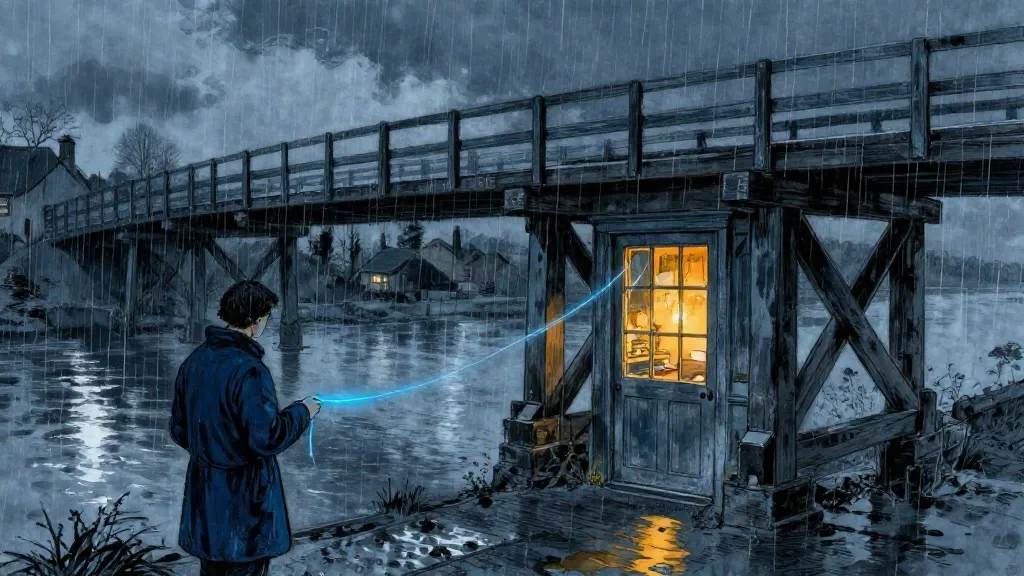
Mara followed the blue thread through the wet streets. It led from Lio’s cottage to the bridge whose inscription said: WHAT WE SWEAR HERE, THE WATER WILL KEEP.
Under the words someone had cut six one-oh-eight.
On the opposite bank stood a woman in an amber coat. Her face was exactly Mara’s, though twenty years younger.
“You took the first lie,” the woman said. “Now Thursday cannot come.”
Mara demanded the unmarked door.
The woman pointed beneath the bridge.
There, sealed between the timbers, was a narrow glass door. Rain silvered it. A warm amber glow showed on the other side, and behind it a kitchen boiled over while a man in yesterday’s coat angrily poured tea.
“That is Lio’s room,” Mara said.
“It is every ordinary room he was meant to have. At noon, one of you must cross and tell the truth. The river will preserve whichever morning you surrender.”
The Door Without a Wall
Mara returned at dusk with the glassblower’s half-moon, a hook, and the blue thread. The unmarked door now stood across the bridge, wet and trembling. She understood with sick clarity: the promise beneath the bridge had never protected Bellwether. It had made safety conditional on silence. The river witnessed every truth, but an oath made from common lies became a lock.
She struck the hidden door with the half-moon. The bridge groaned. Cracks opened in the inscription.
Bellwether’s citizens hurried toward her with umbrellas, jars, ledgers, rehearsed smiles. They offered harmless truths in place of the real one. The river rose quietly, pleased with them.
Only Lio remained in his cottage, holding the pane she had failed to deliver.
Mara crossed the invisible threshold.
On the other side stood a small house on a hillside, with a warm amber window facing east. The town was not Bellwether. A woman at the door wore a blue apron and asked why Mara was crying.
“I kept an ordinary morning,” Mara said. “Please. Let it be ordinary.”
What the River Kept
She woke in her workshop. Outside, the sky had not brightened. Thursday waited beyond the unmarked door.
Mara opened Lio’s unfinished pane in the village square. Its surface first showed the river under a black sky. Then the six-one-eight cuts filled with water. One by one, the citizens remembered the flood: the warning bell, the false reports, the son lost because every bridge had been called safe.
They spoke before they could soften the truth.
The river rose to the inscription and held it beneath the surface. The lock broke. The unmarked door swung inward, revealing Lio’s kitchen, still warm from Thursday morning.
He sat at the table, drunk on tea, glaring at his brother.
Mara placed the pane in its frame.
The amber window caught the first sun. No one mistook the morning for forgiveness. No one called the river kind. But the bridge held, the houses stood, and Bellwether entered Thursday one true detail at a time.





