 Netwrck
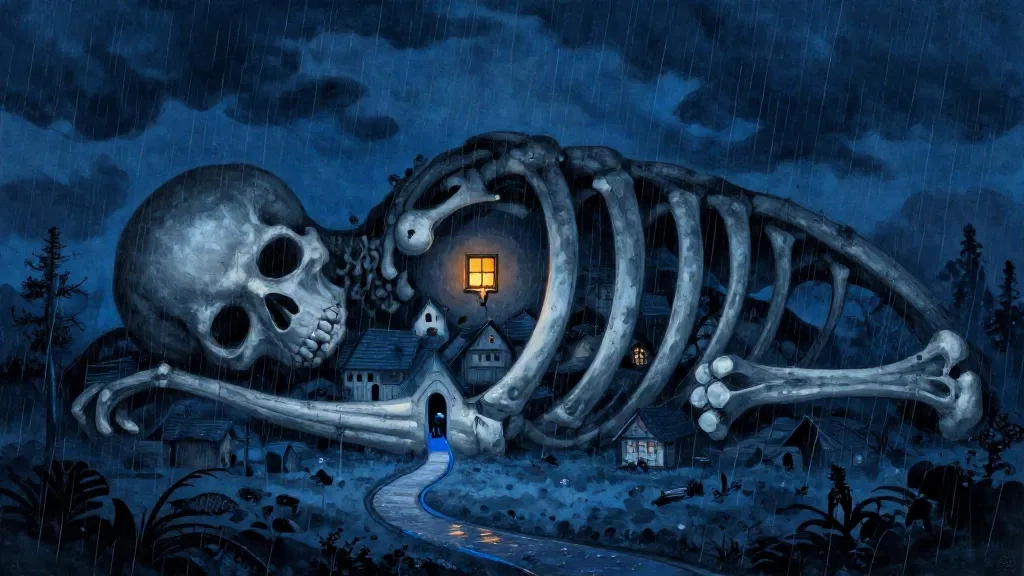
Mystery.
The Unmarked Door
At dawn, glassblower Mara Venn shaped a window no room had asked for.
Rain silver ran down the workshop roof. Beyond it, the village clung to the warm hollows between the ribs of a sleeping giant, its chimneys like crooked stitches across ivory bone. The window she blew was small and square, clear except for one amber square trapped at its center.
Then someone knocked from inside the glass.
Not loudly. Three patient taps, followed by the scrape of a chair being moved away from a breakfast table.
Mara nearly dropped her pipe. Windows made for other worlds carried sounds only when the people beyond them had forgotten what sound meant. Her father had said that. He had also said never to answer after dawn, though he had never explained which dawn.
The tapping became a hum. Mara recognized the tune her mother used while tying blue thread around seed packets. Beneath the workshop floor, her workbench, she found the old door.
It had no handle, no hinges, and no number. Blue thread was wound around its middle.
A Morning Taken Away
The door opened onto a kitchen lit by rain.
Mara stepped through and found the village assembled around her square window, though the room was larger inside than the workshop should have allowed. Her neighbors sat at mismatched tables. Old Pell balanced salt on his fingertips. The ferryman wore both boots on the wrong feet. Even the child who sold weathertokens had grown a second pair of eyebrows.
At the head table, a woman in municipal gray held an empty bowl.
You took this morning, the woman said.
Mara looked through the amber square. Beyond it lay a narrow kitchen under an apple tree. Steam rose from porridge. A gray dawn brightened the window glass. It was the most ordinary scene Mara had ever seen, and she wanted it with a pain that frightened her.
It was her morning.
The woman explained that the giant had coughed during the night. One breath had gone missing, snagged among the ribs. The glassblower had caught it in a window before waking, and the village had been forced to live through the hours it contained twice.
Restore it, the woman said, and everyone will remember the second dawn. Keep it, and the first dawn will be gone forever.
At the word gone, every fire lowered itself.
Mara reached for the blue thread on the door. The thread tightened. Somewhere beneath the floor, a giant breathed in.
The Easier Lies
To free the morning, Mara was told, seven people had to speak the truth about what they had lost.
She began with her father. He stood by the window with his back to her.
I was not afraid of the dark, he said. I was afraid of being the last man awake.
The blue thread snapped. The kitchen brightened by a single silver inch.
So Mara asked Pell about his hands, and the ferryman about his drowned brother, and the weather-child about the father who had sold his name. Each answer loosened the stolen morning. Each answer also made the room sharper: grief found its old edges, fear recovered its teeth.
At the sixth truth, Mara saw the cost.
The trail was safer when everyone stopped telling the truth. Lies moved the village along without scraping against pain. The giant could sleep, and they could keep the stolen morning, if they pretended the theft had been natural.
But the window showed what pretending produced. The kitchen had no shadows. The porridge was cold. Her father sat at the table, smiling at nobody.
Mara understood then that the morning had not been stolen from the world. It had been stolen from the village’s willingness to bear the truth of loss.
She cut the blue thread from the door and tied it around the window’s amber center.
One Ordinary Return
Do not lie, she said.
Tell me the smallest true thing.
Pell said his hands shook because he still wanted to hold his wife. The ferryman said the river had not taken his brother; fear had. The child said the weather tokens were buttons from a coat his mother never came home to mend.
Mara’s father looked at her.
I wanted one morning, he said, where nothing was required of me.
Then he began to cry, and the glass sang.
The unmarked door split into a seam of rain silver. Through it came the smell of porridge, wet grass, and apples bruised on the ground. The village returned to the giant’s ribs as the stolen morning entered the real window.
By noon, Mara stood outside. The room beyond the glass belonged to a woman in another world, who had opened the shutters and was drinking tea beneath an unfamiliar sky. One amber pane remained warm in its center.
Mara never learned the woman’s name. She did not need to. Every morning afterward, the village woke with one small disagreement, one honest ache, one thing that could not be made safe by pretending it away.
That was how they kept the ordinary morning.





