 Netwrck
Mystery.
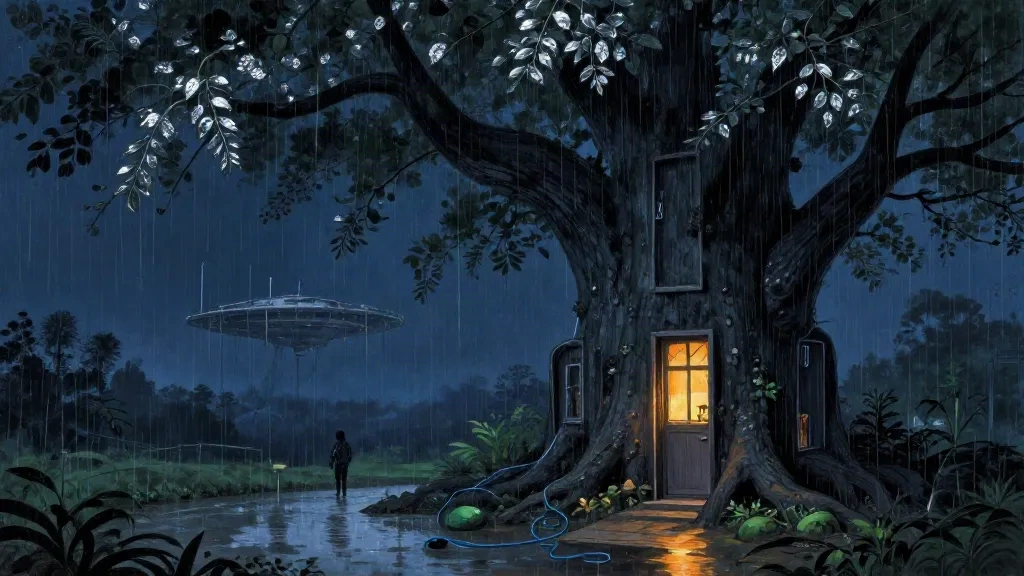
The Tree of Entrances
By morning, the garden had three doors that had not been there the night before.
They grew from the black trunk of the door-tree in long, pale seams, their brass handles turning slowly in the wind. One opened onto a tiled station platform. Another showed only rain. The third stood at the end of an avenue of bluebells, opening onto a room filled with papers.
Dr. Iona Vale knew the room. She had catalogued its shelves decades ago, before the first messages began arriving with no sender. The garden had been built around the tree after a meteor struck the old observatory. The tree answered by making thresholds.
In the observatory above it, former astronaut Elias Rook sat beneath a motionless sky.
He had returned from orbit after his crew found Earth silent. Not empty: silent. Their instruments registered oceans, forests, cities, and weather, but every transmission became a wash of background noise. Elias refused the descent schedule. He stayed in the observation cupola, keeping his wristwatch synchronized to the vanished mission clock.
That morning, Iona carried a green stone to him.
It was warm, smooth, and no larger than a plum. She had found it beneath the tree roots, beside a strand of blue thread.
Noise with a Shape
“Your voice is in the station,” Iona said.
Elias looked at her through the glass. “I never recorded one.”
“You did. During the last orbit. The transmission was damaged.”
She placed the green stone on the console. The thread around her wrist caught the light from the single amber window below.
That window had belonged to the observatory keeper, a narrow rectangle burning steadily through the storm. Whenever Elias watched it, he remembered the first sunrise after reentry: the sea, the salt on his visor, the low human voices calling from the pad.
Now he could not remember their words.
In the garden, the doors began to turn.
At first the motion was slight, a twist of hinges buried in bark. Then the tiled platform slid toward the bluebell avenue. The paper room folded shut. A door opened in the middle of the pond, and one of its panes showed the observatory cupola from the outside.
People ran for cover. The gardener’s daughter vanished into the tiled station, still holding a pruning hook. An elderly visitor stepped halfway through the rain door and stopped, his coat streaming upward into the clouds.
Iona tied the blue thread around the green stone and crossed the flooded path.
“If doors move while someone is inside,” she said, “the tree may be editing their direction.”
“Or their destination.”
The Room Behind the Bark
Elias came down from the cupola for the first time in eleven years.
His knees buckled on the stairs. The air smelled of wet soil, iron, and cut stems. Every tree in the garden leaned toward him, though the wind had stopped.
The paper room was open behind a knot in the trunk. Inside, shelves stretched farther than the building could contain. Hundreds of voices whispered from ledgers and reels. Some belonged to children. Some to machines. Some were only pauses, shaped by the static between words.
Elias found his own name on a black spine.
He opened it.
His voice emerged, thin and distant: “We are looking down at Earth. If anyone receives this, remember that the planet is not a story. It is a place where somebody waits.”
The words broke before the next sentence.
Beyond the shelves, the storm slammed every door at once. The station platform rotated through the paper room. The rain door opened inside the trunk. The amber window appeared in the garden, hanging above the roots, though its light fell from below.
The gardener’s daughter screamed from somewhere inside the walls.
Elias pulled the green stone free. The blue thread snapped and leapt toward the nearest doorway, tightening like a mooring line.
What the Tree Kept
He followed.
Behind the bark was no distance, only layers of weather. He passed a winter orchard under a summer sky, a drowned city beneath clear noon, and the station platform suspended above a field of tall grass. Each scene held a fragment of the missing Earth signal.
Then he found the daughter beside the station door.
She was caught between two places, one boot on the platform and one among the bluebells. Elias held out his hand. The green stone pulsed between them.
“Don’t close the door,” she said.
“I won’t.”
He placed the stone in the center seam. The blue thread burned gold as the two destinations touched.
Every door in the garden opened toward the same point: the amber window. The storm withdrew. Water fell upward from the soil. The station platform folded into bark.
Elias stepped through the last door and returned to the observatory.
His wristwatch had stopped. The mission clock had not.
In the quiet that followed, he played the recovered sentence again. It was only a fragment, damaged and incomplete. But beneath it, where background noise had swallowed every human voice, another signal answered.
Not the world proving that it existed.
A person, waiting for someone to listen.
Elias pressed the recording. On the amber window, his reflection lifted one hand and waved.





