 Netwrck
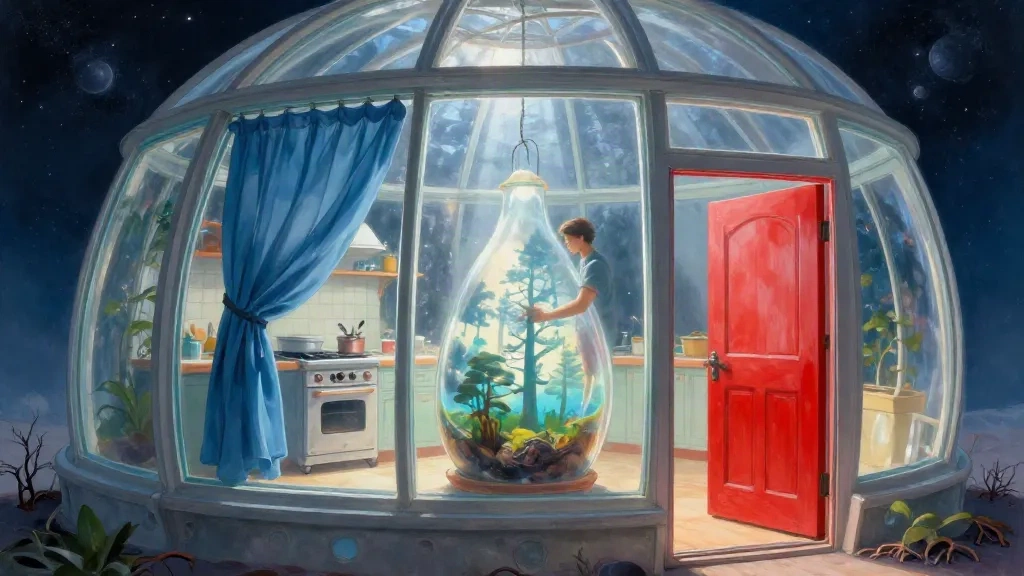
Magical Realism.
Rooms for the Light
At the bottom of the station, below the irrigation decks and the pearled hydroponic shelves, the seed slept in a chamber no larger than a fist. Blue roots rested against the glass. Inside them, forests waited: cork oaks with leaves like small green flames, black cedars carrying winter in their crowns, entire meadows of grass that had forgotten the name of wind.
Mara stood outside the chamber with a blowpipe in one hand and a cooling frame in the other. Above her, nine levels of windows caught the same pearl light and made it travel through the greenhouse. Some windows showed dawn. Some showed rain. One, repaired only last winter, showed a blue hour that refused to end.
She shaped panes for the sleeping quarters where colonists dreamed of other worlds. Her glass carried tiny bubbles, pale seams, and the mineral scent of the seed. A room could open onto its native sky, its former weather, or nothing at all. People paid heavily for windows that remembered correctly.
Mara did not want a spectacular view. She wanted one ordinary morning.
Her mother had described hers before the station doctors corrected her memory: tea boiling on a dented stove, a blue curtain lifting, the neighbor's dog barking once and giving up. Mara had been sixteen when the story ended. Later, she found the morning recorded in the seed, perfectly preserved, and watched the colony's archivists assign it to someone else.
The Blue Thread
That morning appeared first in the greenhouse, then in the corridor outside Mara's workshop. A pale blue thread lay across the floor, thin as a hair, extending toward an unmarked door.
No one else admitted seeing it. The gardener said the corridor was bare. The engineer said blue thread was a sign of bad water pressure. Mara followed it anyway.
At the door, the thread divided into three strands, each slipping beneath the threshold. When Mara asked the station to identify the room, every display answered with a different name. The room behind it answered none.
Inside was a kitchen. Dented stove. Blue curtain. Steam rising from a cup. A dog barked somewhere beyond the wall, then stopped. Mara stepped in, and the door vanished behind her.
The room was warm. The table had been set for two. She put her palm against the cup and felt the faint pressure of an absent hand.
Then the station warning sounded, sharp and official: the trail grows safer when the truth is abandoned.
The Red Door
At first Mara thought the warning was nonsense. The next morning, she told the gardener the seed contained no forests. The red thread beneath the irrigation pump vanished. The boiler stopped roaring. A safe corridor opened where a dangerous one had been.
She told the engineer her mother had never owned a blue curtain. The unstable window in the eastern wing sealed itself. The station's power use dropped by nine percent. Everyone called it progress.
By the third morning, the unmarked door had become a red door. Its paint was the only red in the station, brighter than a warning lamp and deeper than a rose.
Mara understood then that the trail was not guiding her toward a hidden room. It was teaching the station to survive by accepting a quieter story. The red door appeared wherever the truth had been removed.
She tried to warn them, but each warning made the next crossing safer. When she described the forests, the seed lost a color. When she named the dog, the kitchen window clouded. By dawn, the trail no longer led anywhere at all.
What the Morning Cost
Mara took the blowpipe into the corridor and blew a single bead of glass. It floated before her, trembling with borrowed light.
She pressed it to the red door. The paint burned away. Beneath it, the unmarked door returned, and blue thread spilled from the frame like water finding its level.
Inside, the kitchen waited. The tea was cold. The curtain hung still. On the table lay two cups, one overturned, one untouched.
Mara opened the seed chamber's inner valve and let the morning speak. It rose through the station in a thin, bright pressure: the neighbor's bark, the kettle's hum, her mother's hand closing around hers. The blue thread snapped from one end to the other, carrying the greenhouse's lost forests with it.
Every window in the station flared at once.
Some showed homes. Some showed oceans. The red door remained only as a narrow outline in the white wall, then vanished.
Mara placed the small bead of glass in the empty frame of the kitchen window. Morning passed through it, imperfect and unrepeatable. The dog barked twice. Steam rose. Her mother laughed behind the blue curtain, almost out of sight.
Mara did not close the door. She could not keep a morning from being taken forever. She could only make a room where it would be allowed to happen again.
What we preserve is not always the thing we save. Sometimes it is the place where saving begins.
By noon, the station had lost several polished windows and gained an honest view. Mara worked through the afternoon, replacing false horizons with clear glass. Each pane admitted the seed's deep blue light.
That night, no one asked her what lived beneath the greenhouse. The seed answered for itself. In the corridor, the unmarked door stood open, and a thin blue thread waited on the other side.





