 Netwrck
Mystery.
The Door in the Elm
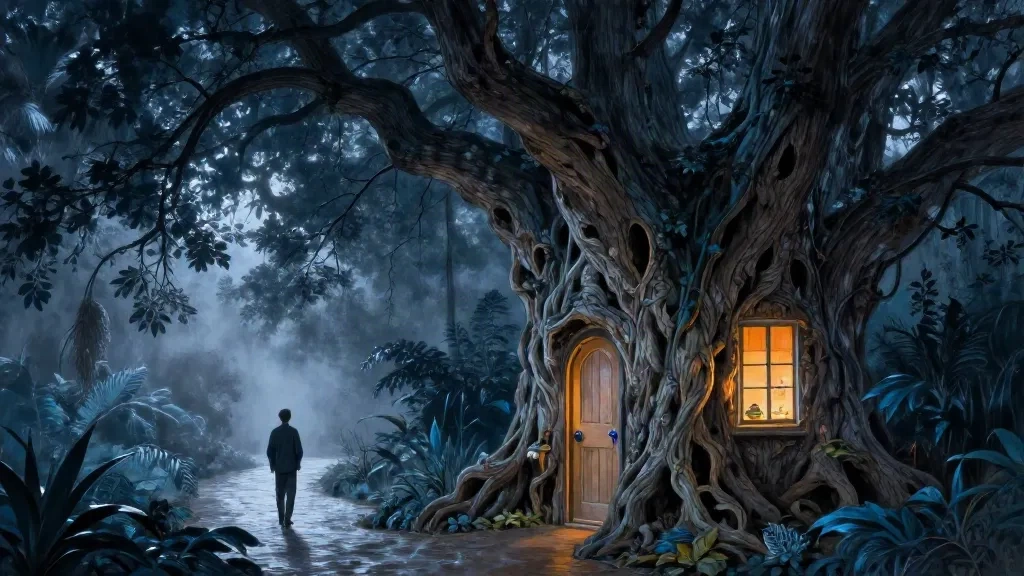
Mara Vale worked before dawn, when the glass cooled blue in the bucket and the garden slept beneath a rain-silver sky. The Threshold Garden stood around an ancient elm whose bark had split into doorways. Some opened on kitchens. Some opened on oceans under glass roofs. One, according to the old catalogue, opened on a room where lost things waited to be remembered.
Mara did not make doors. She made windows for them.
Each pane had to fit a world beyond the frame. A window for a forest of floating stones required thick, slightly green glass. A window for a city built upside down demanded silvering along its lower edge. The amber window was her favorite, cut for a room in another world where morning arrived whenever someone missed it.
That morning, the elm opened an unmarked door.
No brass plate. No hinges. No threshold stone. The blue thread tied to its handle was the same shade as Mara’s measuring cord, and it was the only bright thing in the wet garden.
She tied the thread to her wrist and entered.
What the Path Required
Beyond the door was a gravel path between black hedges. Rain silvered the leaves, though no rain fell. At the first fork stood a sign: THE MORNING BELONGS TO THOSE WHO TELL THE TRUTH.
Mara chose the left path. The gravel softened beneath her shoes. A woman in a green coat appeared ahead, carrying a basket of pears.
“My daughter sleeps beyond the eastern hedge,” the woman said. “I have searched for her since dawn.”
At the second fork, a boy held a crushed red flower.
“I picked it for my mother,” he said. “She is dead.”
Mara felt the path brighten. Somewhere behind her, the elm creaked.
Then the woman’s pears rolled from the basket and became smooth white stones. The boy’s flower turned to dust. The sign ahead changed: THE MORNING BELONGS TO THOSE WHO KEEP QUIET.
Mara understood. The path did not want truth exactly. It wanted agreement. Every honest sentence had made the next danger less visible.
She kept walking, but said nothing.
At the third fork stood a man who looked like her brother.
“You promised to meet me here,” he said.
She wanted to answer. Instead, she tightened the blue thread around her wrist and pointed toward the path.
The imitation vanished. The safer road appeared.
The Cost of Safety
By the fourth fork, Mara had stopped speaking entirely. The hedges grew low. The path was easy, almost gentle. No question could trip her, no confession could summon a consequence.
Then she saw a small glass window set into the hedge. Behind it was an ordinary morning: a striped kettle steaming on a stove, a blue cup, sunlight moving across a kitchen table.
That was the room she had made the amber window for. A room where someone had once told her, Stay as long as you like.
It was the only ordinary morning she remembered choosing.
The unmarked door waited behind the hedge.
Mara lifted the blue thread and tied it to the latch. When she pulled, the door opened, but the path began to narrow.
“Tell the truth,” said a voice from the elm.
She looked back. The woman, the boy, and her brother stood beneath the branches. Their faces were blurred, but their injuries were clear: the woman’s empty hands, the boy’s missing fingers, the long scar across her brother’s mouth.
“I came here because I wanted one morning that no door could take from me,” Mara said. “I wanted to keep it ordinary.”
The truth struck the path like a hammer.
The Amber Room
The hedges caught fire without heat. The gravel turned to glass. Mara ran, not away from the morning, but toward it.
Behind her, every lie the path had hidden became visible. A child beneath the pond, knocking. A city buried under snow. Her own reflection standing at the wrong side of the glass.
She reached the amber window.
It showed the kitchen again. Steam rose from the kettle. The blue cup waited beside the table. Nothing terrible had happened there. It had only been one day, brief and ordinary, and that was enough to make its loss unbearable.
Mara placed both hands on the pane. The window did not open. It became warm.
On the other side, someone finally took the blue cup from the table and set it down again.
That small movement repeated: cup to table, table to cup. The ordinary morning repeated with it.
Mara smiled. Not because she had saved the day, but because she had made room for it.
At dawn, the unmarked door remained in the elm. Mara tied the blue thread to its handle, where anyone could find it, and walked home through the rain-silver garden. Behind her, the path was gone.
In the kitchen, the kettle whistled. The blue cup was warm. Through the amber window, the world beyond looked less dangerous than before, though it still contained many doors.
Mara left the curtain open.





