 Netwrck
Historical Fantasy.
The River’s Midnight Turn
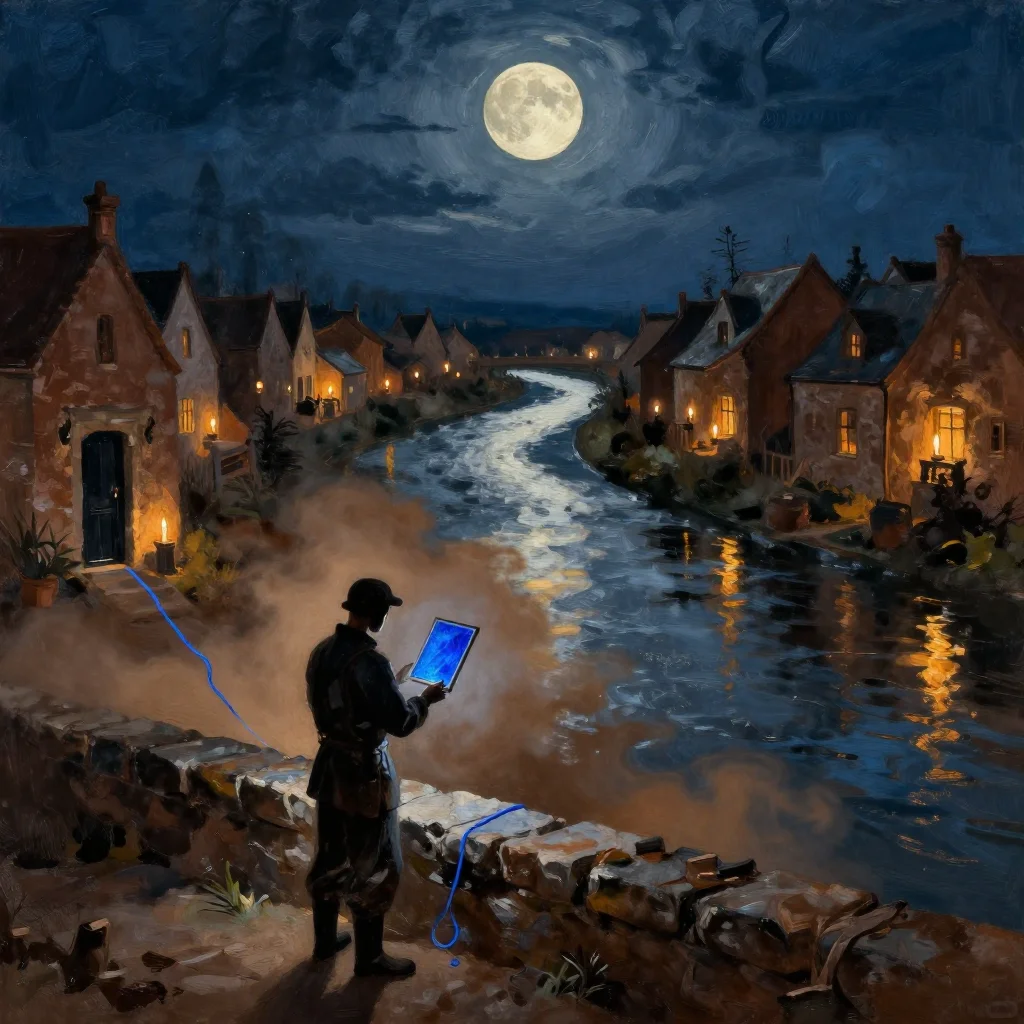
By dusk, the river divided Selharn into two streets, two customs, and two versions of the same weather. The western bank smelled of tobacco and iron. Across the water, windows shone with the reflected candlelight of houses that had burned for three hundred years.
Mara Venn worked in a narrow brick workshop behind the customs house. She made windows for rooms in other worlds: windows for a city beneath a red moon, for a house floating above cloud, for a sleeping room where no one had ever opened the shutters. Her master had called them assignments. Mara called them errands, because the glass obeyed her hands more reliably than people did.
For eleven mornings, her daughter Nessa had come to the workshop before sunrise.
They had eaten barley broth on the back step. Nessa had counted the ferry bells. She had complained about the cold, then borrowed one of Mara’s wool gloves and kept it.
At dusk on the twelfth morning, Mara learned that Nessa’s father had returned from the eastern bank and taken the child across the river before the turning.
“He has a room prepared,” the ferryman said.
Mara set down her blowing pipe. “She has a mother.”
The river changed direction at midnight. It always did. The whole town moved its clocks and fences in the dark, finding the bank that had become dry. Selharn’s border was less a line than a habit.
The Safer the Road
At the old toll bridge, a narrow trail followed the water. A woman in a blue hood was waiting there with a length of thread.
“Your daughter crossed safely,” she said.
Mara looked at the thread. It was blue as deep winter, wound around the woman’s pale fingers.
“You are lying.”
“The trail is safer when we are.”
The woman placed the thread in Mara’s hand. “Follow it after midnight. Do not tell anyone what you see.”
Mara almost threw it away. Instead she wound it around her wrist, beneath her sleeve. The thread led toward an unmarked door set into the river wall. No hinges showed. No lock. Only a narrow rectangle of darkness beneath a ledge of wet stone.
Inside was a room lit by a single candle. Nessa sat at a table, folding paper into boats.
“Mama, you came late.”
Mara crossed the room. “Your father?”
“He is here.”
Beyond the doorway stood a man in a coat green with river weed. He looked like Nessa’s father. Nessa looked at Mara and frowned.
“That is not him,” she said.
The man smiled. “Tell her you came because the window cracked.”
Nessa obeyed. The blue thread went slack around Mara’s wrist.
The candle flame leaned toward the unmarked door. Beyond it, the town’s bells began to ring backward.
What the Glass Held
Mara understood then that the room was made from a lie: a room for a daughter who had crossed, a father who had returned, a morning that had gone where the river could not reach.
The man pulled a pane from his coat. It was clear except for a dark seam at its center.
“Your work,” he said. “A window for this room. Put it in and she stays.”
“And tomorrow?”
“Tomorrow is already tomorrow.”
Mara took the glass. It was warm from his hands. The pane trembled with the reflections of a hundred rooms she had made, all of them empty, all of them waiting for somebody to call a place home.
She put the pane into the unmarked door. The dark seam widened. Through it she saw the workshop, the back step, the barley broth steaming in two bowls. Nessa sat opposite her, younger by exactly one morning.
“Tell me the truth,” Mara said.
“Which truth?”
“The one that makes the road unsafe.”
Nessa looked at the bowls. “You came because you were afraid.”
The blue thread tightened. Somewhere beyond the room, the river struck stone.
“Yes,” Mara said. “I was afraid.”
“Then stay.”
Mara picked up the glass. “No. I came to keep the morning.”
The Morning Kept
She struck the pane against the stone. The glass did not shatter. It became transparent all the way through.
The room vanished. Nessa stood on the riverbank in the rain, clutching the stolen glove. The false father dissolved into black water. The toll bridge turned beneath the moon, and the trail filled with loose blue thread.
Mara crossed. Nessa reached her.
“You came late,” Nessa said.
“I know.”
Before dawn, Mara returned to the workshop and made a small, plain window. No palace. No impossible city. No room beyond the stars. She set it in the eastern wall, where morning struck the glass and broke into ordinary gold.
That day, Nessa counted the ferry bells. Mara lit the stove. Neither of them lied about the river.
At midnight it changed direction, as rivers do. The town moved its fences. The border moved with them.
Morning remained exactly where they had put it.





