 Netwrck
Weird Fiction.
The Door in the Brass Rail
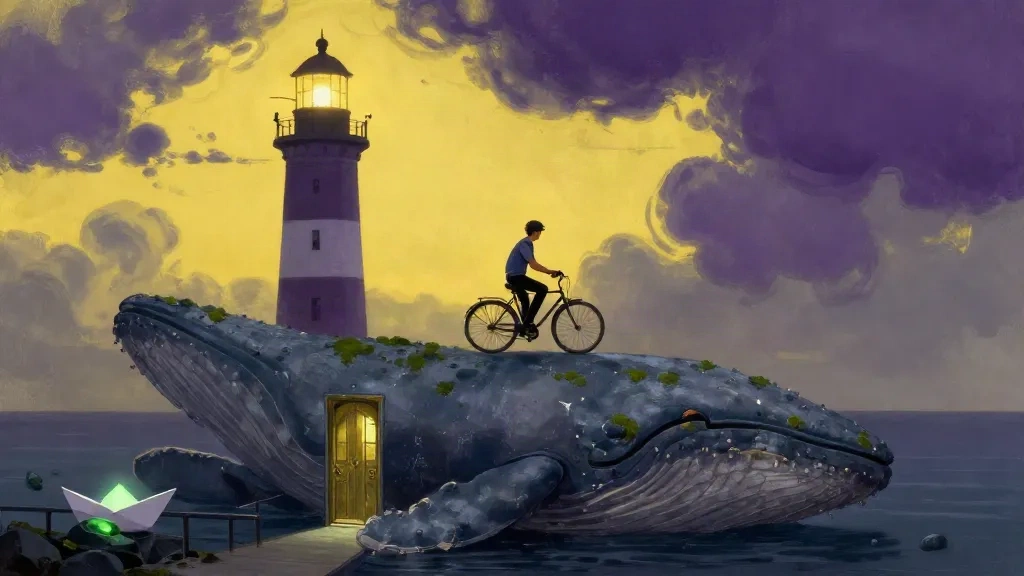
Mara kept her bicycle beside the lighthouse door, though the bicycle was always inside. Its wheels rested in the corridor, one turning slowly beneath the floorboards, while its frame waited behind a locked service entrance.
She had come to the whale with a question and no delivery address. The question was simple enough to fit on a stamp: Why has the future stopped sending letters?
For eleven years, the roads had carried news from tomorrow. A village received its own obituary before the old woman died. A ship captain found the names of drowned passengers in his forecast. Couriers like Mara crossed the narrow hours with sealed envelopes, paid in salt, copper wire, or the names of things everyone had forgotten.
Then the letters stopped.
At first the absence seemed like weather. A delayed season. A flooded bridge. But the silence spread until even the mechanical whales stopped their long-distance calls. Now they slept beneath the saffron sky, their metal ribs rising and falling like hills remembering the sea.
The Land’s Open Ear
The lighthouse stood on the back of the largest whale, its lantern balanced where a dorsal fin had been welded into a spiral tower. The whale had been asleep for nine hundred years. Each night, the tower turned its light across the land, and each morning the land listened.
That was the strange inheritance in the treaty.
The old agreement had been signed by three kingdoms, a drowned city, and the first listening machine. In exchange for the whale carrying the lighthouse above the clouds, the land had surrendered one faculty: it was permitted to hear anything spoken within itself. Every private grief, every false oath, every secret thought under a bedroom floor, rose through the soil as a soft silver hum.
The treaty made the land legal. It did not make it polite.
Mara stood beside the whale’s ear, a seam of black metal beneath the moss, and held up the green stone she had found in her bicycle basket. It was smooth, warm, and gave off a scent of rain.
“I need a letter from the future,” she said.
The seam answered with a thousand whispered voices.
She lifted the stone. The whispers sharpened. A woman’s voice said, Do not open the seventh door. A child counted backward from a number that had not been invented yet. Beneath both, so faint it might have been imagined, Mara heard the future.
It was not silent. It was waiting.
A Boat Made of Paper
In the lantern room, the keeper had left a paper boat on the brass rail. Its sails were folded, its hull filled with grey ash. The keeper had vanished before Mara arrived, leaving only the boat and a note written in a hand that leaned toward tomorrow.
The future seals its own correspondence when the present begins to answer back.
Mara placed the green stone inside the boat. The paper began to sweat saffron yellow. Deep plum clouds gathered beyond the glass, though the sky had been clear moments before.
She wheeled the bicycle into the lighthouse.
Its front wheel found a door that had not been there. The bicycle rolled through without breaking the frame. Mara followed, gripping the paper boat.
Behind her, the whale’s back opened into a sequence of rooms. In one, a market floated above a bottomless street. In another, every clock had stopped at the same impossible hour. In a third, hundreds of couriers sat beneath a green sun, sorting letters into boxes marked sent too soon and never asked.
At the end of the corridor stood the seventh door.
Mara could hear the future pressing against it. Not writing. Breathing.
The Future’s Return Address
She opened the door with the green stone.
Beyond it was a mailbox made of black ice. Inside, letters floated in a slow spiral, each envelope stamped with a year. The nearest carried her name.
Mara took it. The paper was warm.
She broke the seal.
Inside, no message. Only a second paper boat, tightly folded, and a sentence written in the future’s unfinished grammar:
Because you kept asking what we would send, we stopped deciding whether to arrive.
The lighthouse shook. Smoke-grey air poured through the rooms, carrying the land’s permitted whispers. The whale opened its eyes beneath the floor, a single vast eye filled with reflected dawn.
Mara did not take the letter. She set the paper boat on the mailbox and placed the green stone in its hull.
Then she rode the bicycle back through the closed doors.
Behind her, one by one, the future’s letters lifted from their boxes. They entered the rooms, the market, the stopped clocks, the hands of sleeping couriers. The treaty remained unchallenged, but listening was no longer the same as keeping.
At dawn, Mara reached the lighthouse door. The whale sighed beneath her wheels, and the lantern turned toward a horizon that had never been there before.
She finally understood. The future had not stopped sending letters.
It had stopped believing anyone would read them.
In the green stone’s dark reflection, the road ahead appeared: a bicycle, two wheels, and a door opening toward home.





