 Netwrck
Science Fiction.
The Patient Beneath the Water
Dr. Iona Vale treated homesickness the way other physicians treated fever: by asking where the pain had begun, and then by refusing to let the patient keep returning to the same room.
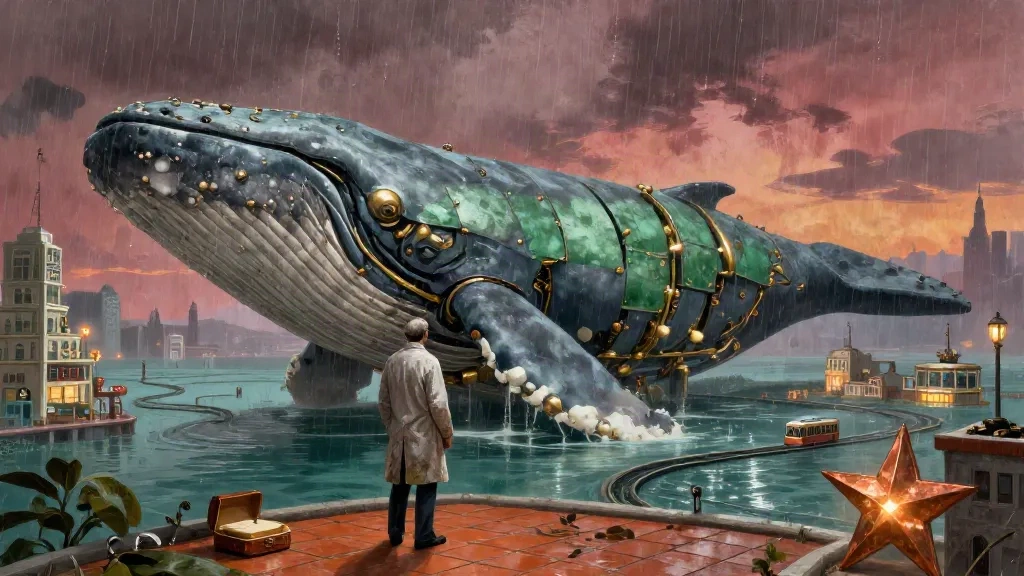
Her clinic occupied the lantern room of an old lighthouse fixed to the back of a sleeping mechanical whale. The whale lay in a dry inland basin, its ribs ribbed with terracotta tiles, its flanks streaked eucalyptus green. Above it, the bruised-fruit sky bruised further whenever the afternoon sun tried to set.
People came to Iona with impossible homesickness. They missed kitchens that had burned. They missed doors that opened toward parents who had died. Some carried tiny maps of apartments they had never lived in, their streets renamed in a dream.
She listened. She measured the pulse beneath their longing. Then she prescribed departures: a walk to the eastern dunes, a train without a destination, seven days spent sleeping beneath a different sky.
The whale itself was her strangest patient. It dreamed through brass eyelids, and in its dreams it traveled beneath an ocean that did not exist. Every night, the lighthouse beam swept its flanks and woke a hundred sleeping windows.
What the Flood Found
On the ninth day of rain, water entered the basin.
It came through the old canal beneath the whale, a forgotten mouth sealed with civic concrete. The flood lifted the basin's silt, peeled away a skin of white salt, and uncovered a second whale below the first.
This lower whale was not sleeping. It was waiting.
On its back lay a city in blueprint stone: terraces, gardens, tramlines, numbered rooms. Each room bore the name of a vanished neighborhood. Iona climbed down through the cracked tiles with a lantern tied beneath her chin. Every third step, the buried city answered her with a deep brass note.
At the center stood a council chamber. Its doors were open. Inside, a table carried the copper star from Iona's own office, though she had never owned such an object. The star had been a patient's token, left behind after a cure, and now it cast seven points of light across the plans.
She unfolded the largest plan. The mechanical whale was not a vessel. It was a civic project: a mobile refuge for people displaced by rising water. The engineers had designed it to accept every lost household, then seal the basin forever so no one could claim ownership of the homes inside.
Beautiful, Iona thought. Beautiful prison.
The Song Under the Floor
She found the music box in room seventeen.
It was made of pale wood, with a copper star hinged to its lid. When Iona opened it, a tune escaped into the buried city. The melody was simple, almost cruel. It made the names on the walls become names she had once known.
Her mother hummed it while washing cups. Her father used it to announce bad news, as though a tune could make the room small enough to survive. The box had been a gift from a patient who said the cure had failed because she could no longer remember which home she missed.
Iona carried the box through the corridors, and the walls answered. A room lit for a market. A door remembered a child's height. Somewhere below her, pumps began to move.
The whale was waking.
She understood then that the buried city was not waiting for floodwater. It was waiting for someone to distinguish refuge from surrender. The machine could open its doors to every lost person, or keep them safe by refusing to let them leave.
A Direction for the Lost
Iona climbed to the lighthouse and released the whale's dreaming circuit.
The mechanism beneath her feet resisted. Then, room by room, the whale opened. Terracotta doors swung into the storm. Eucalyptus leaves tore loose from the upper gardens. In the flooded basin, the buried city's lights rose like a second constellation.
But the whale would not move until each passenger named a destination.
So Iona set the music box on the council table and placed the copper star in its lid. The tune traveled outward through the whale, carried on the beam. Across the basin, people heard it. A child in a red coat stepped from the crowd and pointed toward the dunes. An old man named the hill where his brother had buried a telescope. Others chose rivers, roads, kitchens, names.
By dawn, the whale stood upright.
Its wake crossed the inland sea, and the lost households departed with small lights burning in their hands. Iona remained at the lighthouse long enough to hear the music box finally stop.
Then she carried the copper star onto the whale's back.
Below them, the buried city filled with returning water. It did not become a prison. It became a map: every room recorded, every departure named, every home allowed to become a direction rather than a cage.





