 Netwrck
Science Fiction.
The Archive in the Blue Suitcase
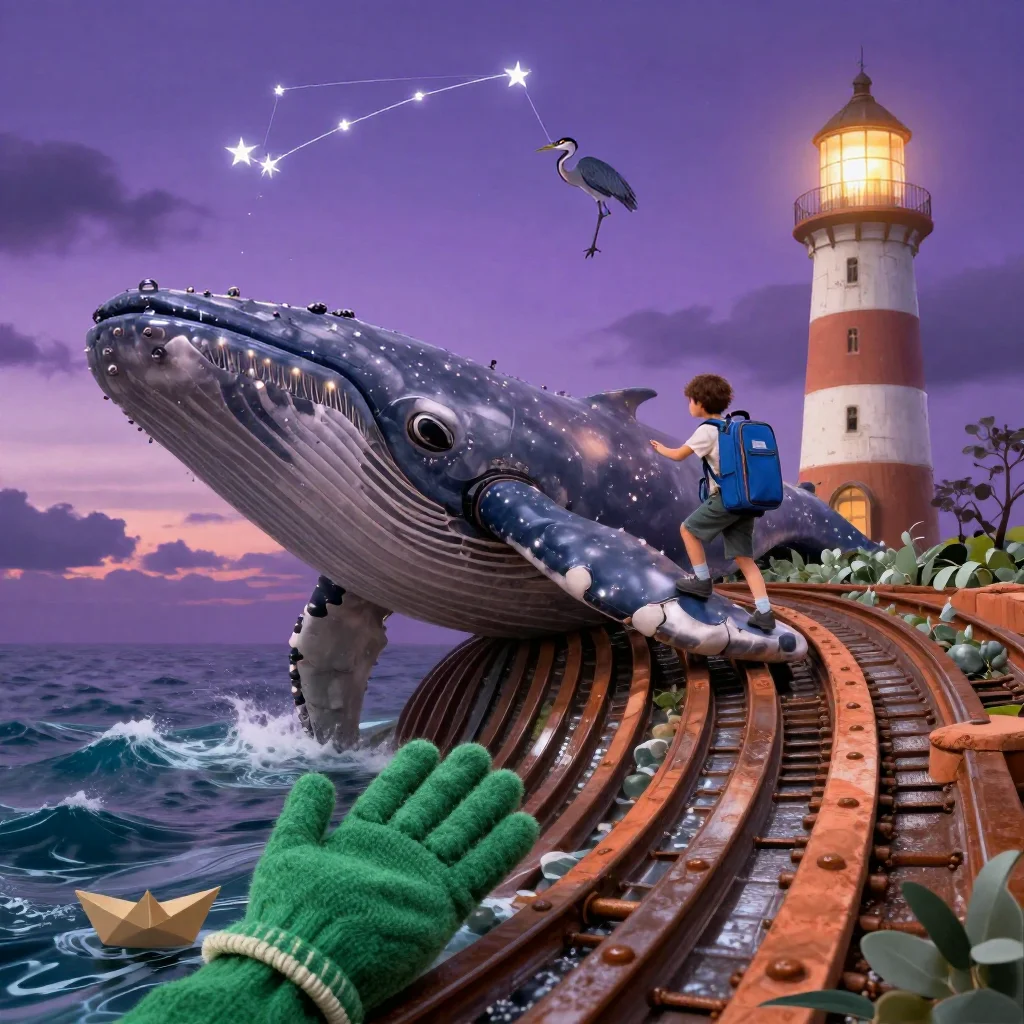
Mara’s mother had warned her never to wake the whale, though the whale was nine hundred meters long and had slept beneath the sea for one hundred and eighty-seven years. It surfaced only to breathe, a black iron ridge lifting from the bruised-fruit sky, seawater streaming from its barnacled flanks in warm, mineral-smelling curtains.
On its back stood Lighthouse Sixteen, painted terracotta from base to lantern. The light swept across empty ocean. Nobody lived there except Uncle Sol, who trimmed the wick, polished the lens, and kept the whale’s dream from settling too deeply.
Mara arrived by launch with a blue suitcase strapped across her back. It contained the Lunar Index, nine volumes of rain records, a map of vanished roads, and one book with no catalog number. The book was open.
On its pages, constellations floated in white ink.
Her mother was the custodian of those stars. One by one, she had removed them from the sky and stored them in the whale, where they could be guarded from people who mapped hope and sold it by the acre. The final constellation was the Heron of Summer: seven stars in the shape of a bird carrying a flame.
Mara’s task was written inside the front cover.
Return the Heron to the original sky before the last breath of Keeper Mara Venn.
Mara read the sentence twice. The second time mattered more.
Last breath. Keeper Mara Venn was her mother, alive in the lighthouse below, asleep in a copper bed with a paper sickness moving beneath her skin. Doctors had given her until sunrise, though Mara suspected they did not understand where the time was being kept.
Mara found one wool glove on the landing, dark green and fingerless, smelling faintly of eucalyptus. She put it in her left pocket. Her mother’s glove. Her mother had carried it on the night the Heron was taken down.
A Deadline With a Pulse
Keeper Venn was awake when Mara opened the infirmary door.
“You took your time,” her mother said.
The room smelled of wax, salt, and the crushed leaves stored in the lighthouse medicine drawers. Copper instruments trembled above the bed on threads no one else could see. Each vibration pulled a little more light through the western window.
“The stars are in the whale.”
“The stars are everywhere.” Her mother smiled without opening her eyes. “That is where the trouble began.”
Mara laid the anonymous book on the blanket. When she turned to the final page, the Heron appeared above the ink in a scatter of trembling points.
“How do I return it?”
“Climb.”
“Climb where?”
Her mother’s breathing slowed. Beyond the walls, the machinery of the whale clicked and settled. On its vast back, sleeping gears turned their immense bronze teeth.
Mara tucked the glove deeper into her pocket and took the ladder to the lamp room.
There, Uncle Sol was winding the great lens. He was ninety at least, white-haired, bare feet tucked into canvas trousers. A paper boat rested in the basin of his palm, its bow chipped and its sail marked with a small burning bird.
“Your mother knew you would come,” he said.
“She said I had until her last breath.”
Sol stopped winding.
“Then she has told you too much and too little. The deadline is not her death. It is the last breath of this lighthouse. When it expires, whatever remains inside the whale will remain inside forever.”
Below them, the lens turned with a sound like winter trees.
Mara looked at the paper boat. “What happens at dawn?”
“The whale forgets the sky. Your mother forgets you. We become a place where lost things go to be lost properly.”
He set the boat on the windowsill.
Inside the Sleeping Engine
The hatch beneath the lamp room opened onto the whale’s back. Its iron hide was warm, its plates furred with pale lichen. Mara crossed fields of salt grass and shell while the lighthouse beam swept over her, unable to touch what it had helped imprison.
At the whale’s shoulder she found a round door set between two immense ribs. Its brass wheel turned but once every few breaths, driven by the animal’s sleep.
Inside, stairs descended through a blue-green darkness. The library in Mara’s suitcase knocked against her hip: books shifting, pages fluttering, as if eager to be home.
The chamber at the bottom held the night before it was broken. Stars drifted in cages of glass. Comets curled in jars. Names rested in shallow drawers, each one shining when spoken. The Heron waited in an open vault, seven white sparks arranged around an empty center.
Beside it stood a steel woman with a key-shaped hole in her chest.
“The original sky?” Mara asked.
“Inside,” the woman said, though no one had spoken aloud. Her voice came from the walls. “The whale carried a fragment of first night beneath its skin. The Heron was taken from that place and hung above the lighthouse. We are going to return it.”
“Who are you?”
Mara looked at the wool glove in her pocket. “My mother’s oldest machine.”
The woman’s mouth did not move. “Then she is still here.”
A tremor passed through the chamber. Above them, the lighthouse bell rang once, a sound Mara felt in her teeth.
Dawn had begun to reach the whale.
Mara placed the paper boat on the steel woman’s palm. The boat filled with a reflected sky.
“The first night needs a bearer,” the woman said. “The lighthouse needs a keeper. The whale needs a dream. Your mother needs one last choice.”
“And me?”
“You need to stop carrying her books for her.”
The Original Sky
Mara gave the Heron to the paper boat. Its folded sail caught an impossible wind, lifting from her hand and climbing the dark stairwell. The stars left their vault one by one, answering the distant lighthouse with flashes too bright to look at.
Then the whale turned beneath them.
Not waking. Turning in sleep, as if disturbed by a familiar scent. The whole tower leaned toward the sea. The bell rang twice. Three times. Mara climbed with one hand on the ladder and the blue suitcase banging against the wall.
In the lamp room, her mother stood beside the lens. Sol had collapsed against the brass housing, his empty hands curled around a stain of seawater. The last wick burned green.
“The original sky is under the whale,” Mara said. “The Heron can call it out.”
“It will wake him.”
“He is already awake.”
Her mother looked toward the black horizon. Dawn pressed terracotta light beneath the clouds. Her face had become thin and translucent, the machinery of the paper sickness visible at her throat.
Then Mara did what no archivist should do. She stopped preserving the order of things.
She took the Heron from the paper boat and threw it into the lens.
Seven stars broke through the machinery and crossed the sky. The lighthouse blazed white. Beneath them, the whale exhaled, and its back opened along a seam of blue light.
For one breath, an older darkness lifted from the horizon: the first sky, folded beneath the creature like a remembered sea. The Heron flew into it. Its seven stars found their places, and the constellation turned its flaming head toward the lighthouse.
Keeper Venn drew one last breath.
When she released it, the lighthouse did not go out. The light passed into the blue suitcase, filling every book with moving constellations. Sol sneezed. The whale dived, and the sea closed over the tower’s shadow.
Years later, mariners reported a moving light beneath the western water, bright enough to guide ships through storms. It crossed the sky once each summer in the shape of a bird carrying a flame.
Mara kept the lighthouse archive, though she no longer carried it from room to room. On the last page of the book without a catalog number, she wrote a new note.
Some collections end when the keeper dies. The living may choose otherwise.





