 Netwrck
Romance.
The Weather Bureau
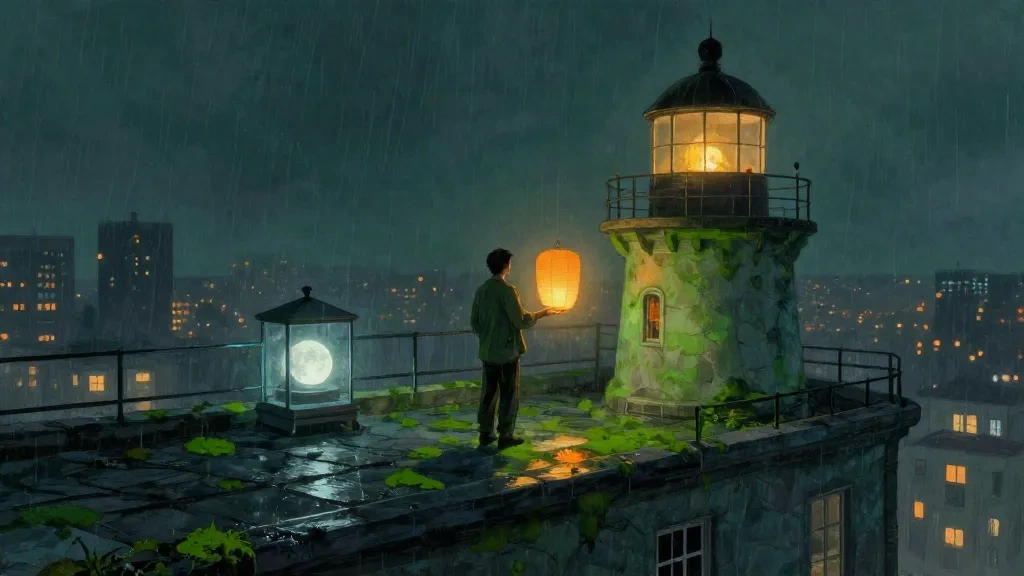
Mara kept the lighthouse on the seventh floor, where the building's brass compass pointed toward tomorrow instead of north. Every morning she catalogued weather from worlds that had not happened yet: ash falling upward in a violet city, rain that burned cold on the roofs of sleeping machines, a monsoon crossing an ocean beneath two moons.
Her room smelled of wet stone and moss. A small moon hung in its glass case beside her desk, though no one remembered where it had come from. It was not the moon of this world. Each night it dimmed at the hour when somebody in the building forgot something important.
Her only visitor came at sunset. Elias worked in the municipal archive, sorting the laws that governed impossible weather. He brought a paper lantern every evening, folded from notices nobody was allowed to read aloud.
Do you know what happens to a person who is forgotten by everyone?
“They remain,” Mara said. “They just stop having witnesses.”
Elias set the lantern on the sill. Its paper glowed the color of marigolds.
The Illegal Rescue
They met in a city where the future arrived before its causes. Children spoke in deadlines. Lovers remembered quarrels that had not happened. Old people sold memories of next spring to pay for medicine.
Elias's name had begun disappearing from the records. The archive still held his file, but the letters of his surname faded whenever Mara looked away. His hands were warmer than they had been that morning. His shadow lagged behind him.
“There is a rule,” he said. “Municipal Continuance Act, subsection nine. Any act requiring intervention in an unwritten event is prohibited as an impossible correction.”
“That rule was written by people afraid of changing their own futures.”
“It is still law.”
Mara opened the weather ledger. Across its pages, she found the same storm approaching every possible version of their city: a white absence sweeping through the building, erasing relationships one by one. Elias was scheduled to vanish at midnight.
Her task was simple. Her desire was not. She wanted to save him.
A Future With His Name
The municipal observatory stood beneath the tram lines, sealed with brass and red tape. Mara carried the small moon inside a velvet pouch. Elias carried the paper lantern, though the wind had not touched him.
They passed the sleeping rooms, the memory market, the garden where tomorrow's flowers bloomed in sealed jars. At the observatory door, a clerk read the rule from a glowing screen.
“You cannot alter an event that has not been witnessed.”
Mara set the moon on the threshold. It cast a pale green circle across the stone.
“Then witness it,” she said.
Elias looked at her. In the reflected light, his face was clear, every feature present and stubborn.
“The storm will take everyone connected to him,” he said.
“No. The storm will take everyone who lets it.”
She opened the weather ledger and wrote their names together. The clerk protested that the act was illegal. Elias unfolded the lantern, revealing a narrow flame inside the paper walls.
“The lantern remembers what the city forbids people to carry,” he said.
Mara understood. They were not changing the future. They were giving it witnesses: a touch, a promise, a choice made in the present before the storm could choose for them.
She took Elias's hand.
The Morning After Midnight
At midnight, the white absence entered the building.
It passed through rooms and erased tomorrow's appointments, unborn children, the names of strangers. When it reached the observatory, it struck the glass case and broke around the small moon.
The lantern flared marigold.
Elias did not vanish. Neither did Mara. In every possible morning afterward, they were inconveniently present.
By spring, the municipal council amended the Continuance Act. Impossible rescues were still illegal, but the amendment allowed one exception: the deliberate preservation of a person who had freely chosen to be remembered.
Mara did not celebrate. She disliked laws that arrived after the damage. Instead, she catalogued the weather of the day they had changed: sunlight, west wind, a thin rain beginning over the roofs.
Elias left a paper lantern on her desk.
“For what future?” she asked.
He looked toward the window, where the city was already forgetting yesterday.
“For the one where we get to choose it again.”





