 Netwrck
Mythic Fiction.
The Forecast of Lost Things
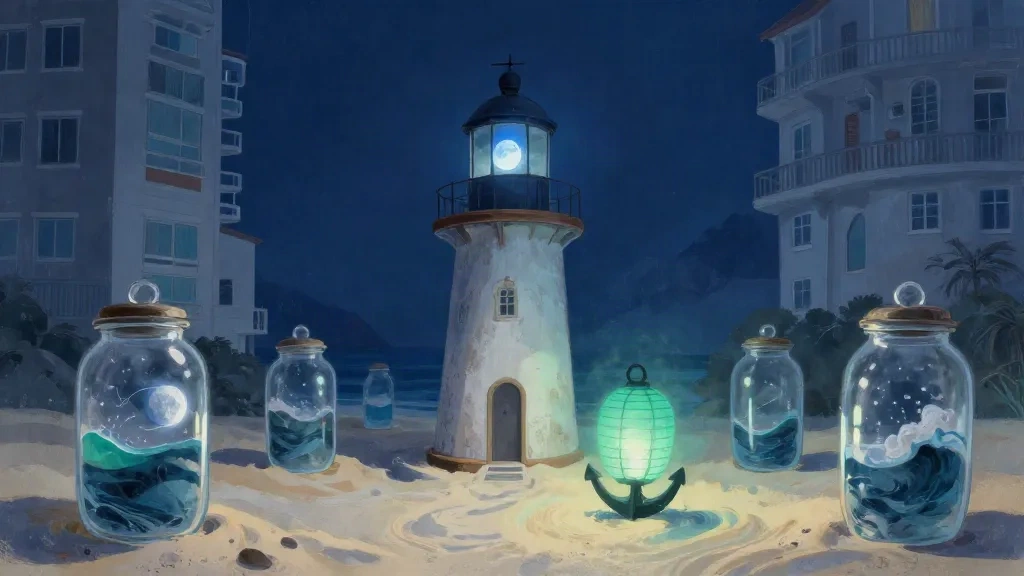
Mara Vale kept the weather ward beneath Number Seven, three floors below a lobby where nobody used clocks. The stair down was narrower than a stair should be, and warmer, and it smelled of salt and hot circuitry, and if you held your breath at the fourth step you could hear the sea that did not exist in any direction.
She unlocked the ward at 11:52 each morning, never earlier, never later. The copper key had worn a notch in the third tooth from handling and she had never had it repaired, because a repaired key would not be the key that had opened the door for eleven years. Inside, the room waited: cabinets of pale wood along the north wall, glass jars in ranks, labels gone soft with salt.
Thunder from a violet desert. Hail that fell upward and had to be caught in jars with the mouths downward. Rain that smelled of cloves and made people confess. A white frost that whispered in Old Harbor vowels and turned every sentence spoken in the ward into something a grandmother would have said. She catalogued each jar three ways: by origin, by probability, by the color of the clouds it had carried. Nine hundred and six jars. Nine hundred and six small apocalypses, kept from spilling into an apartment building where the residents lived almost entirely in anticipation.
That was the peculiar disease of the upper floors, and Mara had a chart for it. They remembered meals before tasting them. They apologized before speaking. They rehearsed goodbyes while still standing in the room with the person being left, hands at their sides, waiting for the correct moment to let go, which never came, so they stood there until the other person went first.
It made them easy to live with and impossible to love. Mara had tried, once. She had tried with a sound engineer from the eleventh floor whose name she could recall and whose face had gone the particular smooth of a thing continually unpracticed.
She wrote the date in the register and did not write the name, because names were the load-bearing part.
The Forecast of Lost Things, Continued
Her brother Cael had come to her nine years ago, wet to the ribs, with a forecast in his coat that read inland drowning, cause: none.
He had not been afraid. That was the part she could never forgive him for, then or since. He had come to the ward to be reassigned, the way a man brings a leaking tap to a plumber, and she had looked at the classification and understood that the sea that would take him was weather from an unwitnessed event, and that uncaused weather cannot be prevented, only misfiled.
So she misfiled it. She stamped it unsettled conditions, administrative review pending and put him out into the rain of a Tuesday, and by Wednesday there was no Cael in any registry in the district. His coat was in her closet. His teeth marks on the hall table were gone. She was the only ledger that still carried him, which is why she wrote his name every night in the ward register, in the small hours, in ink that does not photograph.
She had told no one. The law made telling complicated: to describe an omission accurately is to cause it.
Orin Sable, Eighth Floor
The forecast that broke her week arrived folded like a summons.
Complete weather, clearing by municipal decree.
Not a storm. She turned the page twice, looking for the second line, the way you tap a coin for the false bottom. There was no second line. A whole life had been classified as unsettled conditions, and the classification had come out of her own office, out of her own hand, in her own handwriting, which meant that some clerk two floors up had read a forecast for Orin Sable, decided it had no cause, and let the system take him.
She found him in the eighth-floor corridor beneath a paper lantern that cast sea-glass green across his shoes. He was young in every direction, which she had a term for and did not like: unfinished in the retroactively. His coat pockets held tools for repairs he had not yet lost. Six screwdrivers, a coil of wire, a tensioner. A man carrying the future of every cracked thing he had ever met, and none of it spent.
At his left hand a pale anchor-light floated, bright with futures that might have belonged to him, and it flickered when he moved, which it should not have done, because anchor-light is meant to be steady by the person who carries it.
“You're the ward,” he said.
“I'm the weather ward.”
“You're the one who files.”
She did not answer, which is an answer.
“My mother called me Wednesday,” he said, in the tone of a man reading a diagnosis. “Four times in one morning. Not wrong. Just—unfinished. She keeps starting sentences about me and putting them back.” He laughed. It had no floor under it. “By evening my sister will look at my chair and wonder who spilled tea.”
The Register of Forbidden Hours
The lobby of Number Seven held one clerk, one dead plant, and the bronze plate of Municipal Enactment Sixteen, which read, in the flat language of a law nobody survived to revise:
Any event lacking an approved cause is void and unlawful. A door may not open for no reason. A coin may not land on its edge. Love may not begin without a recognized meeting. Where cause is absent, the fact is removed, and removal is municipal.
Mara had read the annotations on the plate. Most people saw the ban on the impossible. Fewer saw what it was built out of.
Eleven years before the enactment, in a year the newspapers still called the Year of Openings, forty-one thousand doors in this city opened at once onto weather that had no cause: rain that fell upward out of the sewers and drowned people in their kitchens, hail in a heat wave, a warm red snow in the harbor that carried something the health office never named. No cause meant no warning, no forecast, no insurance, no grave. The dead of that year had names, and the law that followed them had teeth, and the teeth had been her business ever since: not the killing but the forgetting, because a city that cannot explain a death eventually stops holding a place for it.
Registrar Pell sat behind a desk no taller than a knee and did not stand when she came in. He was sixty and immaculate and had the stillness of a man who had once been surprised and had trained it out of himself.
“The weather is not a legal person,” he said, before she could sit.
“It is moving toward him.”
“Then arrest the weather.”
“It has a name. His.”
Pell took the forecast and did not read it. He read her, instead, in the way of a man checking a figure he had already memorized. “Sable. Eighth floor. Anchor-light, unregistered. The parent classification is clean, which means it was approved somewhere. Find out where and come back and I will stamp it properly, and he will be reclassified as gradual decay, natural, cause: time, which is dull and legal and will last him perhaps a decade.”
“Ten years is not a sentence I can hand out.”
“No. It is a sentence you can hand out.” He set the paper down. “I have been twenty-two years in this chair. I have signed four hundred omissions. I do not know one of them was wrong. That is not virtue. It is the only posture available to a man in my position.”
She noticed what he had not said, and it sat in her chest like a swallowed jar. Four hundred omissions, and he had a daughter whose name he had not said out loud in twenty-two years, and there was a version of this conversation in which that was a coincidence.
The Cobalt Drawer
She went down the warm narrow stair with the paper lantern light still on her eyes, and she took out the register of the ward, which is not a book of weather but a book of debts, and she turned back nine years to the entry she had written about her own misfiling: cause substituted, claimant informed, forecast retired. Informed. She had informed him. He had asked her, standing in six inches of standing water in her basement, whether his forecast meant he was going to die, and she had said no, and he had believed her, and that belief was the only brick holding the lie up.
Below the jars sat a drawer of cobalt steel, smaller than the others, and it had a label she had written herself: weather borrowed from elsewhere.
There were eleven jars in it. She had told herself for nine years that she would never open one, and the reason was not moral. The reason was arithmetic. Borrowed weather is not created; it is taken. Somewhere there is a world with a monsoon in it, and if you take its monsoon, that world notices, in the way a body notices a pint of blood gone. The debt does not expire. It is only a debt with a schedule you did not write.
She crouched and read the label on the smallest jar. Monsoon, uplifted peaks, green sky. Twelve days remaining before the donor season.
She had catalogued it eleven years ago on a night when she believed she was being careful.
A Storm Under the Stairs
She cracked the seal on the eleventh step, below the fire door, and the ward went to sea.
Rain came through the walls without sound, which is the terrible part of it: you can see the water and you cannot hear it, and the silence makes the whole building feel like it is holding its breath. The floor of the lobby became shallow sea, and it came up the stairs behind her, brown at the edges, smelling of green. Orin came down after her with his lantern held above his head like a boat, and the anchor-light at his hand had gone the color of a struck match, steady, finally, because anchor-light steadies when someone is standing in the weather they were promised.
Behind him his footprints filled first with sand, then with water.
“Mara—”
“Keep walking toward me. Do not look at what you leave.”
She had seen what it left behind before, in jars: a person walking through borrowed weather does not accumulate. Every physical evidence closes over. The sand was the first draft of the evidence. If he had stopped walking in it, he would have become an explanation.
The alarms went at 14:20, and the building's voice said emergency regulation, all persons accounted for, all persons accounted for, twice, with no past tense anywhere in it. The lobby lights went cobalt. The fire doors locked in sequence from the top down with the sound of a sentence being finished. Municipal containment crews were nine minutes out; she knew because the desk in the lobby still had a paper on it, and Pell had a horror of paper.
Pell came down to the second landing and stood above the waterline with the register held over his head.
“Foreign weather is contamination,” he said. “Under Sixteen, subsection nine. You have contaminated a building with a storm that belongs to another world, and every person who touches him in that weather is signing a false cause.”
“Then arrest the weather.”
“Do not use my words at me.” He was breathing hard. “Listen to me carefully, because I am about to do the only kind thing I have left. I have a daughter.”
The rain kept falling without sound, and Orin's lantern threw a circle of green light onto the flood, and in the circle the water was perfectly still.
“Her name is Elian. She was the first one I signed. Nineteen years old, and she came into this lobby with a forecast that said she would stand in the open air and not come back down, and there was no cause for it, and I could not find one, because there was none. I signed her at twenty-six years old because I was told the alternative was forty thousand more doors.” He was shouting now, which he had never done. “If he is remembered in public, on a witness, the precedent comes apart. Every omission I have ever made comes apart. And then someone, somewhere, has to go looking for Elian, and if she is not— if there is nothing there— then I will have done all of it for nothing, twice.”
So he was not a monster. He was a man who had bet everything on the blankness holding.
The Morning They Refused to Lose
“Your future is clear,” Mara called up the stairs, because Orin had stopped in the water and was looking at the surface as if it might be a mirror. “Orin. Look at me. No storm. No loss. Nothing permitted.”
“What?”
“Nothing permitted. Say it back.”
“Nothing permitted.” He said it the way a man says a word in a language he is inventing, and the anchor-light in his hand steadied, and the green on the water shook itself flat.
Mara had one lawful forecast left in the ward register, the last entry that had not been retired or reassigned, and she read it out with the ward voice, the flat clerk voice, the voice that had misfiled her brother: Tomorrow: rain in the morning, clear by noon. Ordinary. Cause: none.
“That cannot happen,” Pell said from the landing. “Nothing extraordinary has caused it.”
“Then we cause it.”
She took Orin's hand and set the paper lantern above his head, and the future-flame inside its paper walls stood up straight, blue at the base, and the whole lobby smelled suddenly of hot paper and rain about an hour off.
“A forecast needs a witness and a cause,” she said. “The ward supplies the forecast. I am supplying the cause. Every person in this building who comes down those stairs and says his name is going to be the cause of a piece of weather, and it will be the truest cause in the history of the ward, and no registrar alive can call it administrative.”
She struck the emergency declaration with the register. The paper tore and the ink did not.
And then the hour that had been removed from Orin Sable opened across the whole building like a floor giving way, and everybody felt it, everybody on every floor at once: a small empty space at the exact hour where he should have been, an appointment no one had made, a chair with tea in it.
They came down. An elderly engineer from the ninth who had been carrying the future pressure of bridges in his forearms since March. A girl from the sixth with tomorrow's lemonade sweating in her hands, unsweetened, untasted. The woman from apartment twelve, already dressed in the correct clothes for a funeral no one remembered scheduling, and who stopped on the second landing and said, “Oh,” in a voice Mara had heard in weather ward jars, and began taking off her shoes.
They stood in the borrowed monsoon in a ring around a young man with a paper lantern and said their names, one after another, out loud, into the rain that made no sound.
What the Rain Collected
At dawn the storm moved through Number Seven as weather. Just weather. It soaked the wallpaper, it put salt into the radiators, it left a fine brown sand on every landing and in the fire door's hinge, and the small moon that had hung outside the clerk's window the whole night went behind cobalt cloud — and every tenant remembered seeing it there, which is the difference between an event and a fact, and is the entire content of Mara's profession.
Pell did not report it. He sat on the flooded landing until the water went down and then he walked up the stairs past everyone without a word, and at the top he left his seal, the little sea-glass stamp, on the doorframe of the ward, which is not a thing you do unless you are resigning, and nobody said so.
Orin went back to the eighth floor with soaked sleeves and all six screwdrivers and the wire, and his sister's teacup was still under his chair where the tea had gone cold two days ago, and she came out and looked at it and then looked at him and said, “You were here,” in the tone of a woman placing a bet that had just paid out. Nobody forgot him again. Not in that building, not in that year.
They left the lobby clocks unwound. That was the first cost, and it was cheap, and everyone loved it.
The second cost came in the sixth week, and it did not come from the city.
On a Tuesday the ward door opened without the key turning, and a rain came in that was brown at the edges and smelled of green, and it did not stop when Mara sealed the drawer, because the seal on a borrowed jar is a receipt, not a lock. Twelve days had never been a limit. It had been a schedule. The donor season had come due, and the storm that came through the ward that morning walked up the stairs in the shape of a woman, and she was wet to the ribs, and she looked exactly like a stranger, and then she looked at Mara and stopped being a stranger.
“You took it,” the woman said, in a voice with green under it. “You took it out of us. Do you know what it was for?”
Mara's hand went to the register, to the page, to the nine years of a name written in ink that does not photograph, and the woman said, “You have been keeping a man in a book. I have been keeping a season in a jar. We are the same kind of thief, keeper.”
And behind her, in the lobby, other people had begun to arrive.
They were not dramatic. That was the part that undid the ending Mara had been writing for herself in the small hours. They came up the narrow warm stair one at a time with folded forecasts in their hands, and they were old, and young, and frightened in the flat administrative way of people who have already been reclassified once. A man in a bellhop's uniform, forty years into an omission, asking whether the desk was still taking appointments. Two women holding hands, neither of whom could remember which of them had been introduced to which. A boy of about nineteen who said his name and then said, “Sorry, that's wrong,” and Mara said it again for him, and he wrote it down.
She had made one man's tomorrow undeniable and the city had learned the trick. The precedent did not stop at the building. It walked.
The inspector from the municipal weather office came on the hundredth day with two clerks and a writ, and found the ward full of people and the cobalt drawer open, and she was very calm, and she said, “You are aware that when the last file closes, the finding is a finding of mass cause-forgery, and the finding is not yours to contest.”
Mara looked at the queue on the warm narrow stair, at the brown water drying on the fourth step, at the register open on the desk to a page that read Rain in the morning, clear by noon. Cause: people choosing to remember.
“Yes,” she said. “Log the hour. I'll answer to it.”
And behind her, from the top of the stairs, somebody knocked on the ward door with the flat, unhurried sound of a man who has no expectation of being answered, and Mara thought: there is a green-tinged word for what I did to him, in a language I have never bothered to learn, and I do not get to use my own name to be forgiven.
We cannot inherit the future, she thought. Only make it impossible to forget.





