 Netwrck
Adventure.
The Keeper of Other Skies
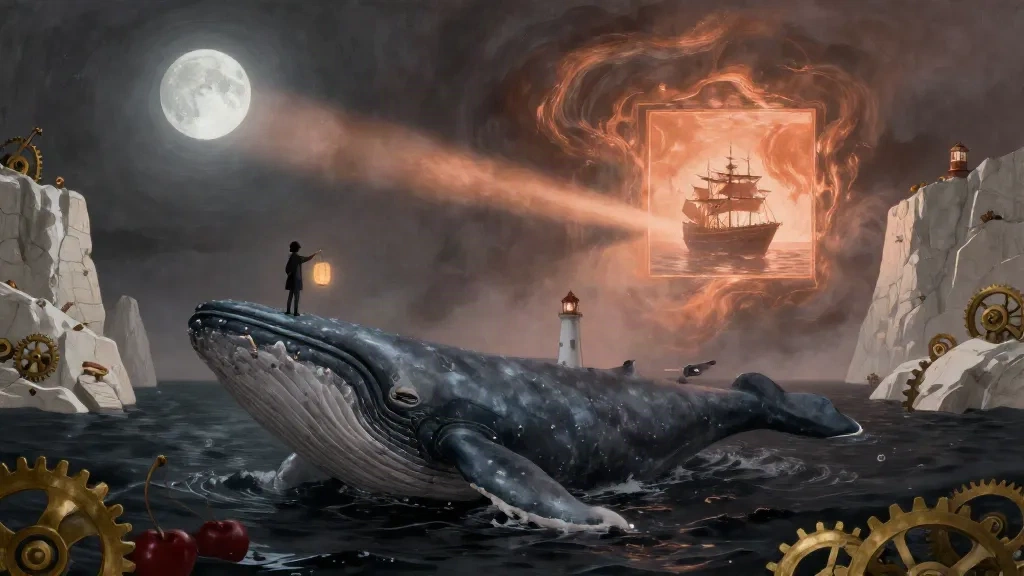
At the edge of the drowned republic, the lighthouse stood on the back of a sleeping mechanical whale. Its brass ribs rose and fell beneath the keeper’s floorboards, each breath carrying the patient click of hidden gears. Above her, the lantern turned a narrow beam across a sea of black cherry waves. The horizon burned copper beneath a sky the color of pale stone.
Keeper Amara Venn recorded weather in a ledger bound with salt-dark leather. She had catalogued rain that fell upward, thunder that spoke in forgotten alphabets, and snow that remembered the names of extinct stars. Every entry began with a question: What does this world believe is happening?
On the morning the small moon appeared, the whale opened one brass eye.
The moon hung above the lighthouse, no larger than a clenched hand. It should not have been there. Amara checked the horizon charts, the whale’s deep hum, and the municipal sky register.
Then a voice crackled through the speaking horn.
“By order of the Coastal Weather Office, all impossible phenomena are prohibited until classification.”
Amara frowned. The small moon cast no shadow. It moved only when someone looked away.
That evening, a woman arrived by launch. She wore a soaked red coat and carried a paper lantern with one corner blackened. When she stepped onto the whale, the lantern’s flame leaned toward her.
“My name is Ilyra,” she said. “I was on the ferry from Bellweather. The storm took everyone else.”
Amara looked past her. The sea was empty.
“I remember the crossing,” Ilyra continued. “I remember my brother steering us through the black water. But when the lighthouse found us, he was gone.”
Amara opened the ledger. Ilyra’s name had been written there already, though the ink was wet.
Beneath it, another sentence appeared: SHE WAS ALREADY FORGOTTEN.
A Law Against Weather
Amara brought Ilyra below, where the whale’s ribs surrounded a copper engine room. The municipal inspector arrived before midnight, carrying a black case stamped with silver.
“Impossible things are technically illegal,” he said. “A moon that is not celestial. A person who is not on the passenger list. A storm with no recognized cause. You must classify the weather or dissolve it.”
“What happens if I refuse?”
“The whale forgets how to surface.”
The inspector set down a paper lantern identical to Ilyra’s.
“This is a municipal lantern. It records approved events. Place it beside the unregistered one, and the city will know which version occurred.”
Amara understood then. The small moon was not bringing the storm. It was holding one place open against the city’s corrections.
She took the two lanterns into the lamp room. Ilyra held the blackened one. Amara held the municipal one.
When their flames met, the air tore open.
A rainstorm poured through the ceiling without wetting the floor. Inside it stood a ship, bright and impossible, trapped in a square of weather. A man at the helm waved toward them.
Ilyra screamed. “My brother.”
The inspector shouted that they were manufacturing a prohibited event. The whale shuddered. Somewhere beneath them, a million brass teeth slipped out of alignment.
Amara seized the speaking horn. “Weather Office, this is Keeper Venn. I am cataloguing a storm as personal memory.”
“That category does not exist.”
“Then create it.”
The Small Moon Holds
The horn answered with static. The municipal lantern began to turn white. Ilyra’s paper lantern bent inward, its flame shrinking to a blue point.
Amara pulled the little moon from the sky.
She could not touch it. But she could catalogue it. She wrote its color as pale stone, its weight as the memory of a hand, and its location as wherever one person still waits.
The moon dropped into the lantern between them.
Light erupted across the lamp room. The trapped ship broke apart into warm rain, and the man at the helm stepped through the square. His boots touched the whale’s deck. Ilyra reached him before Amara could warn her not to.
Then the municipal lantern cracked.
Black ink spilled from it and covered the ledger. The inspector’s voice vanished. The official rules tore themselves apart, page by page, as the storm rewrote the weather.
By dawn, the whale floated above a copper sea. The small moon had become a pale stone set in the lighthouse lantern. Ilyra’s brother slept below, feverish but whole.
Amara recorded the event under a new heading: LOVE, UNREGISTERED.
At the bottom of the page she added the date, the wind, and one final note: The city may declare this impossible. It may not make it unremembered.





