 Netwrck
Adventure.
The Market of Unowned Weather
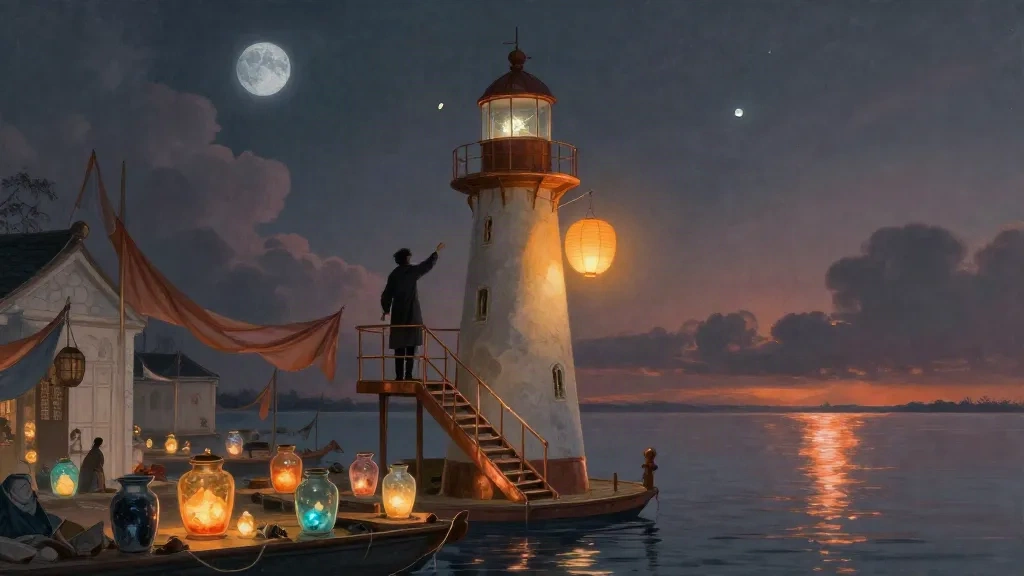
Every morning, Orren climbed the copper staircase to his lighthouse and wrote down the weather from other worlds. He recorded silver rain falling upward, violet gusts that whispered in forgotten languages, and thunder warm as bread. Above the floating market, the sky shifted between black cherry clouds and a pale stone moon no larger than a coin.
Below him drifted the market of memories that had lost their owners. Merchants sold them in glass jars, folded handkerchiefs, and bundles tied with copper thread. A childhood swing played without a child nearby. A wedding song trembled in an empty coat. Each memory had a price, but none had a name.
Orren kept his lantern beside the observatory door. It was made of pale stone, its panels covered in tiny black-cherry stains. The paper lantern was his only light below deck, though its flame cast no shadow. He preferred it to the electric lamps. Shadows made the market look less honest.
The Illegal Storm
The trouble arrived on the fourth morning as a woman stepping through the rain.
She wore a red scarf and held a ticket stamped with a date that had not happened yet. Orren recognized the shape of her face from a memory jar near the north pier: a boy laughing in a train station, carrying a small moon made of folded paper.
“Mara Vale,” she said. “I need to remember my brother.”
Orren looked through his catalog. Mara Vale appeared nowhere. Neither did her brother. The market clerk, a severe woman with a brass seal pinned to her coat, frowned.
“That is not a name,” the clerk said. “That is a conclusion.”
She handed Orren a notice. The Municipal Code of Unlikely Events, Article Nine: All impossible things are illegal until proven ordinary.
Orren read the line twice. The paper was warm beneath his fingers.
“You cannot restore a memory,” the clerk continued. “You cannot alter the weather. You cannot give an unowned thing its former owner. These actions are forbidden. They are also impossible.”
“Then why arrest someone for them?”
“Because the city must be ready when the impossible becomes ordinary.”
Across the market, the paper moon rose above the stalls. Every face turned toward it. For one breath, the crowd remembered Mara all at once. They remembered her as a daughter, a thief, a singer, a daughter, a stranger. Their borrowed memories collided, and her features began to blur.
A Forecast of One Person
Orren climbed the lighthouse and pulled down every weather chart. He arranged the scraps across the floor: Mara's red scarf, the ticket's impossible date, a report of rain that fell inside sealed rooms. The paper lantern trembled between them.
He discovered a pattern. The city was forgetting Mara by telling too many stories at once. Collective memory had become a storm, and no single witness could anchor it.
Orren opened the municipal archive beneath the lighthouse. The oldest book was bound in black cherry leather. Its pages recorded every exception granted by the city council. He found no law permitting impossible acts, but he did find a loophole: a fact becomes ordinary when witnessed consistently by one authorized keeper.
The authorization required a name. Mara's name was the thing the storm had taken.
So Orren began to remember her himself. He remembered the exact pressure of her fingers around the ticket. The cut on her thumb. The way she had said brother as if the word were a rope thrown across deep water.
Each memory steadied the lantern. The market below went silent. Even the clerk lowered her brass seal.
The Smallest Possible Rescue
At midnight, Orren carried the lantern into the storm. The paper moon had swollen until it filled the copper horizon. He found Mara at the edge of the market, where memories drifted into a cloudless void.
Her brother was there only as a tune between two flashes of lightning. Not a ghost. Not a reward. A sound the city had nearly forgotten how to hear.
Orren held out the lantern. “Mara Vale,” he said, giving her name to the dark. “This is your testimony. One witness. One consistent account.”
The Municipal seal struck the deck behind them. The clerk had followed.
“You are making an unauthorized exception,” she called.
“Yes.”
“Then you are guilty.”
“Then write it down.”
Mara listened. The tune returned, faint but clear. She stepped through the lantern's pale-stone light, and the storm broke without rain. The black-cherry clouds parted. Copper sunlight spread across the market.
At dawn, the clerk wrote a single new line into the code: One person may be saved from a collective forgetting when their name is witnessed, held, and returned.
Orren climbed back to the lighthouse. He entered the first weather report in his book: pale stone moon, black-cherry sky, copper wind, one person remembered.





