 Netwrck
Mythic Fiction.
The Keeper of Borrowed Storms
In the apartment building for people who can only remember the future, the elevator had no buttons. It stopped at whichever floor the tenant needed, though no tenant ever admitted to needing one.
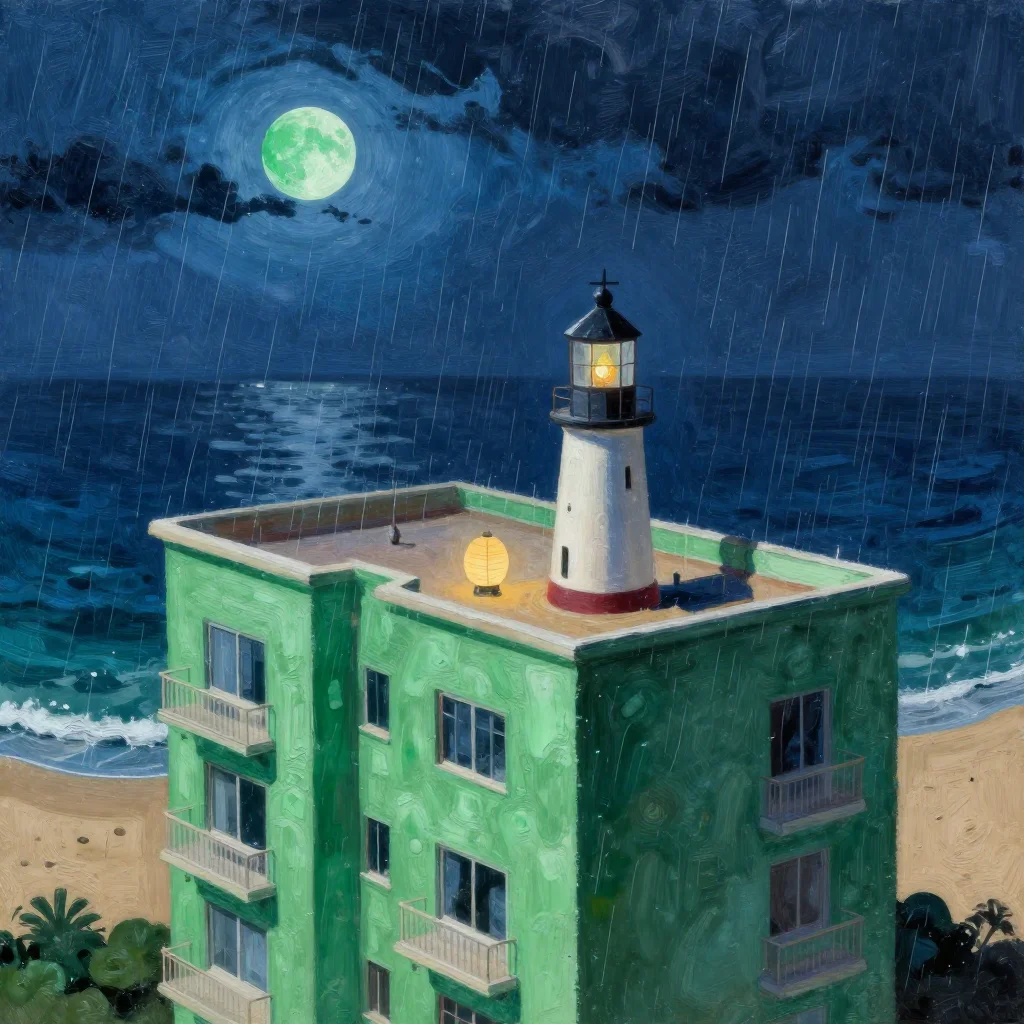
On the seventh floor, Mara Venn kept a lighthouse beneath her kitchen table. The tower was made of blue salt and tin, and its little lamp shone whenever the weather changed.
Mara catalogued the weather from other worlds: rain that fell upward, thunder that arrived as a flock of white birds, snow carrying the scent of scorched stone. She recorded each storm on blue paper, along with the date it would arrive and the name of the person who would remember it.
Her own building had begun to forget. Every morning, the halls were shorter. The windows looked onto streets that no longer existed. Names vanished from the mailboxes, then from the lips of the people who had lived behind them.
Only Mara's little moon remained fixed above the roofline, a small moon no larger than a peach, shining sea-glass green through the cobalt shadow.
The Law Against Impossible Things
On the eleventh morning, a notice appeared under her door. It was printed in sand-colored ink and sealed with a paper lantern.
By order of the Municipal Continuity Office, all impossible phenomena are hereby illegal. This includes remembered weather, unbuilt rooms, unborn reunions, and any private forecast not licensed by the Office.
Mara read it twice. The paper lantern at the bottom had been folded from a child's drawing: a circle, a yellow window, and a crooked line for the sea.
She folded it into her coat and carried the notice downstairs. The clerk in the lobby wore a brass crown filled with tiny barometers. He frowned when she asked who had issued the order.
“The city,” he said. “The city that remains.”
“There are no buildings in this city without possible futures,” Mara replied.
“Precisely.” He stamped the notice twice. “An impossibility may be individually necessary and collectively prohibited.”
Outside, the sea-glass sky trembled. A rain began somewhere above the roof, but Mara could hear it inside the walls. Each drop carried a memory from a different world.
The Woman in the West Window
One of those memories belonged to Ilyan Reed, a woman in apartment 6C. Ilyan had been the building's last resident who remembered backward. Every morning, she remembered the previous night, and every night, she remembered the morning after it.
For three weeks, Mara had heard Ilyan's voice through the walls. She described a storm coming in from a blue sea, a lighthouse sinking beneath a silver tide, and a small moon caught in the rigging.
Then the building forgot Ilyan.
Her door appeared on the ninth floor, then the fourth, then nowhere. The other tenants began to forget the woman who had lived among them. A child asked why the west window was always covered.
Mara climbed to the roof carrying her catalog, her paper lantern, and the little moon's green light. She placed the lantern beside the skylight.
“I need a forecast for Ilyan Reed,” she told the weather.
Thunder answered from below. The municipal rule cracked across the rooftop like a sheet of ice.
Every impossible thing was now visibly illegal. The lantern flame dimmed, the catalog pages turned blank, and Mara's lighthouse lamp went dark.
She understood the trap. The city could not erase a person directly. It only required everyone else to become unable to recognize the proof that the person had existed.
A Future Worth Breaking For
Mara opened the catalog to the final page and wrote a forecast she had never seen: rain in the shape of footsteps, arriving tonight from the west.
The first page vanished. So did the second. The law erased every impossible detail, leaving only the bare fact of her handwriting.
Mara tore the page into a strip and tied it around the paper lantern. Then she carried the lantern down the stairs, past the shrinking halls, to the lobby where the clerk had begun dismantling his crown.
“I am filing a prediction,” she said. “One person will remember Ilyan Reed.”
“That is not an impossible thing,” he said. “That is a municipal convenience.”
“It is a person.”
He looked away. Outside, the first raindrop struck the pavement in the shape of a bare foot.
Mara opened the lobby door. The paper lantern flared, sea-glass green and sand-gold, and her small moon rose over the roof despite the cobalt shadow swallowing the stars.
In the west window, Ilyan's face appeared between the rain. Not a memory. Not a forecast. A woman still waiting to be remembered.
Mara stepped into the weather. Behind her, the clerk began to write her name on a blue form, and in every room of the building, one voice answered the next.





