 Netwrck
Surrealism.
The forbidden weather
At the Monastery of Clockmakers, the clocks had no hands. They were kept in oak rooms beneath a roof stained burnt orange, each one tuned to a different hour and each forbidden to display it. The country had abolished reliable time after a year of premature mornings, and the monks repaired the old measures in secret.
On the western wall, Keeper Ilma Venn wrote weather reports from other worlds. She recorded the green rain of a planet where oceans climbed stairs, the blue storms that gathered inside glass fruit, and the dry winds that carried voices backward. The reports were posted beneath a paper lantern, though nobody came to read them.
Ilma wanted to save one person: Seran Vale, the last apprentice who had vanished from every official memory. The municipal rule was simple. Impossible things were technically illegal. A tower could not hear a star. A bell could not summon rain. A person could not be remembered by someone who had never met them.
Seran's missing hour
The proof had arrived in a sealed cylinder from the observatory. Inside was a strip of blue storm-light, a copper gear, and Seran's name written in soot. The name faded whenever Ilma looked away.
She carried the cylinder to the monastery's counting hall, where monks bent over dismantled mechanisms. Their master, Brother Oren, listened to the metal tick without touching it.
“He is not missing,” Oren said. “He is being forgotten by the weather.”
“Can you restore him?”
“Not without an impossible witness.”
Ilma remembered the old ceremonies. At the seventh bell, a keeper carried a paper lantern to the shore and named one thing the country had lost. The law forbade the naming of impossible things, but it did not forbid true ones.
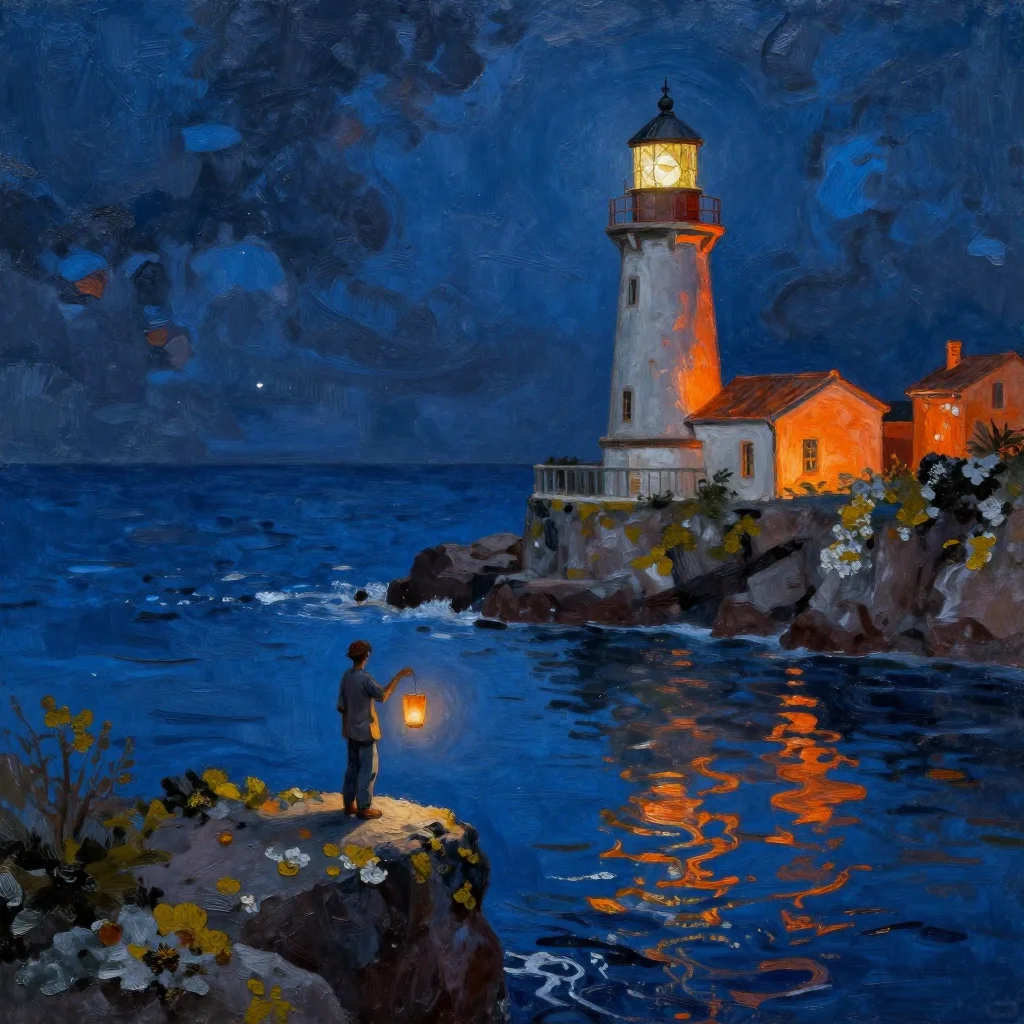
Before dusk, she left the monastery with the cylinder in her coat and the lantern in her hand. Its small flame burned without consuming the paper, casting a circle of blue storm-light over the lichen.
The municipal sea
The road down to the lighthouse had become a jurisdiction. At every boundary, officers in gray coats measured her footsteps and declared them unaccounted for. One confiscated the lantern. Another stamped the cylinder and said, “This object has no legal origin.”
Ilma kept walking. When they demanded the names of the things she carried, she answered with their impossible weather.
“Rain that remembers the ocean.”
“A bell that has no bell tower.”
“One person.”
The officers hesitated. The law had no category for a person who existed only when named.
Beyond the final boundary, the sea was neither wet nor dark. It lay across the cliffs like a sheet of storm-light, moving in slow blue folds. The lighthouse stood at its edge, its lamp pointing inward.
Inside, Seran sat at the base of the stairs. His face was clear to Ilma but not to the instruments. He was counting on his fingers, trying to remember the number of steps he had climbed.
“I have been here,” he said, “but no one has been here with me.”
Ilma held up the paper lantern. The flame bent toward the stairs, revealing a small moon lodged in the ceiling, pale as a coin. It had been invisible from outside.
A name against the tide
She opened the cylinder. The gear turned by itself, slow and patient. Blue storm-light spilled over the steps, and the hidden moon brightened.
“Seran Vale,” Ilma said.
The sea clenched. The lighthouse shook. Above them, impossible thunder rolled across a sky without weather.
“You are illegal,” an officer called from the doorway.
“So is the person you are trying to erase,” Ilma answered.
She named him again. She named the monk who had carried the cylinder, the keeper before her, the woman who had built the paper lantern from a map soaked in lichen ink. Each name restored a little light to the lighthouse. Seran's face stopped slipping.
At last the small moon fell from the ceiling and broke against the floor, releasing a warm rain of amber sparks. Seran stood. His shadow touched every wall at once.
By morning, the municipal officers had gone. The rule remained, written on every public door: no impossible thing shall be made true. But the lighthouse had acquired a new window, and through it Ilma could see storms moving across worlds.
Whenever the country forgot someone, the paper lantern would glow in the tower. Seran would climb the stairs, and Ilma would open the ledger of other weather.
Somewhere beyond the blue horizon, a bell rang at an hour no clock could name.





