 Netwrck
Magical Realism.
The Lantern Without a Flame
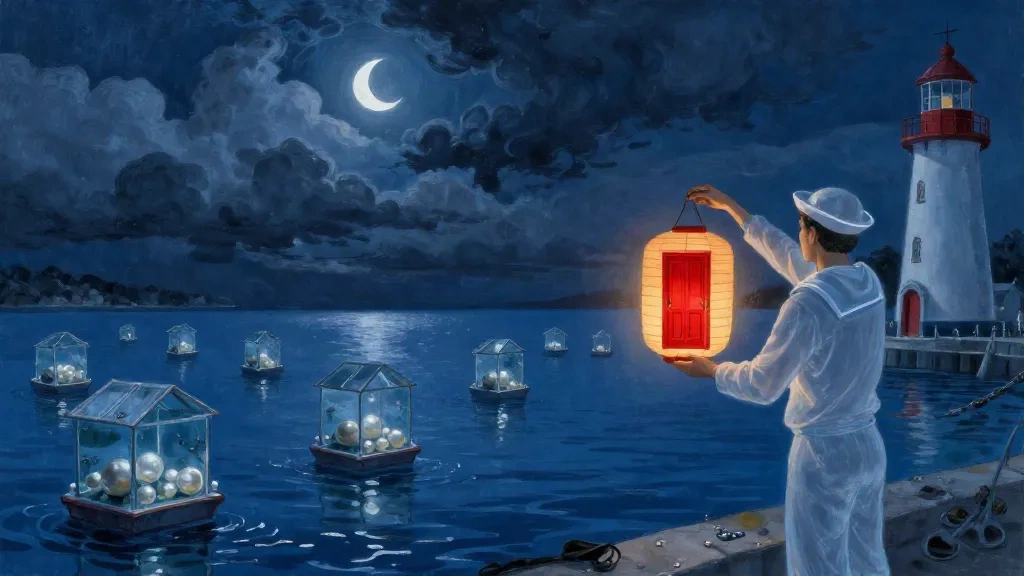
On the night the moon shrank, the market appeared beneath the lighthouse, where the sea had been black and empty for eleven years.
Its stalls floated on chains of pearl and blue glass. Memory drifted between them in labeled jars, folded parasols, and small paper lanterns, each holding a vanished afternoon, a farewell, the sound of someone laughing in another room. The keepers called them lost articles, though the buyers never asked what they had been.
Severin Ardent kept the lighthouse and catalogued weather from elsewhere. His ledgers recorded rain that fell upward, thunder that arrived without clouds, and snow in the shape of silver fish. He had learned to measure every impossibility according to the Harbor Office: pressure, duration, direction, and whether the sky had consented.
That evening, beneath a stall marked SEASONS WITNESSED, he found a paper lantern with no flame inside. A red door was painted on its paper panels, bright as a cut in the night.
Inside the lantern lay a single memory: Elian Voss, leaning against the lighthouse rail, watching weather arrive from a world where the horizon was a closed eye.
Severin knew the face. Elian had been the last sailor to speak to him before leaving on a boat that never touched water. Now the memory had lost its owner. At dawn, the market would sell it, and Elian would become a name no one could attach to a living voice.
The Law Against Impossible Things
Severin crossed the market toward the Office of Unusual Events, dragging the lantern behind him by its silver handle. The municipal rule was painted above its doors:
No impossible thing shall occur, be preserved, or be transported without written permission.
The Office had existed since the market opened. Its walls were made of stamped forms, every blank space filled with the words UNAUTHORIZED, UNAUTHORIZED, UNAUTHORIZED.
A clerk named Pella wore seven pairs of spectacles and frowned at the lantern.
“A memory without an owner,” she said. “Technically illegal.”
“It is already occurring.”
“That is the problem.” She tapped the rule with one fingernail. “Impossibility is prohibited, yet you brought evidence.”
Severin set the lantern on her desk. “I need permission to save one person.”
Pella examined the red door painted on the paper. “Saving is not a weather category.”
“Then classify it as a storm.”
“A storm requires a forecast.”
Severin opened his catalog. The page for Elian was blank except for one line, entered years ago in blue ink: weather capable of returning the lost to themselves.
Pella stamped the form. The ink said FORBIDDEN.
Severin took the lantern and walked out.
A Forecast of Red Doors
All night he worked beneath the lighthouse, feeding fragments of memory into the lantern. He added the taste of salt on Elian’s lips. The weight of a rope leaving his hand. The exact pause before he had said, I will come back.
Each fragment was a crime against the rule. Each made the lantern warmer.
Near dawn, a clear wind rose from the market. It had no origin. It moved through the stalls, rattling jars and setting every paper lantern swinging. The little moon appeared above the harbor, reduced to a bright seed, and cast a narrow blue shadow across the water.
In that shadow stood Elian, translucent and shivering.
“You are late,” he said.
Severin lifted the lantern. “The law says you cannot be recovered.”
“The law also says a red door cannot open inside a lantern.”
Severin looked at the painted door. He had assumed it was part of the memory. Now its brass hinges were moving.
The door opened onto the lighthouse stairwell. Warm air rushed out carrying lamp oil, rain, and the scent of old timber. Elian took one step toward it.
The municipal rule appeared in the sky, enormous and black: NO IMPOSSIBLE THING SHALL RETURN.
The door began to close.
The Name in the Weather
Severin did not pull Elian inside. Instead, he opened his catalog and read the forecast aloud.
“Wind from the west. Pressure rising. Visibility: one person.”
Elian laughed, and the laugh sounded across the market. Jars turned on their hooks. The pearl chains brightened. In every stall, a buyer paused with a forgotten name in their hand.
Severin stepped through the red door.
He found himself on the lighthouse gallery beneath a sky full of borrowed storms. Elian stood beside him, solid at last, though his hands remained transparent.
“Will it hold?” Severin asked.
“No,” Elian said. “A person is not a place.”
Then he said Severin’s name.
It was small, ordinary, and enough. The lighthouse bell answered from below. Across the water, the floating market rang every bell at once. People looked up from their jars and remembered not what they had lost, but whom they had lost it with.
By sunrise, the red door had vanished from the lantern. The little moon climbed into the pearl sky. Severin entered one final line in his catalog:
Elian Voss: returning, weather permitting.
Below them, the first ferry horn sounded.





