 Netwrck
Weird Fiction.
The Botanical Garden Above the World
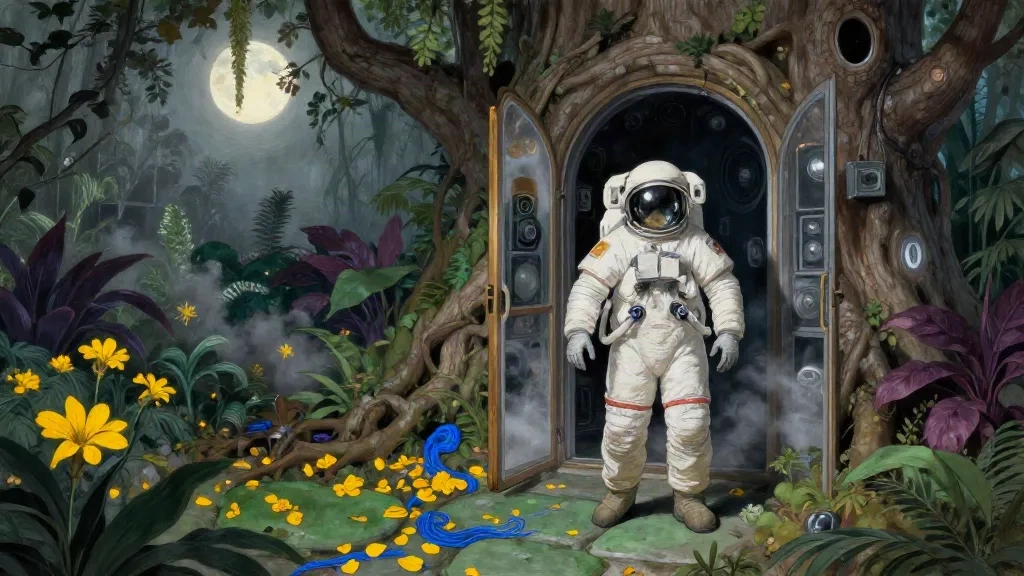
Mara Venn had not left orbit for nineteen years. She kept the observation deck cold, the kettle empty, and the old launch suit hanging behind her bedroom door. Below, through the blue smear of atmosphere, the botanical garden had grown around the Door Tree, a colossal maple whose bark opened into doorways whenever the moon was thin. The gardens supplied the orbital cities with medicine, fruit, seeds, and arguments about what counted as weather.
Earth was a rumour by then. The transmissions arrived damaged, and the histories disagreed on coastlines, cities, even the number of moons. Mara refused to certify them. If she returned, someone would make her stand beneath a familiar sky and call it proof. Here, among the irrigation towers and white greenhouse roofs, she could remain uncontradicted.
In her left pocket she carried a green stone from the garden’s oldest bed. In her right, a blue thread, pulled from the cuff of her first pressure suit. The stone had been warm when the doctors declared her grounded. The thread had been blue when she arrived home and had never taken the colour of anything else.
521
The storm came from inside the garden. It arrived as a pressure change beneath the maple’s roots, then as rain falling upward from the soil into the branches. The doors began rearranging themselves. A greenhouse door opened onto a salt mine. A service door opened onto the landing bay where Mara had once waited for rescue. A narrow orange door appeared in the trunk at eye level.
People went inside. Gardeners vanished carrying seed trays. A botanist called through one opening, then appeared inside another, shouting that the rooms were changing faster than the corridors. Mara watched the blue thread lift from her hand and drift towards the orange door. The green stone grew hot against her palm.
She knew the storm was not a natural phenomenon. The Door Tree had been planted with a navigation seed from the first lunar expedition, a seed designed to return lost objects to their proper places. The number on the orange door was 521, and beneath it someone had written a date two centuries before Mara’s birth.
The Voice in the Wall
Inside the orange door was a hallway lined with listening devices. Every speaker hummed at the frequency of forgotten conversations: declarations made by leaders, the last words of climbers, the background noise of nations. Mara had been told her own voice was among them. During re-entry, the radio had caught her saying, “I know you are there,” while the control tower had been empty.
She wanted that sentence back. Not the public transmission, which history had edited into courage, but the private breath before it, the voice history used as background noise. She followed the thread along the floor. It passed beneath doors marked with dates, names, and languages she no longer spoke. The green stone pulsed whenever a voice moved nearby.
At the end of the hall, a woman sat behind a glass panel, holding a reel of blue thread. She did not look up. “You are late,” the woman said through the wall. Her voice was Mara’s, stripped of its warning. “Or you are early. The storm has not decided which.”
What the Doors Kept
The storm struck the hallway. Doors slammed open, then folded into one another. Smoke-grey air poured through the gaps, carrying saffron petals and the smell of burnt metal. Mara grabbed the thread, but the woman’s voice slipped away behind a wall.
She opened the nearest door. It led to the orbital garden. The maples shook under a saffron sky, and every door in every tree showed the same black interior. Mara could return to her observation deck, seal herself inside, and keep Earth as a rumour.
Instead she opened the next door. Behind it was the launch bay, unchanged. Her suit waited where she had left it. The control tower stood silent, but its console displayed a single waveform, steady as a pulse. Mara understood then that history had not stolen her voice. It had scattered it among all the moments when a message passed through a room and no one believed the listener mattered.
She crossed the bay, entered the storm, and let the blue thread lead her through the moving doors. The green stone cracked in her palm when the final doorway opened. Beyond it, the woman’s face appeared in a dark window, speaking the sentence Mara had discarded before re-entry: “I know you are there.”
Mara answered from the floor of the garden, where petals struck the glass like rain. “Now you know.”
One More Door
The storm passed without rearranging anything. The Door Tree stood quiet, its bark sealed over except for one low opening. Mara entered before she could reconsider.
Inside was a white room with a microphone suspended from the ceiling. It played the sounds of Earth: engines, insects, engines, insects, a child counting stars. The green stone had become a smooth green button in her hand. She placed it on the console and held the blue thread beneath the microphone.
When she spoke, her voice returned not as an echo but as an answer, arriving from several directions at once. The garden recorded her. The orbit carried her. The empty world below received whatever it could.
At dawn, Mara opened the last door and found the control tower waiting. She stepped through, leaving the blue thread tied to the microphone, and kept the green stone in her palm. The voices followed her home, quiet but no longer background noise.





