 Netwrck
Romance.
The Keeper of Other Skies
On the seventh night of the wet season, Mara Venn climbed the lighthouse ladder and opened its brass roof to the weather.
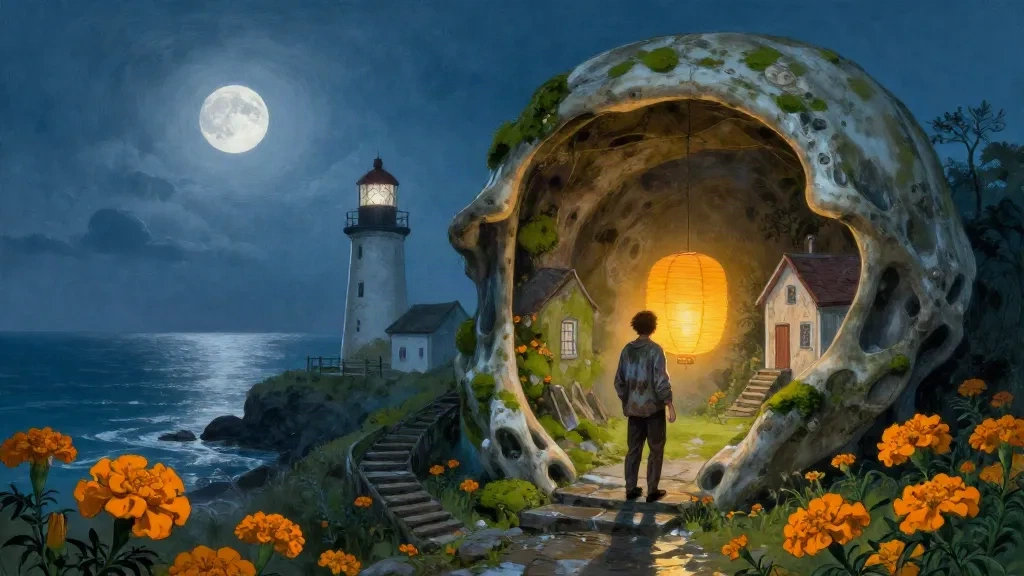
The village of Ribfall occupied the hollow between two ancient bones, its houses built along the giant’s sleeping ribs like barnacles on a shipwreck. Above them, the small moon hung low enough to touch from the lighthouse balcony. Mara kept it there in her catalogue, along with rains that fell upward and winds that carried the scent of cinnamon.
Each dawn, the municipal clerk stamped her record. Atmospheric phenomena, locally possible, she wrote in the green ledger. No exceptions without Council approval.
Mara had learned not to ask what happened to exceptions. They were removed from the village record, then from conversation, then from the faces of those who had witnessed them.
That morning, the clerk brought her a new order. The village would forget every storm, stranger, and impossible thing recorded since the previous moonrise. All weather not witnessed by two approved witnesses was to be erased.
“Including the man on the western stair?” Mara asked.
The clerk’s face became polite. “There is no man on the western stair.”
The Name in the Rain
There was a man there when Mara climbed to the western stair after dusk. He stood beneath a paper lantern, its yellow light trembling in the rain. His coat was dark with seawater. He held a small moon in one cupped palm, though the real moon was already above the lighthouse.
“You are in my catalogue,” Mara said.
“Then you know I came from somewhere the weather is honest.”
“Your name?”
He smiled. “I had one. The rain took it.”
His name was Ilyan. He had arrived three years earlier from a drowned city where every storm had a name and every name was carried by a lantern. He remembered Mara because he had once watched her catalogue a wind made of blue leaves. The village had forgotten him since dawn, but he had left her one small moon to keep the memory from closing.
“The clerk says the forgetting is a regulation,” he said. “A municipal rule makes every impossible thing technically illegal.”
“That sounds like fear wearing a seal.”
“Your council has a seal for everything.”
His hand, when he touched her cheek, was warm despite the rain. Mara had spent years recording skies that could not hurt anyone. This was the first warmth she did not know how to classify.
A Law Against Lightning
At midnight, Mara opened the western gate. The village square was empty, though every window shone with remembered weather. On the notice board, a fresh decree read: All unapproved phenomena are forbidden within the municipal boundary.
“If I bring you into the village, it will be illegal,” she said.
“If I leave, the forgetting takes me.”
“Then we make an official exception.”
“They will not grant one.”
“I did not ask them.”
She took Ilyan’s hand. The small moon in his palm brightened, and the rain reversed, rising from the stones in a silver sheet. Mara opened her catalogue and wrote beneath the clerk’s last stamp:
Witnesses: Mara Venn and the man she loves.
Phenomenon: a love that remains when the village chooses to forget.
Lightning cracked across the ribs of the sleeping giant. The decree ignited. A single marigold flame appeared in the paper lantern between them, vivid as a fallen petal against wet stone and moss green.
Council bells rang. Clerks shouted. A line of blue salt formed across the square, separating the legal village from the impossible night.
Ilyan stepped toward it.
Mara caught his hand. “If we cross, the forgetting cannot distinguish us from the storm.”
“Then let it try.”
The Light Kept
They crossed together.
The salt hissed. The small moon rose above the lighthouse, no longer a stolen wonder but a second evening sun. Every weather Mara had ever catalogued returned at once: rain over the roofs, cinnamon wind through the market, snow melting on moss, the hush before a storm.
The council’s decree turned to ash. Ilyan’s face appeared in the village bells, then on the clerk’s ledger, then in the memories of the children sleeping beneath the giant’s ribs.
By dawn, he had a name again.
Mara wrote it in the green ledger. Below it she added the first entry of a new kind:
Weather observed: one person, preserved by another. Classification: miracle.
The municipal seal cracked. Then the paper lantern fell from the council house and burned without heat. Its marigold light spread over the wet stone until every window looked like a star.
At the top of the lighthouse, Mara stood with Ilyan beneath the small moon.
“Will they forget again?” he asked.
“No,” she said, taking his hand. “Now every storm has two witnesses.”





