 Netwrck
Surrealism.
The market above the drowned road
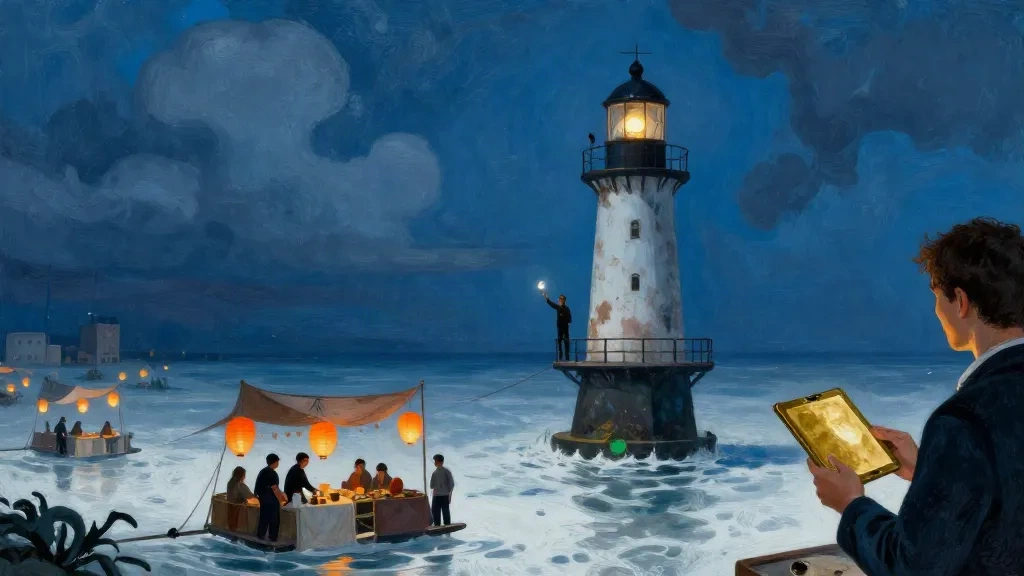
The market floated where the old coast road had been, held above a white sea by chains and patient balloons. Stalls leaned together beneath a sky the color of blue struck metal. Vendors sold weather in stoppered bottles: rain from a planet with two moons, hail that remembered falling upward, the dry red breath of deserts that had never existed.
At the market's center stood a lighthouse, though no shore remained beneath it. Its keeper was Elian Vey, a narrow man with salt in his cuffs and a blue storm-light permanently caught in his spectacles. He catalogued each weather sample in a blue ledger, naming its pressure, shame, and probable destination.
Every stall displayed a paper lantern, though the paper had been made from memories that had lost their owners. The lanterns leaned toward the lighthouse whenever the wind changed. Elian pretended not to notice.
He was waiting for one particular memory to appear: the last memory of Iven Sarr, a courier who had vanished from the market three nights before. Iven had stolen a small moon from the municipal observatory and hidden it in his coat. The theft had been reported by someone who could not remember having seen him.
Every impossible thing is prohibited
Before dawn, the market received its daily notice. It was printed on blue paper and delivered by a bell-shaped bird.
By order of the Municipal Council of Unlikely Conditions: any object, person, event, or recollection that cannot be proved possible is hereby illegal. Possession of such a thing is punishable by forgetting the possessor.
The rule had existed for years, but lately the clerks had grown inventive. A blue sunset was illegal because sunsets were not permitted on Tuesdays. A door that opened into yesterday was illegal because yesterday was no longer an accepted location. The most dangerous objects were those that had belonged to someone and could still evoke them.
Elian read the notice twice, then walked to the northern stall. The merchant there was selling tears in blue bottles. Beside the bottles sat a paper lantern, swollen and warm.
“Iven's memory,” the merchant said.
Elian touched the lantern. A flash of rain filled the stall: Iven running across the drowned road, the stolen moon tucked beneath his shirt, calling a name Elian had forgotten. The memory ended before the name.
Elian bought the lantern. The merchant refused payment.
“It is already yours,” he said. “You are the one forgetting.”
The small moon testifies
Elian returned to the lighthouse and climbed to the lamp room. Below him, the market prepared for inspection. Municipal inspectors moved through the stalls with measuring rods, checking for impossible objects. They had begun at the western pier and would reach the lighthouse by nightfall.
He opened the ledger and copied Iven's memory into its own page. The ink behaved strangely. It formed a sentence, then crossed it out, then formed another.
IVEN SARR IS NOT PROOFABLE.
“That is not true,” Elian said.
He set the paper lantern beneath the lens and placed the small moon beside it. The moon was only the size of a peach, cold enough to numb his fingertips. It had been stolen from a sky that did not obey astronomy, and the inspectors would certainly recognize it.
Elian spoke into the lantern. “I remember you running.”
The storm-light strengthened. Across the market, every paper lantern turned toward the lighthouse.
“I remember the weight of you in the rain. I remember your hand striking my shoulder. I remember that you were afraid of the council, but more afraid of something else.”
The moon brightened. Inside it, a tiny silhouette moved.
A rule cannot forget its witness
At midnight, the inspectors reached the lighthouse. Their leader held a brass tablet and a stamp shaped like an erased face.
“This weather is impossible,” he said, pointing at the moon. “It is also unregistered. By municipal law, both the object and the person connected to it must be forgotten.”
Elian stood between them and the lantern. “Then forget me.”
The inspector stamped the tablet. The name ELIAN VEY disappeared from its pages.
He felt himself become lighter, less sharply bounded. The name Iven Sarr slipped from his mouth. He could no longer remember why the moon mattered.
Then the paper lantern split.
Light poured out in a warm orange thread, and with it came the sound of rain on the drowned road. The silhouette in the moon became a man: Iven, transparent at the edges, carrying a lantern of his own.
“You remembered me,” Iven said.
“I did.”
“That is impossible.”
“No,” Elian said. “It is witnessed.”
The inspectors lowered their brass tablet. The blue storm-light broke into lichen green, then burnt orange. Iven stepped out of the moon and onto the lighthouse floor. His feet made no sound, but the market remembered them anyway.
By sunrise, the council had sealed the rule inside the lantern, where it glowed faintly whenever someone spoke a true name into the dark. Elian never recovered his old name. He did not need it. Every evening he lit the lantern, and Iven came down from the little moon to tell him which weather had returned.
Some nights, the market forgot everything except the sea. On those nights, the lighthouse kept two names burning in its glass.





