 Netwrck
Speculative fiction.
The First Upward Drop
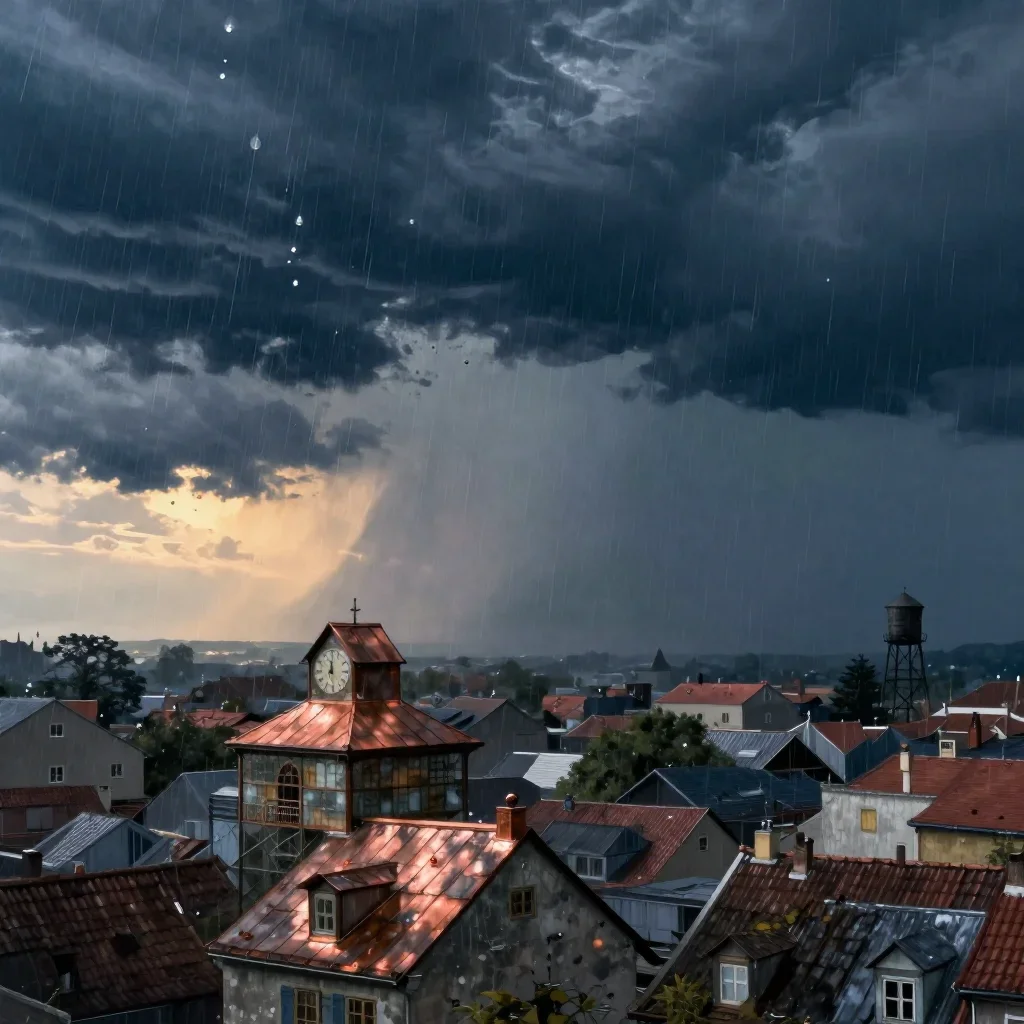
At 6:17 on a wet Tuesday, the rain stopped falling and began rising.
Mara saw it happen from the kitchen window, where she was burning barley water for her father’s cough. The drops struck the porch roof, hesitated, then lifted into the gray morning. They trembled above the street like silver minnows trapped under glass, each one carrying a blurred reflection of something that was not there.
Across the road, Mrs. Vale left her house holding a tin basin. She tilted it over the pavement. Water arched upward into the rain and vanished into the low clouds.
“Don’t let it touch the roof,” she shouted. “It’s remembering.”
Mara carried the basin to the front step. The upward rain darkened the water, then filled it with images: a red bridge over a flooded city; a child in a white coat waving from a train; a field of yellow grain beneath two moons; a narrow street where every window blazed with blue fire.
Her father came outside in slippers and a wool coat.
“Don’t look too long,” he said.
“What is it remembering?”
He watched the drops turn over one another. “Places the weather has traveled through.”
The Reservoir of Lost Things
By noon, the town had formed a committee. The school gym became a shelter. The high school’s science room became a weather station. Mara, who repaired clocks for a living, discovered that the phenomenon obeyed no instrument except memory. A copper wire rang when someone remembered a dog. The temperature dropped whenever the council debated the future.
Her father claimed the rain had been collecting above Bellwether for years. “The sky is crowded,” he said. “It keeps what the ground refuses.”
That afternoon, the mayor announced that the upward rain could restore the reservoir. Bellwether’s water supply had failed in the century’s hottest summer. If the rain returned, the farms would survive. If it did not, the town would leave before winter.
Mara wanted to believe there was a simple exchange: a little rain for a little relief. But in the basin, the reflected places kept changing. She saw her own house as a child, its porch painted blue. She saw her mother leaving with a suitcase. She saw neither event clearly, only the feeling of an interrupted departure.
Mrs. Vale confessed that she had seen her daughter in one of the drops. The girl had been missing for thirty years. Everyone else had accepted that she had drowned in the river. Mrs. Vale kept an empty blue cup on the mantle and washed it every morning.
“Can I bring her down?” she asked.
No one answered.
What the Sky Gave Back
The rain began falling normally after sunset. The first drop landed in Mara’s palm, cold and ordinary. Then came thousands, drumming on the roofs and filling the gutters. Mrs. Vale stood in the street with her arms lifted, but the restored water brought no daughter. The only gift was the river rising, brown and powerful, and the reservoir spilling over its stone lip.
Mara’s father watched the clouds break apart.
“You wanted to see what was lost,” he said.
“I wanted to find out whether it could be returned.”
“That is not the same question.”
Before dawn, Mara climbed the water tower. The town was quiet below. In the reservoir, the reflected sky flickered. She saw places no map contained: cities under glass, forests singing in extinct languages, a coastline where whales wore houses on their backs.
The rain had not been falling upward. It had been carrying the world’s forgotten places away. The town had survived because it had been small enough to be ignored, and old enough to hold more than it knew.
Mara reached into the water. The surface closed around her hand. A single image rose: her mother’s hand on the porch rail, turning toward a car. No face. No destination. Only the gesture, repeated every year whenever Mara looked at the blue paint.
She understood then that memory was not a key. It was an anchor.
When she withdrew her hand, the sky went clear.
The rain did not fall upward again. Instead, every puddle in Bellwether reflected a different season. Children stepped around patches of autumn snow. Fishermen watched their nets fill with leaves. The old woman at the bakery found flour where stones had been.
Mara descended from the tower. Mrs. Vale was waiting below, holding the blue cup.
“I saw her,” the old woman said.
“Was it her?”
“No. It was where she could have been.”
Mara nodded. Grief had become a country without borders, and love was the only map capable of crossing it.
At the center of town, the water tower bell rang by itself. The sound passed through every wall. Somewhere above the fields, beyond the repaired reservoir and the bright, ordinary morning, the sky kept moving all its hidden places toward the horizon.





