 Netwrck
Mystery.
On the night Mara Venn began losing herself, the sky above the village was perfectly clear.
The Clear Night
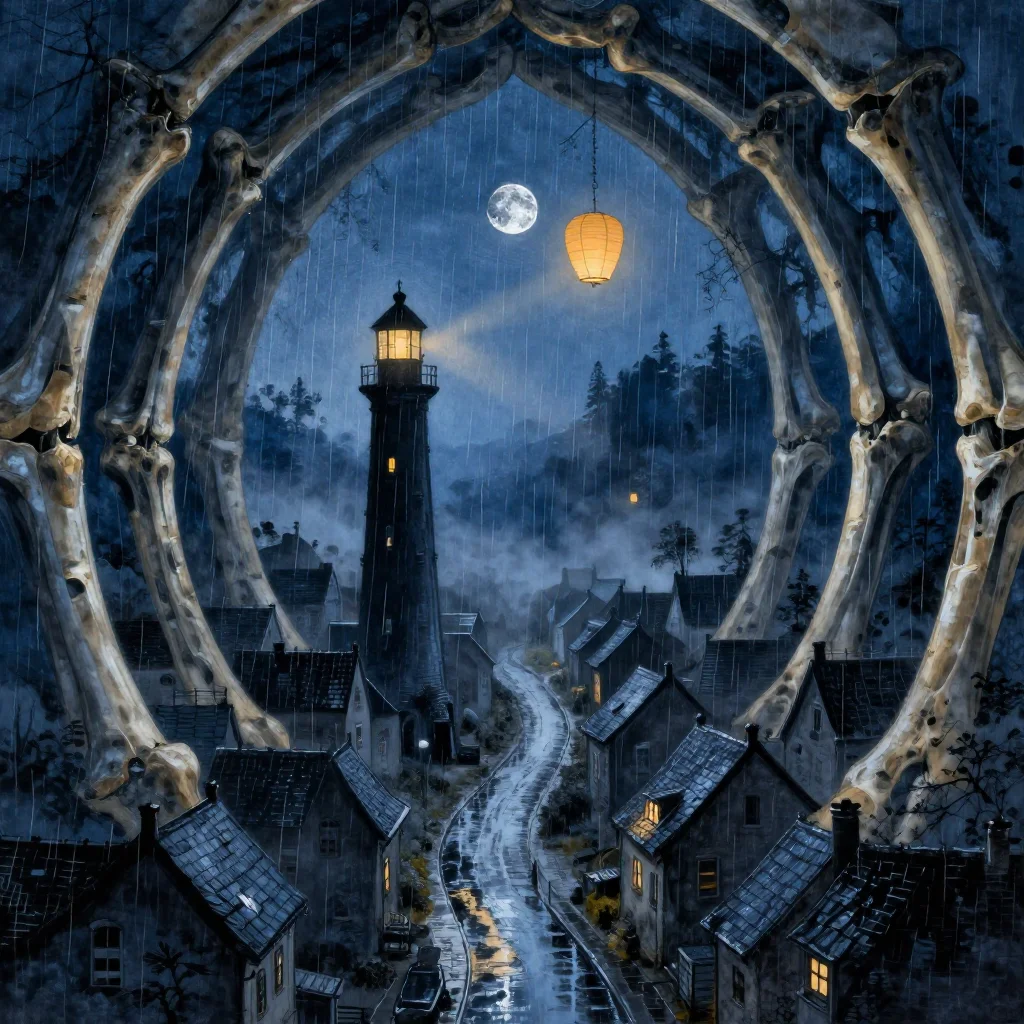
The village of Ribmarch had no horizon, only a ceiling of bone arcing high above its narrow streets. At its center stood the lighthouse, a black spindle wedged between two ancient ribs. Mara kept the lamp burning and recorded the weather in a blue ledger.
Her entries did not concern Ribmarch. She catalogued weather from other worlds: red rain in the kingdom of Orison, thunder that arrived before lightning, snow falling upward from a silver sea. Each morning, the keeper delivered her observations to the municipal weather office.
That evening, the office had been empty. Its amber window shone across the wet cobbles, but no one answered Mara’s knock. On the step lay a folded notice:
By order of the Ribmarch Continuity Committee, all impossible phenomena, including remembered skies, false stars, unauthorized weather, and persons not presently witnessed, are henceforth illegal.
Mara folded the notice and returned to the lighthouse. The small moon had risen above the eastern rib, a coin of pale silver. Beside it hung the paper lantern she had carried since childhood.
The Woman in the Ledger
At dawn, Mara found a new entry in her ledger.
Missing person: Elian Rook. Last witnessed beneath the amber window. Condition: collectively forgotten.
Elian had been the lamplighter who brought Mara tea during storms. She remembered the exact tilt of his cup, the scar through his left eyebrow, the song he used to whistle while climbing the ribs. Yet when she spoke his name, the faces around her went blank.
At the tavern, the baker shook his head. “No Elian Rook here.”
At the market, Elian’s wife stared at Mara as though she had asked for a currency no longer minted. His tools were gone. The house had been bricked over. Even the paper lantern in Mara’s hand seemed dimmer when she carried it toward the old waterline.
She found Elian there, crouched beneath a rib, his body surrounded by water that flowed uphill. He could see her, but every time she looked away, his face became smooth.
The Law of Unseeing
The Continuity Committee met beneath the lighthouse, where six old women and three solemn clerks sat around a brass compass.
“You have violated the ordinance,” said the eldest clerk, “by remembering an impossible person.”
“He is possible,” Mara said. “You are simply not looking.”
The compass spun. One clerk presented a law book whose pages had been cut into paper strips and re-bound without titles. Every prohibition ended with the same sentence: No exception may be entered without a witness who is also impossible.
Mara set the lantern on the floor. Its small flame revealed writing on the wall behind the compass: What cannot be seen may be saved, provided it is named by two witnesses.
“The village would forget us,” said one clerk.
“It has already forgotten him.”
“That is the price of order.”
Mara looked at the amber window across the square. One warm light trembled in the rain. Elian’s wife had once said that grief was a fire requiring two hands to keep it alive.
Mara took the lantern and walked into the rain.
The Second Witness
At the waterline, she placed the lantern beside Elian. The uphill water broke around its paper walls but could not extinguish the flame. Mara called his name, then described him to the small moon: the copper ring on his hand, the missing tooth, the way he tapped twice before entering a room.
The moon brightened. Across the village, windows went dark.
One by one, people stepped into the street. They remembered different pieces of Elian. A child remembered his laugh. The baker remembered the soup he made after storms. His wife remembered the promise beneath the amber window. Mara held the lantern high and named him until the whole village spoke with him.
The brass compass cracked. The mayor tried to arrest Mara, but the clerk holding the law book discovered that the ordinance had erased itself from every page.
By sunrise, Elian stood in the square, shivering but whole. The small moon set behind the giant’s ribs, and the paper lantern became ordinary paper again.
That night Mara recorded the weather: clear, with one returning person.
In the amber window, a second cup appeared beside Elian’s. Nobody could remember who had put it there. Mara did not need to know. Some promises survive because, even when the law denies them, two people keep looking.





