 Netwrck
Magical Realism.
The Keeper of Other Weather
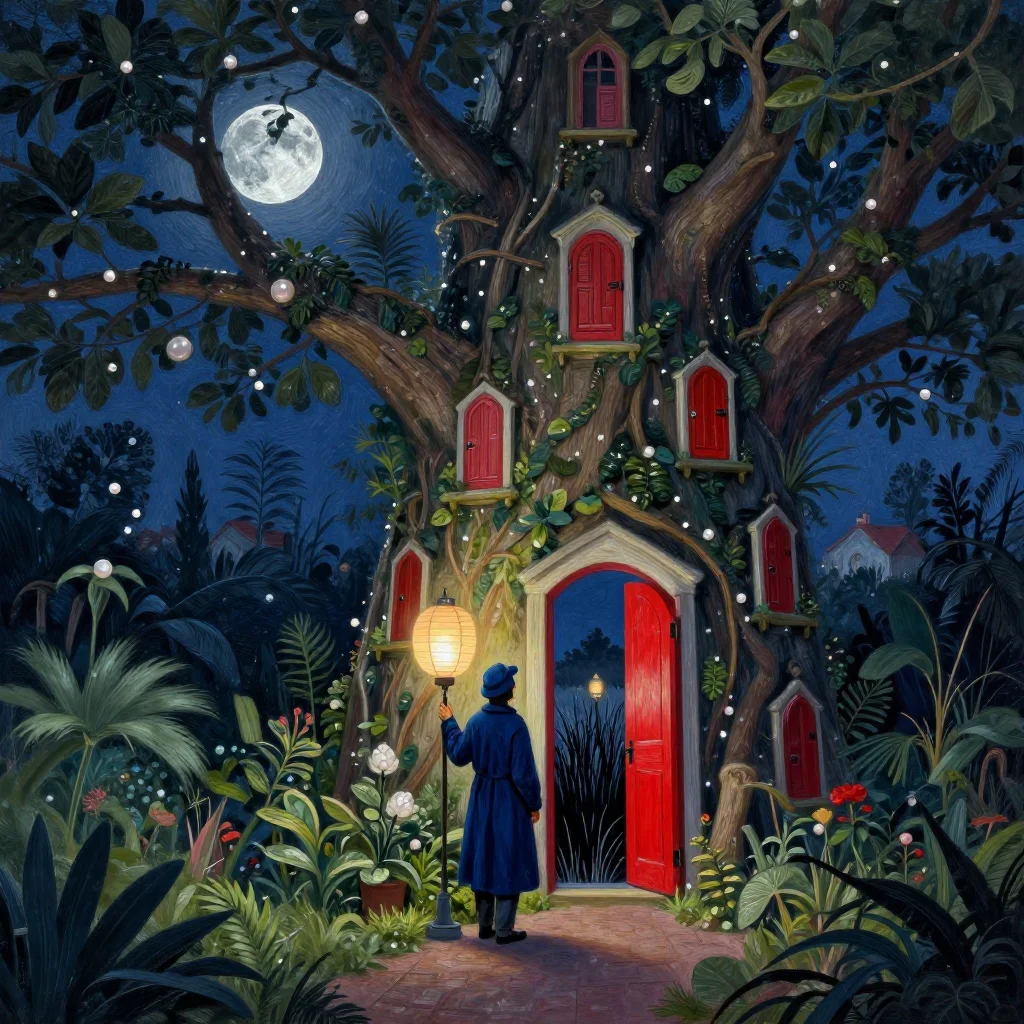
Mara Venn kept the lighthouse inside the botanical garden, though no sea could be seen through its pearl-glass windows. The tower rose among ferns and glasshouses, its lamp burning a soft blue over paths that curved toward the old municipal tree. At the trunk's base, hundreds of doors had grown in every direction, each one breathing a different climate into the leaves.
Her work was to catalogue them. She recorded the dry heat behind Door Three, the silver sleet behind Door Twelve, the monsoon that struck without warning behind Door Twenty-Eight. Each world kept its own sky. Mara wrote its pressure, wind, and temperament in a ledger bound in midnight blue.
On the morning the moon appeared in the garden, it was small enough to hold in one hand. It hovered above the paper lantern Mara carried through the paths, giving off a light like a pearl held underwater. She had seen the moon before, always at the hour when the city forgot something.
That morning, the moon stopped above Door Nine.
The Law Against Impossible Things
Door Nine opened onto a garden with no walls. A narrow path crossed a field of black grass toward a small house, and above it hung a sky crowded with unfamiliar stars. A woman stood at the threshold, waving with increasing urgency.
“Tell them I am here,” she called. “Tell them I have not vanished.”
Mara stepped through. The woman was named Anja, and she had once been the keeper of a lighthouse on a coast made of warm stone. In Mara's world, nobody remembered her. Every morning, more details disappeared: her mother's face, the color of her coat, the sound of her laughter. The city had not killed Anja. It had simply agreed, collectively, that she had never existed.
Mara returned with the woman and went directly to the Bureau of Municipal Reality. The clerk presented her with a regulation sealed in red wax.
“The existence of a person without a registered origin is prohibited,” he said. “So is the appearance of celestial bodies below the municipal horizon. So is weather originating outside an approved atmosphere. So is any door that opens upon a place not listed in the city register.”
He tapped the regulation with one finger.
“Everything impossible is illegal if it has not been properly documented.”
Mara set down her ledger. “And forgetting?”
The clerk smiled without opening his mouth. “Forgetting is not an event. It is an administrative state.”
A Red Door Among the Leaves
To bring Anja back, Mara would have to make the impossible visible. She began at the botanical garden, opening every door and recording the worlds beyond them. Door Three exhaled dust. Door Twelve released snow. Door Twenty-Eight shook the windows with warm rain. With each entry, the clerk sent inspectors to seal the doors.
By sunset, the garden had become a courthouse. Officials nailed red notices over the glasshouses, warning that unauthorized climates could not be admitted. The small moon lowered itself behind the roofline, and the paper lantern's flame turned from pearl to silver.
Anja began to fade at the edges.
Mara opened her ledger and wrote the first true sentence: Anja existed.
The tree answered with a groan. Deep in its trunk, a door split open, painted the same red as the notices. Beyond it stood the Bureau's archive, where forgotten lives were stored as empty shelves. A red door had been sealed there for ninety years, waiting for someone to admit that memory was not the same as fact.
Mara crossed the threshold with Anja beside her. The clerk followed, carrying his regulation. Behind him came the inspectors, the gardeners, the lighthouse keepers, and all the people who had agreed to look away.
The Weather of a Witness
At dawn, the red door opened onto the garden. Behind it was a sky with no stars, only a small moon hanging low over the trees. A paper lantern floated beside it, bright as a remembered promise.
The clerk read the regulation aloud. Then Mara read Anja's entry, followed by every weather record she had gathered from the doors. Finally, Anja spoke.
“I was here,” she said. “You all stood beside me.”
The city listened. Not with applause, but with silence. One by one, people remembered. A child remembered Anja's red scarf. An old ferryman remembered her argument with the sea. The garden doors opened, and their impossible airs passed over the crowd.
Later, the bureau rewrote the law. Impossible things remained illegal until someone could name them honestly.
Mara returned to her lighthouse and entered one final observation. The pressure was high. The wind was warm. The horizon contained a house, a black field, and a woman who waved without fading.
Then she wrote in the margin: No weather is impossible once someone remembers where it came from.





