 Netwrck
Adventure.
The Copper Horizon
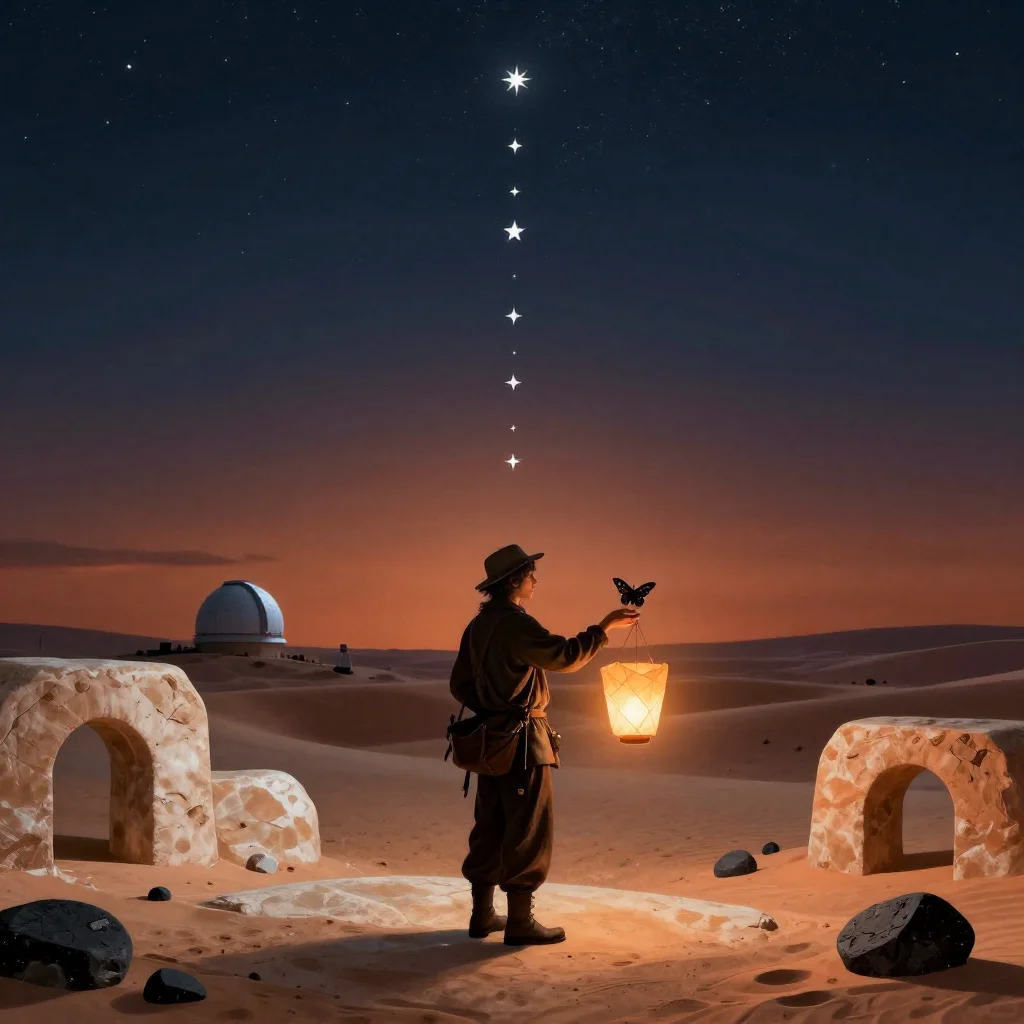
Mira repaired the observatory’s clocks beneath a copper horizon, where the sun set into a red seam and the stones kept shining after dark. Her clocks did not measure hours. They counted the slow turning of seasons, from the first green whisper after drought to the hard blue pause before rain.
Each one was a small machine of brass, black cherry wood, and pale stone. Each had a hand shaped like a thorn, and a bell that rang only when the season changed. People came from distant camps with broken seasons: a winter that would not end, a summer that had forgotten how to ripen fruit, a morning trapped beneath the same cloud for eleven years.
Mira listened to their complaints, opened the backs, and listened again.
That night, while dust silvered the observatory walls, she found a moth wing beneath the great telescope.
It was no ordinary wing. Its scales were the color of black cherries, and across them ran pale veins like cracks in old ivory. A paper lantern stood beside it, folded flat, with a single match inside. Mira recognized both objects immediately.
She had made the wing thirty years earlier, for an astronomer named Ilyan. He had asked for a clock that could preserve one dying night. The wing was part of its delicate escapement, cut from a silver moth that had entered the observatory through a telescope lens.
Someone had stolen it. Someone had carried the lantern here.
Mira wrapped the wing in cloth and carried it into the listening room.
The Choir Below the Floor
The room was beneath the observatory, cut into the rock. Seven brass horns hung from the ceiling, each one shaped like a folded wing. When Mira entered, they began to sing.
The voices were memories.
One was Ilyan’s, young and impatient, insisting that the star called Verdant Eye had sent a message: bring the wing to the southern salt.
Another was his older voice, bitter and quiet, saying the message was a trap.
A third belonged to a girl named Sera, who had climbed the observatory as a child and hidden inside the paper lantern during a storm. She remembered the wing differently. She said Ilyan had made it from her own lost shadow after she vanished into the western sky.
Then the voices argued.
The wing wanted to go north, toward the drowned observatory where stars touched the sea. The lantern insisted on being carried east. The oldest memory, Ilyan’s, burned with a dry heat that smelled of iron and lavender.
“He is waiting,” the young voice said.
“He is dead,” the old one replied.
“He is singing,” Sera whispered.
Mira tightened her grip on the cloth. She had promised Ilyan that she would return what he made to the person who made it. For years, she had believed that person was him. Now the confession had changed.
The true maker had been Sera.
In the memory-choir’s confusion, Mira heard the truth: Ilyan had asked Sera to design the wing, then stolen her name from the finished work. The stars had preserved the theft, not the message.
Mira stepped back.
“I cannot carry your memory,” she said. “I can carry the wing.”
The Road of Wrong Directions
Outside, the stars had descended low enough to touch the desert. They lay across the sky in bright black-cherry bands, and between them moved messages written in copper light.
Mira left the observatory with the lantern hooked to her belt and the wing bound beneath her coat. The choir followed as a pressure behind her teeth.
At the first dune, the wing pulled north. She planted her heel into the sand and waited.
At the dry riverbed, the lantern flared open. Its paper walls filled with a warm, pale glow, and the lantern whispered that the maker was beneath the eastern stones.
Mira turned east.
By midnight she reached a field of black stones. Between them stood a ruined arch, its surface covered in pale scratches. The stars above it had gone silent.
Sera waited there.
She looked no older than the memory claimed, but her eyes held the same silver as the wing. In one hand she held a broken seasonal clock. Its thorn-shaped hand pointed backward.
“You took your time,” she said.
Mira could not speak.
Sera looked at the wing and smiled without joy. “I made it to save a person I loved. Ilyan changed the purpose. He wanted a message from the stars, and the message wanted a life in return.”
“What person?”
“The star that sent the first warning.”
Mira understood then. The observatory had not been built to study messages. It had been built to hide them. Each voice in the choir was a message given a human memory, each memory altered by fear and desire. The lost wing was a key: it could restore the original sender without changing the words.
Sera extended her hand.
“Give it to me,” she said. “I will finish what I started.”
Mira looked at the wing. Returning it meant losing Ilyan’s last message forever. Keeping it would make her a thief of someone else’s creation.
She placed it in Sera’s palm.
The Season That Opens
The scales brightened. A soft wind crossed the stones, carrying the scent of rain from a place where no rain had fallen for years.
The choir fell silent.
High above the desert, one star detached itself from the copper horizon. It fell slowly, then divided into thousands of points. They entered the ruined arch, the paper lantern, and every clock in the observatory.
Seasons turned across the land. Frost left the northern fields. Seeds opened in the dry riverbed. The observatory’s broken clocks began to strike, each bell ringing at the right hour for the first time in years.
Sera watched the wing grow transparent. “He remembered me as the maker,” she said. “That is enough.”
Mira took the lantern from her belt. Its paper was warm, and inside its folds a tiny flame burned without consuming anything.
She did not know who had sent the messages, or why the stars had chosen a desert watchmaker to carry the answer. She knew only that some things returned changed, and that returning them remained necessary.
Behind her, the observatory opened its eastern door. The night entered freely, carrying dust, stars, and the first pale breath of spring.
Mira walked home beneath the copper horizon.
Every season, she told herself, has a door. The lock is never the difficulty.





