 Netwrck
Hopeful Science Fiction.
The Note Before Morning
At the Vesper Crest winter resort, shadows arrived three days before the guests.
They slid beneath the gondola pylons at dawn, crossed the wet asphalt of the arrival road, and gathered beneath the pharmacy sign, whose green glow made them look like spilled enamel. By breakfast, every lampshade had acquired a small, patient darkness.
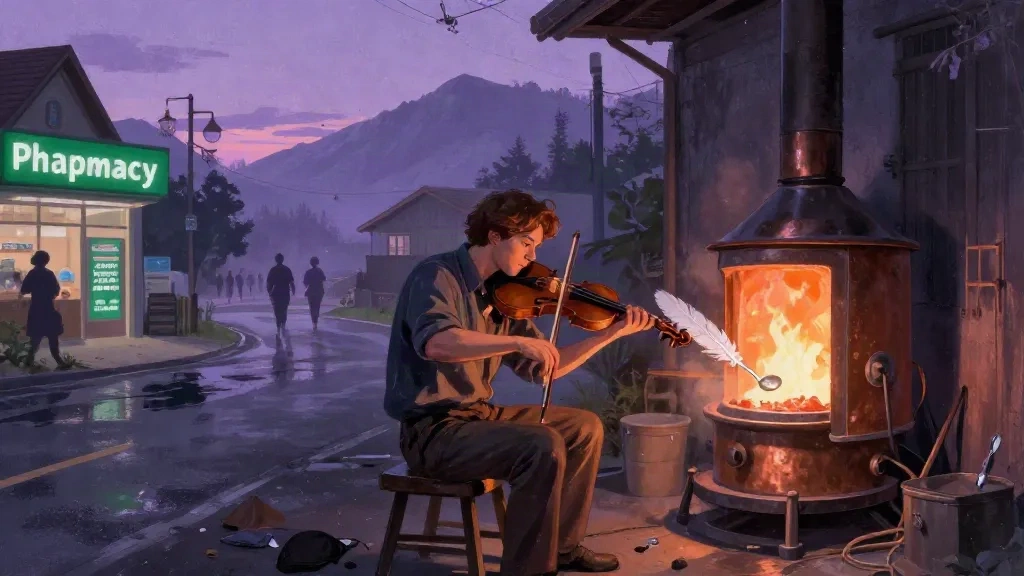
Ivo Vale repaired violins in the old cinema because the heating pipes shook there when the mountain weather shifted. On the first morning, while tuning a warped E string, I heard a note that did not belong to the instrument.
It rose from somewhere behind my left ear: clear, high, and warm as a match struck underwater.
The resort manager, Mara Saye, was standing in the doorway. Snow had entered her coat and silvered one eyebrow. “I came to tell you the season will close in September,” she said.
Another note. Longer, almost triumphant.
“I came to tell you it won’t,” she corrected.
By noon I knew the note belonged to truth. The cook received one when she admitted her soup was yesterday’s. A lift operator got three when he confessed he had never liked the mountain. But the mayor of Vesper Crest received only silence when he promised that the winter was a civic inconvenience and would be resolved shortly.
That winter lasted a generation. People aged beneath its lavender sky. Frost flowered across glass, then melted into black rivers beneath the streets. The resort’s guests stopped arriving.
So did the shadows. But they had already learned where people would walk.
A Machine for the Last Voice
I wanted to build something that could survive the storyteller.
Not a machine that forced the truth, which seemed ugly and impossible, but one that could hear the truth after every witness was gone. I called it a Recall Furnace. It would warm the valley not with wood, nor fuel, nor memory, but with the changing pitch of honest speech.
The engineer Priya Rann agreed to help. We built the furnace inside the ruined cinema, where the old projector booms made good resonating chambers. Mara collected a white feather from beneath the projectionist’s window and a silver spoon from the absent hotel’s breakfast service. I did not know why. She placed both on the furnace’s copper plate.
“Proof that softness can be carried,” she said, producing another note.
“That you can be fed without being emptied,” I answered.
The white feather lifted. The spoon shivered. Truth poured into the pipes, and snow began retreating from the cinema doors.
It was not enough. Truth supplied the fire, but people did not speak often enough when the cold made them lonely. Each winter lasted longer. Eventually only children remained who had never known a summer.
The Generation That Kept Cold
On their eighteenth birthday, the last children gathered beneath the pharmacy sign. The letters of VESPER CREST hung dark above them. A crowd had travelled from the lower valley to hear Mara retell the story of the year the sun vanished.
Her tale was beautiful. In it, the winter began because a astronomer hid one bright star inside her pocket. It ended when a generous child carried the star across the mountain.
Everyone praised her.
The furnace gave only a dry click.
Then Lio, the first child she had ever taught to ski, opened his hand. A white feather rested in his palm, impossibly clean among the grey ashes. He said, “I know what happened. But my telling will sound small beside hers.”
The note from his voice entered the furnace.
Small notes followed. The hotel cook admitted she had hoarded a jar of coffee beans. Priya confessed that our first prototype had failed. A rescue driver said he had once abandoned the wrong road, and the people he could not reach had died. Grief entered the copper pipes without becoming punishment.
Mara listened. For the first time, her story was not the only one that mattered.
What the Fire Could Not Keep
By midnight the furnace shone lavender-white. Meltwater ran beneath the arrival road, revealing black asphalt shining under the pharmacy’s green sign. Shadows withdrew from the doors where they had waited all winter.
The machine could not preserve one story. It could preserve the courage to tell another.
Years later, I taught Mara’s method to strangers. We built small copper plates in every settlement, each one tested not by what it remembered, but by what it invited people to confess. The white feather marked the words we meant to soften. The silver spoon marked the truths that could nourish.
On the morning the ice finally withdrew from Vesper Crest, nobody gave a speech. The valley simply made room.
High above the resort, a blue morning opened. Beneath it, the shadows arrived—but this time they followed the guests home.





