 Netwrck
Fantasy.
The Surveyor of Moving Weather
At violet dusk, when the lanterns along Veyra came alight in their long violet procession, Iriq Vale lowered his brass sextant into the river and measured the sorrow moving beneath the water.
Emotions ran downstream in visible bands. Grief moved slowly, green-black and heavy. Anger flashed oxidized copper against the stones. Joy traveled brightest, almost cloud-white, but the river never gave the same reading twice. The current shifted beneath him. The surface curved. The maps in his notebook went obsolete before the ink dried.
For seventeen years, Iriq had charted these changes. He marked where longing pooled, where shame clung to the pilings, where apologies sank and dissolved. His public maps showed only safe crossings and sound foundations. His private map showed what the city preferred not to admit: that its bridges were not built over the river so much as over the feelings the river carried.
Each bridge was a promise. Not a declaration. Not a contract. A promise required witnesses, and the river witnessed everything.
On the eastern bank stood the first bridge, its stones furred with copper. The second crossed near the salt market. The third had no railing because its builders had trusted one another completely. The fourth was wooden, the fifth iron, the sixth invisible except when rain revealed its arch. The seventh carried only children. The eighth was reserved for people returning home. The ninth joined the cemetery to the town hall, a route the mayor called practical and Iriq called inconveniently honest.
His own vow lay beneath the ninth.
He had made it when he was twelve, kneeling in wet socks while his sister vanished downriver in a borrowed boat. He had promised that if she ever came back, he would build a bridge where no one had to cross alone.
She had not come back. The river had kept the promise anyway, waiting in the silt for a builder who had never arrived.
The Tenth Crossing
On the evening the first frost silvered the salt jars in the market, Iriq found a new line in the river.
It ran from the old quarry to the center of town, straight as a ruled edge, though the current had never taken that direction. Along it floated fragments of wood, slate, and painted iron. Every scrap carried a mark: a bridge maker’s notch, a mayor’s seal, a child’s scratched initial.
The river was bringing back the records of every bridge ever built.
They gathered beneath the water with a soft, continuous knocking. Stone rubbed stone. Rope creaked against rope. The sound entered the bones of the buildings and made every window tremble.
Iriq opened his survey chest. Inside lay the tools of his trade: a silver spoon polished by decades of use and a salt jar with a cracked amber lid. His mother had called them useless things. His father had said they were instruments for measuring what could not be weighed.
He dipped the spoon into the new line. The water tasted of iron, rain, and burnt paper. When he lifted it, a violet reflection moved across the bowl.
His sister’s face appeared in it, older than he remembered.
She was standing on the far bank of the ninth bridge.
Iriq nearly dropped the spoon. The reflection vanished. The salt jar began to tremble against his chest.
By midnight, the river had raised a ghost bridge over the market square. It had no planks, no stone, no visible supports. Only the space where a bridge might be, held together by the memories of ten thousand crossings. People came from their houses to stare. Lovers tested the empty span. Children ran across it, laughing when their feet found nothing and landing safely on the other side.
No one else saw it.
To the rest of Veyra, the river was simply swollen after rain. Iriq alone understood that the old promises were leaking through. The dead were being forgiven. The living were remembering what they had refused to say.
He climbed the mayor’s tower and opened every civic ledger. The records were blank beneath the official ink. He scattered salt across the pages, and names appeared: his sister, the bridge makers, the first mayor, the woman who had sold her land so the cemetery bridge could be built.
Each name required a witness to release it.
Only then did Iriq understand the river’s demand. The tenth bridge could remain private, preserving his private shame, or become public, forcing the town to acknowledge every promise it had buried beneath convenience.
The Public Shape of a Promise
He carried the silver spoon and salt jar to the square at first light.
There, beneath a sky whitening at the edges, he climbed onto the invisible bridge and began to survey. He measured its span. He recorded its weight. He dipped the spoon into the river and called out the names he found, one by one.
“Mara Vale. Watched by the river. Crossed by the city.”
“Edda Fen. Promised a house and received a road.”
“The first bridge. Bound by stone, witnessed by hunger.”
His voice cracked. The salt jar slipped from his coat.
It struck the bridge, but did not fall through. The salt rose around it in a cloud-white pillar. The river answered with a sound like thousands of names spoken at once.
The invisible bridge hardened.
Not into stone. Into a public fact.
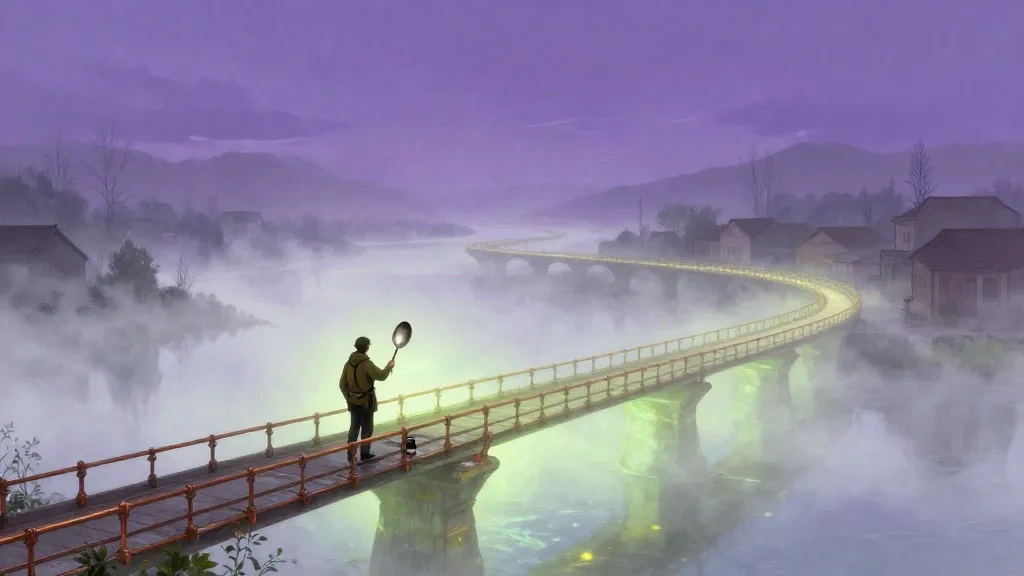
Pilings appeared beneath the arches, pale as winter clouds. Copper rails gleamed along both sides. The ninth bridge joined it, and the tenth extended from the town hall to the far bank, carrying every recorded promise in Veyra at once.
People came to test it. They brought grievances, apologies, marriage vows, debts, and names of the dead. The river did not judge them. It weighed them.
Iriq stood at the center while the town walked over the vow he had hidden for twenty years. His sister did not return. The river had preserved her record, not her body. That was the truth, and he had to let it stand.
By sunset, the salt jar had emptied. The silver spoon had gone black with river silt.
Iriq opened his private map and drew one final line: not a route between two places, but a boundary between what a person conceals and what a city must carry.
Then he nailed the map to the town hall door.
Below it, the river moved on, shining violet, copper, and cloud-white through the arches of all the bridges it had remembered.
What the River Keeps
That night, Iriq stood on the new bridge beside the salt jar and the spoon. He no longer needed them to find the hidden record. He used them only to taste the current, to mark the hour, and to remember that a promise is not kept because the river remembers it. It is kept because someone else is willing to cross.
Across the water, windows brightened one by one. The town had begun to tell the truth.
And beneath them all, the river kept witness.





