 Netwrck
Weird Fiction.
The Catalogue of Future Debts
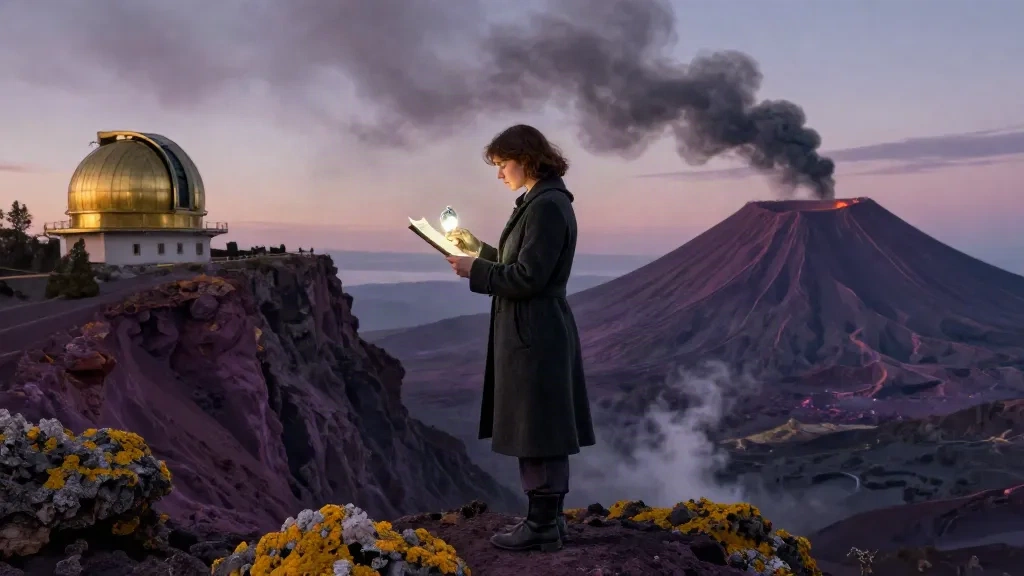
Mara Venn kept the observatory's catalogue beneath the ash gallery, where the walls sweated saffron yellow and the air smelled of iron filings after rain. The mountain was asleep, but its breath arrived every ninety seconds, lifting dust from the brass rails and making the old lenses tick in their frames.
She had been an archivist for eleven years. Her duty was to record what the mountain surrendered: extinct flowers sealed in ice, weather reports from towns erased by landslide, the names of surveyors who had walked into white cloud and never returned. Each entry received a date, a classification, and a small blue stamp confirming that the land had accepted it.
On the morning the glass seed arrived, Mara found it inside the catalogue's empty drawer. It was no larger than a plum pip, clear as smoke-grey water. Beneath it lay a wool glove, missing its thumb seam, still warm.
The note attached to the seed read: Name to be restored: Venn, Mara. Status: pending.
She searched the index. Venn, Mara appeared under 2081, filed beneath territorial names recovered from the eastern crater. Her handwriting was there, unmistakably her own, though the ink had browned with age she had not lived.
Mara closed the catalogue. Somewhere below, the mountain exhaled.
Land That Required a Signature
Forgotten names were not buried in stone. They were held in the mountain'spermissions. A name withdrawn from a valley could leave the trees sour, the rivers mute, and the houses unable to keep their doors shut. That was why the observatory existed: to preserve names until the land could receive them again.
Mara's predecessor had written that in the margins of the first ledger. He had also warned that a name could be claimed by someone who knew its shape. The warning ended there. No one had ever explained who or what could sign.
She took the glass seed, the wool glove, and a brass recorder to the eastern crater. The path descended through saffron lichen. Above her, the sky was deep plum. Ash floated in the still air, each flake holding perfectly still.
At the crater rim, a shadow detached itself from the volcanic stone.
It was taller than a man and had the soft, uneven edges of smoke-grey cloth. It bowed. Then it produced a pen from somewhere inside its darkness.
“Archivist Venn,” it said. “You are late.”
Mara planted her boots. “I have not signed anything.”
“You have been signing for three hundred years.”
The shadow opened a document suspended in its hands. Every line was written in her script. At the bottom waited her signature, already complete.
The Glove's Missing Thumb
Mara remembered a winter storm. She had been a child, lost in the upper galleries. A gloved hand had found hers in the dark. The glove had smelled faintly of wool and rain. Her mother had called it impossible, because the observatory records showed no other child inside.
She held up the glove now. “Whose name did you take?”
The shadow wrote a single character, then stopped.
“The one the mountain cannot pronounce.”
“Then say it.”
“You will surrender your claim.”
Mara understood at once. The name in the future catalogue was not a record of her death. It was a receipt. The mountain had taken a forgotten person, preserved her inside the language of the future, and made Mara responsible for returning her. If Mara signed, the land would accept the name—but only if it surrendered the name currently holding it in place.
That name was Mara's.
The shadow pressed the pen into her hand. The wool glove tightened around her wrist, its absent thumb closing around nothing.
“Sign,” it whispered.
She took the glass seed instead. When she dropped it into the crater, the sleeping mountain cracked open a thread of golden light. The saffron cliffs began to sweat. The deep-plum sky lowered.
A Name Given Back
Mara wrote the forgotten name in the ash, not with ink but with the seed's light. It was Oru Vey, a child erased from the mountain's first survey. The shadow shrieked. Its document burned from the edges inward.
She signed beneath Oru Vey's name and wrote her own beside it, not as recipient, but as witness. The wool glove split along its missing seam, releasing a cold gust that smelled of snow.
At the crater's centre, a small stone rose from the ash. The red flowering plant that had not grown there for a century opened around it.
The shadow knelt. Its pen became a root.
“Now the catalogue is incomplete,” it said.
“No.” Mara watched the future pages darken. “Now it has room for the land.”
By dawn, Oru Vey's name had returned to the valley's springs, its birdsong, and the lichen-stained stones. The observatory's index still listed Mara for 2081, but beneath the entry someone had added a second note in fresh black ink:
The archivist is not the missing name. The archivist is the door.
Mara put the wool glove in her coat. Outside, the sleeping volcano breathed, and the smoke-grey air carried saffron petals across the observatory roof.





