 Netwrck
Historical Fantasy.
The Last Man in Orbit
In the autumn of 1891, the desert observatory tracked a new red star above the Kharif range, and Captain Ilyan Voss refused to come down.
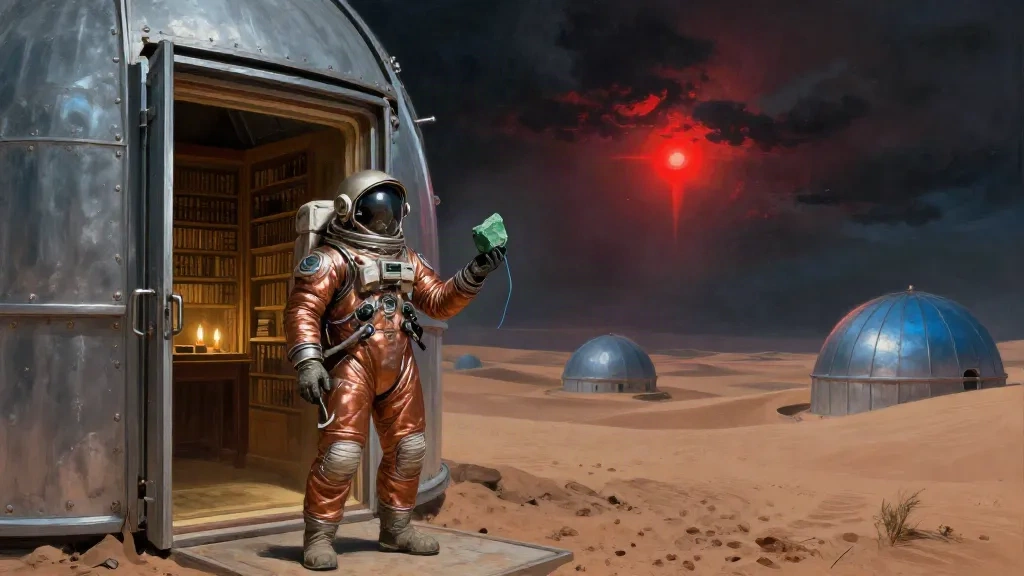
His ship, the Mercy Bell, hung in a permanent orbit with its engines cold, a brass-and-iron coffin learning the slow grammar of the sky. From its cupola he watched the observatory below: a low fortress of steel-blue domes half buried in sand, the wind moving over it the way a hand moves over a sleeping brow. Once a month he descended by ladder, entered through the western airlock, and returned before dawn. The directors called his visits inspections. He let them, because the alternative was explaining that he came down to touch the ground and make certain the ground was still there.
Two hundred and forty rungs. He had counted them every month for eleven years and had never once said the number aloud, because saying it would make it a measurement, and a measurement could be shown to be a habit rather than a need.
The cold came first, in the rungs, then the smell of wet iron that the desert never earned. Heat arrived after, walloping up from the sand like a struck drum, and by the sixth rung his palms were slick and by the fortieth his breath had gone to a labor he had been trained to make invisible. Below him the fortress waited. Above him eleven years waited with him, and he had long since stopped being able to tell which was the larger number.
The Arithmetic of Leaving
He told everyone the arithmetic was obedience. He had been the first man ordered into orbit, in the year the Kharif venture was still described in circulars as aerial survey. Three went up. The upper atmosphere tore the ship along a seam nobody had thought to weld, and two of them were gone before the first hour ended. Voss was the one who came back alone, which the directors recorded as a survival and the desert recorded as an abandonment, and the two records have never agreed on the tense.
The true arithmetic was smaller and uglier. He had come back with a message in the sealed tube of his suit, transcribed from a signal that arrived eleven minutes before the flare that would be recorded as the Kharif fire, and he had handed that tube to a man in a wool coat who read it on a stagecoach and then, six weeks later, burned two villages to keep a treaty from being written. Voss had signed nothing. Voss had carried it.
He stayed in orbit because the ground was where the arithmetic was settled. Orbit was the only place left where nothing he had touched could be improved or punished.
Mara, and the Knot She Taught Him
Mara had kept the listening array on the eastern ridge, and her hands had always been better than his. She wound cable with a hitch he could not name and could not unlearn: the loop taken once through, once around the standing part, drawn left over right, and pulled until the threads lay flat without a wrinkle. When they married she re-tied his bootlace in it. When he left she re-tied the green stone in it.
The stone was a chipped fragment of observatory glass from his first landing, the color of deep water, and it was not a talisman for luck. He had told her that and she had laughed at him for a long time. Luck, she said, is a thing that happens to you. A knot is a thing you do. Choose which you would rather own.
Her last transmission had repeated beneath the static for eleven years. He had listened to it more times than the observatory had recorded. It was not a farewell. It was a coordinate, and he had known that on the third night, and he had gone back up the ladder anyway, because a coordinate is a promise that something is still standing at the other end of it.
A Door in the Wrong Wall
On the night of the storm, Voss found the western airlock opening onto the eastern archive.
There was no corridor between the two. One moment his hand was on cold iron with sand ticking against it, and the next the same iron opened onto a room lined with paper, the smell of lamp oil and dust and the dry mineral breath of old glass. Across the floor stood a narrow iron door, its paint blistered tobacco brown, and beyond it he heard Mara cough, then say the childhood name she had not used since they were nineteen.
He took the green stone out of his pocket. Chipped edge, cool center, blue thread wound four times and knotted in her hitch. He held it and understood, with a clarity that arrived later and would not leave him, that he had not kept it. That it had been kept, by a woman in a room he was not in, through eleven years of a voice arriving eleven minutes before the event it described.
The door handle turned.
Voss opened it and found himself beside the western airlock instead. Behind him the archive had become a corridor of stars, sand streaming through the walls in pale ribbons that moved like water and did not wet anything. Candles floated above the tables, their flames burning upright and their reflections bending toward the ceiling, toward a sky the room had no business containing.
The Director in the Wrong Room
He found Director Emerick in the reading alcove, sitting with his back straight and his coat buttoned, as though he had been waiting eleven years for this particular interruption and had dressed for it.
“You are late by a season,” Emerick said. “The meridian numbers will be sealed at dawn.”
“There is no meridian chamber on this floor.”
“There is no floor.” Emerick turned a paper over. He was eighty-one and had not aged in the way the desert aged men, which had always frightened Voss more than the desert did. “Captain, I erased a hundred and nine names. I would do it again. I want you to hear me say it plainly, because you have been up there for eleven years composing a speech in which I am the villain and you are the man who finally listened.”
“I listened on the third night.”
“You listened and you climbed. That is what I mean.” Emerick's voice did not rise, and that was the frightening part. “A voice arriving from tomorrow is not a witness, Captain. It is ordnance. It told us a treaty would fail, and we buried a village, and twelve years later another voice told us a famine would end, and we buried a province to be certain. I did not hate those people. I had no time. Do you understand what I am telling you? I did not have time.”
“Mara had time,” Voss said. “Three weeks of it, inside the storm. You wrote static event, unrecoverable in the log and you entered her numbers as weather.”
“I entered them as weather because weather is what the building accepted.” Emerick set the paper down. “We built this place to hear the future. Then we discovered that the future does not answer politely; it answers continuously, and it answers to anyone with a receiver, and there is no species in this desert that survives being told the future twice. So we built a way to make it stop. You may call it erasure. I called it weather.”
“You called it murder and then you filed it under meteorology.”
“Yes,” Emerick said. “And what did you file the tube under?”
The candles bent. Somewhere in the building a door moved before he could reach it, and the room folded, and Emerick was gone, and his last words arrived from a cupboard, then from the floor, then from a wall that had not been there that morning.
The Record of the Unheard
He followed Mara's voice from a speaking tube to a cupboard, from a cupboard to the floor, and understood at last that the building was not haunted. It was looping. The red star's signal came down folded back on itself, arriving before itself, and every erasure the directors had performed had to happen again in order to complete the shape of the message. The fortress was not remembering. It was repeating, and in the repetition the geometry came apart, and the doors stopped belonging to the walls that held them.
At the meridian chamber the voice became clear.
What She Wrote on the Glass
The chamber held a brass cylinder fixed to the floor by six bolts. Voss cut them with his astronaut's wrench, one, two, three, and the noise each bolt made was the noise of a small permission ending. Inside, instead of charts, lay a narrow strip of smoked glass wrapped in oilcloth, and across it the red star's signal ran in bright fractures, the way lightning writes itself across a window and is gone.
It was not a signal. It was a testimony, and the observatory had received it correctly and had chosen to file it as atmosphere.
“They entered the numbers as weather,” Mara said, “because a number that indexes a person will hold. A number that indexes a storm will be forgiven. I gave them four, eleven, nine, two and they copied it into the barometric column, and for nine years the desert had a low pressure with my name on it. I hid this. If he comes down, he will come down in the storm, because storms are the only weather this building believes. Look for the meridian numbers. Do not look for me.”
Then her voice, lower, almost apologetic, as though she had rehearsed it against an audience of one for eleven years.
“Ilyan. You will want to hear me say it was the order. It was not the order. The order was one of two reasons, and the second was that you were afraid of the ground. Both are true. Fear does not cancel. It travels with the man, like a knot, like a stone, like a stone somebody tied for him because he could not.”
He read it twice. The second time he was on his knees on the meridian floor with his forehead against the brass, and he did not pray, because he had never been a man who traded, and because the woman who would have argued with him about it was the one being vindicated in his hand.
He thought of the tube in his wool coat. He thought of the two villages, and the province after them, and the arithmetic he had carried up the ladder and called orbit. Mara's glass did not accuse him. It located him, which was worse, the way a meridian locates a star: not by blame but by the fact that you can only find one by standing in the place it is measured from.
The Instrument of Two Small Things
The iron door slammed shut.
Voss could no longer see the cylinder, and Mara's voice whispered through its painted surface, claiming the room, claiming the years, the storm folding the archive around him until the walls narrowed to a seam of candlelight. He tied the blue thread around the green stone and pressed both against the door. The stone remembered the first landing, the heat, the taste of iron dust in his teeth, the small ridiculous joy of a man standing on a world. The thread remembered Mara's hands, and the hands had known how to fasten a thing so it would not be lost and how to loosen it so it could be carried.
Together they made a small instrument: an observatory reduced to direction, color, and a voice refusing to be filed as weather. He had spent eleven years holding it in his pocket like a charm. He understood now that it was an instrument, and that it required only the one thing he had no practice at, which was to be in the room while the reading was taken.
He said, “Receive me.”
The Door Opens Downward
The wall became a floor.
Voss fell into the desert with the stone and thread clenched in one fist and the oilcloth in the other, and the fall was not a fall but an inventory: sand, ruined rooms, a child's shoe, a brass ruler, a cup of tea still standing on a table that was now a ceiling, a thousand small ordinary objects of a working building, all of them falling at the same speed, all of them, he understood, in the wrong order. The storm lifted him beneath the red star through layers of sand and drowned architecture, and the last thing he passed was a ceiling lamp with its reflection bent upward like a flag.
He arrived at the original airlock, or the copy of it, or the version of it the storm had decided to use. The cylinder was inside his coat against his ribs, and it was warm, and when he spoke into it the brass gave her voice back to him with the fidelity of a bell, above the wind, across the years.
“History is not what survives. It is what someone returns to hear.”
He opened the airlock.
Forty-one people were inside it: the night watch, three of the record clerks, the cook and his daughter, four students of the signal school, and Director Emerick, who had apparently been walking toward this door for some hours, because he was calm, and buttoned, and dry. The observers looked at the man who came in out of the storm in a pressure suit with a brass cylinder pressed to his heart, and no one spoke, because the building was already gone behind him, taken by the storm the way a sentence is taken by the person who finally repeats it correctly.
Behind him the red star went dark. In the darkness, a blue thread drew itself across the threshold.
What the Desert Kept
The Kharif observatory was rebuilt in stone the following spring, without domes, and the instrument the new building installed was a barometer. Voss testified for six days before the inquiry, and the transcript survives, and it is the only document in the history of that desert that mentions the word torture in connection with the Kharif fire, which the government had classified as a cartographic inconvenience.
He was not believed, exactly. He was inconvenienced. The inquiry found that the archive had been structurally unsound, that the red star's emissions were ordinary and that Voss's descent had occurred during a season of anomalous pressure, and that the testimony of a man who had not slept in a bed for eleven years could not be expected to observe the ordinary rules of evidence. The inquiry also recorded, without comment, that Voss had produced a strip of smoked glass bearing writing in no hand anyone present recognized, including his own, and that the glass had been entered into the museum collection as an unattributed technical specimen, number four hundred and four.
He could have released the whole account. He had it in his head, whole, and he had learned by then what a voice from the future costs when it is believed by the wrong people at the right hour. So he did something Emerick would have recognized and would have hated: he made copies. He dictated the testimony to the record clerks in the new stone building, and the clerk copied it, and the copy was carried by hand to eight libraries, four monasteries, and a society of women in Kharif city who kept births, deaths, and floods with a precision the government found embarrassing. He sent the barometric numbers to the newspapers with the column heading attached, so that the world would have to look at its own weather and see the pressure that had a name in it.
Nothing changed. That is the honest measure of it. The villages stayed burned. The province stayed unplanted. Emerick died in his sleep in the fourth winter, and the obituary in the Kharif Courier called him a servant of the public, and Voss read it standing in the yard of the new building with the stone in his hand and found that he could not decide whether it was a lie, and that the not-deciding was itself the last remnant of the thing the future had been made of.
The ladder, though, he kept. Two hundred and forty rungs, monthly, before dawn, and the observatory's students came out to watch, and he let them. They asked the ordinary questions. The girl from the cooking staff had grown into the archivist and still asked the largest one, in the doorway, without any cruelty in it at all.
“Is there a floor up there?” she said. “Not a bottom. A floor.”
“There is a floor,” Voss said. “It is just not where you leave it.”
He told her about the meridian, and about the numbers, and about the woman who had been entered as weather. He told her that the record of the unheard is kept by whoever climbs back down, and that this is a heavier occupation than it sounds, and that it cannot be delegated, because the only testimony the building accepts is the one carried in by hand.
Each year, once, on the night the red star stands low over the range, he goes up. He has been forty-one years old, and fifty-eight, and once seventy, in the order the observers entered him, which is not the order the mirror agrees with. The desert keeps what he gives it and returns it at its own exchange rate. He goes up to hear her, and he comes down with his boots full of sand and the stone still knotted, and he does not always return the same size, and no one at the observatory writes that down.
What they do write down is this. On the ninth of the month, a man descends. On the ninth of the month, the barometer in the new stone building drops four points and rises again, and the clerk in the record room marks the column in her hand, the way her grandmother marked it, and under the figure she writes four, eleven, nine, two, and she does not cross it out, and she does not enter it as weather.
At the bottom of the ladder they have left a chair, bolted down, for the men who cannot manage the descent in one piece. Nobody uses it. It stays empty, and it is not sentiment, it is instrumentation: someone has to be where the returning lands.





