 Netwrck
Fairy-Tale Fiction.
The Physician of Borrowed Rooms
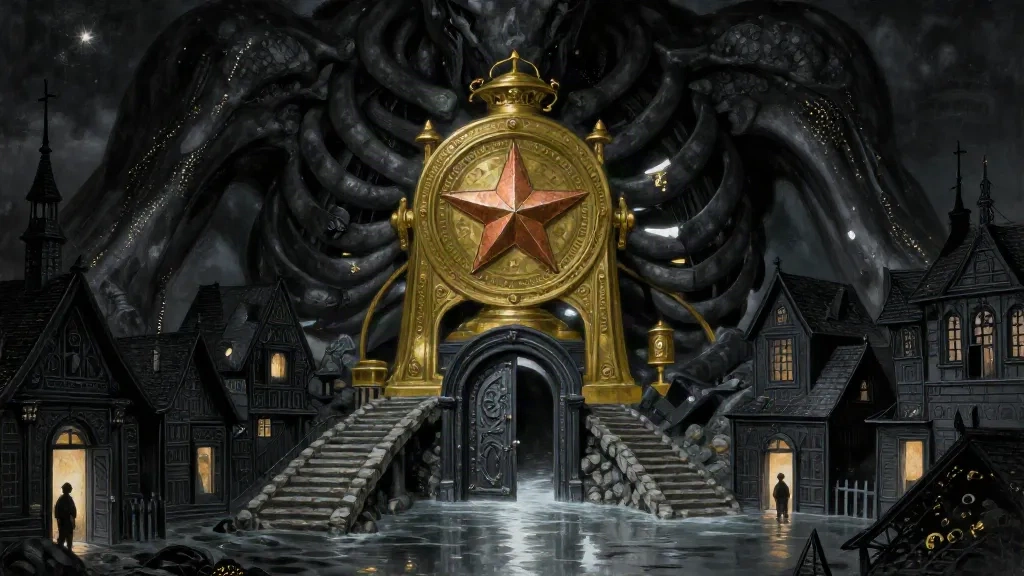
Dr. Elian Vale treated homesickness the way other physicians treated fever: by listening for the body’s hidden heat. He visited the village inside the ribs of the sleeping giant, carrying a black lacquer case filled with silver instruments, small brass cups, and a music box whose winding key was shaped like a bent finger.
Patients described the same symptom. A widow missed the sea even though she had never seen it. A baker dreamed nightly of a blue door in a city that no longer existed. A child had left one spoon beneath his pillow and could not remember why.
Elian did not prescribe medicine. He prescribed rooms. He measured the distance between a person’s present dwelling and the place their longing had made, then altered the angles of their home: one window faced toward remembered rain, another door opened onto the scent of an absent kitchen.
At dusk, he wound the music box. Its single melody traveled through the curved bone corridors and settled in the black-lacquered shutters. People relaxed. Their homes became gentler, and their grief acquired a polished edge.
What the Flood Found
On the ninth night of rain, the river beneath the giant’s lowest rib rose and entered the village through seams no mason had recorded. Water spilled into the market, drowned the lanterns, and carried a black iron door into the central square.
The door belonged to no house. It was taller than a two-story building and covered in gold dust, its surface crossed by channels of blue light. When the flood withdrew, it revealed a stairway descending underground.
Elian descended with Mara, the village engineer, and Niko, who had once repaired the music box. At the bottom lay a machine.
It was beautiful. Brass arms revolved around a copper star, counting the rooms in the village. Each room appeared as a tiny black box inside the star, connected by silver threads to a central drum. The drum turned whenever someone felt homesick.
On its face, engraved in gold dust, was a civic seal: EVERY HOME SHALL REMEMBER.
The buried project had been built to preserve the village through catastrophe. Its architects had believed that a person could be healed by giving their longing a permanent address.
The Contract in the Music Box
Elian opened his case. The music box began to play without being wound. A child’s voice emerged, reciting the names of every resident who had ever left.
He found the governor of the machine at the far end of the chamber, suspended in a glass tank of black water. She was young, dressed in lacquered armor, and smiling without opening her eyes.
“You built a beautiful prison,” Elian said.
“We built a beautiful promise,” she answered.
Her machine could summon absent places inside existing homes. A villager might sit beside a fire while the dead mother drew water in the next room. A traveler could return to the family table without anyone knowing he had crossed the world. The arrangement required only one thing: the traveler must surrender the door home.
That was why the copper star had begun to glow. It was collecting departures. Each silver thread led to a person trapped in a room that felt perfect because it admitted no change.
Elian’s own mother was among them. He had spent years treating other people’s longing because remembering hers made the rooms in his own house sway.
The Star Without a Center
He climbed onto the machine and cut the silver threads with his smallest instrument. Each severed thread released a shadow from the star. The shadows did not disappear; they became wind, rain, insects, and the smell of bread baking elsewhere.
The machine accelerated. The governor’s glass tank cracked. Across the village, every black-lacquered shutter flew open.
People woke inside impossible rooms. Some wept. Some laughed. Some ran toward doors they had spent years refusing to use.
The copper star spun free of the machine and struck the buried floor. It broke at the center, but before the pieces cooled, Elian held his music box over them.
He let the melody finish its last phrase, then smashed the box.
The melody broke apart. In its place came the giant’s breathing: immense, slow, and finally audible through the ribs. The village rose with it. Water drained into the buried stairway. Doors opened onto mud, grass, and the uncertain road.
By morning, the machine was only a field of brass, glass, and gold dust. The governor stood beside it, alive, grieving. Elian found the copper star among the fragments and gave it to Niko.
“What will it count now?” Niko asked.
Elian looked at the open doors.
“Nothing,” he said. “That is how we know we are free.”





