 Netwrck
Adventure.
The Empty Place
Mara Venn kept a brass spoon above every cooking pot and a place at the table for whoever the meal remembered. On rainy days, the kitchen filled with absent footsteps. Bread rose for dead grandmothers. Onion softened in the hands of sailors drowned beyond the western shoals. A broth could coax a lost child back long enough to taste it, though the child always vanished before dawn.
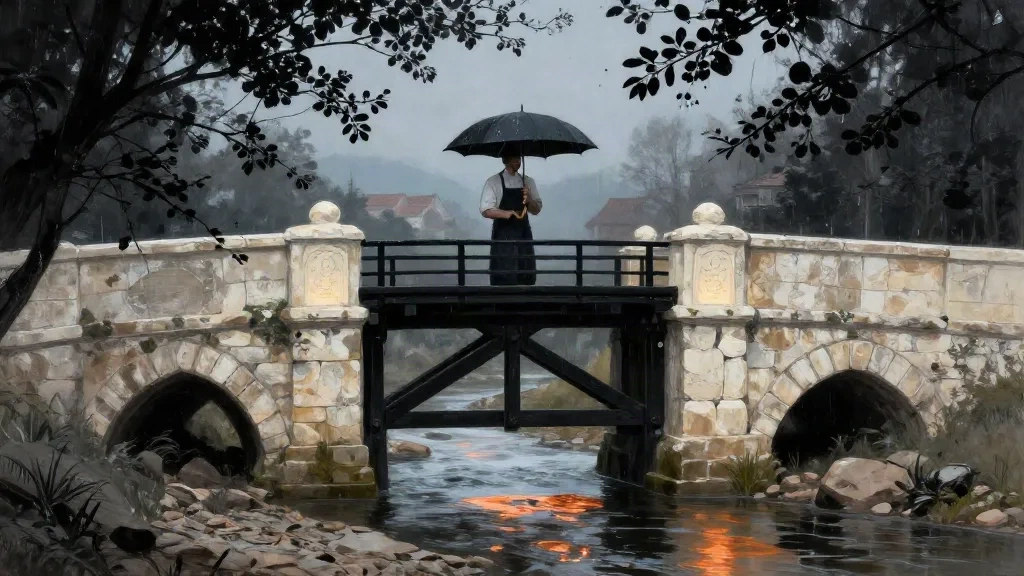
In Bellwether, every bridge bore a carved vow. Marry beneath me. Return what you borrow. Let no child cross alone. The river was the town’s witness, carrying declarations downstream until the banks caught them in pale stone. Yet, for nine dry years, the river had shown only its cracked bed.
Mara kept her family’s oldest promise in a black umbrella, though she had never seen it open. Her grandmother claimed the Bellwether Gate lay beyond the first bridge, guarded by a keeper who demanded the final mouthful of every journey. Whenever Mara asked how the keeper knew a journey was finished, her grandmother touched the umbrella’s silver handle.
“Some prices remember being paid,” she had said.
Mara needed proof. The legend was the only inheritance her family had, and lately people called its stories compensation for hunger. She wanted one true thing.
A Recipe for the Missing
On copper evenings, when the low sun struck the exposed stones, Mara set a black cherry in a bowl of water and made a clear soup from river salt, barley, and pepper. The legend claimed the first keeper had cooked with the last water beneath the old bridge.
She had not expected an answer.
The broth went cold before the second spoonful. Across the table, a man appeared with his coat dripping black water. He wore the copper-buttoned uniform of the vanished river patrol.
“Is that the Bellwether gate?” Mara asked.
He looked at the empty place beside him. “It was. Your grandmother promised us a road home. I have carried my half since the flood.”
Mara understood the unspoken accusation. Generations of cooks had served the river dead, but none had opened the gate. Her family’s legend might be true, or it might be an excuse she had repeated because there was nothing richer to inherit.
The patrolman pointed toward the black umbrella. “Tomorrow the witness will rain. Carry it. Do not let it dry.”
By morning, the dry riverbed held footprints.
The Cost Paid Twice
They ran beside the stones, into a culvert, and down a stair no maps admitted. At the bottom waited a gate of black wood between two bridge-shaped arches. A woman with a cook’s soot-stained apron stood before it.
She was Mara’s grandmother, unchanged.
“You came late,” the woman said.
“You let me believe you were dead.”
“Belief was the payment. I surrendered the memory of your mother, and the gate surrendered me to dry years.” Mara looked at the umbrella. The silver handle bore a bright crescent. “If I open it now, what do I forget?”
“Why you cook. The fire, the names, the faces that return. A gate accepts the last reason for its keeping.”
The patrolman struck the wood. Beyond it, the river roared with voices.
“Then leave it shut,” Mara said. “You warned the town. Your work is done.”
Her grandmother shook her head. “A warning is not a witness. The living must choose what survives.”
Mara understood then. The cost was not knowledge of a meal. It was the particular hunger that had made her grandmother teach her, the solitude that had made her set a place for strangers, the grief that had entered the kitchen with Mara and taught her to feed it. Lose that, and the river might return, but the family legend would be the only truth left: a dead woman had believed in magic.
Mara opened the umbrella over the gate.
The Copper Horizon
Rain struck the black canopy in warm coins. Water filled the dry channel without rising above its banks, and every carved promise shone on the surface. The patrolman went home carrying not the final mouthful of his journey, but the memory of why he had stayed away.
The gate would not open again.
Mara climbed back with the umbrella closed. She could no longer remember her mother’s face, but she remembered placing salt in a bowl, remembering mattered less than making. The kitchen had no returning guests that night. Mara cooked barley until the broth tasted faintly of rain.
Years later, strangers entered from the copper-bright evening. Hungry, lost, furious at the world. Mara set a bowl before each.
“Why do you feed us?” they asked.
She could not explain. The reason had left with the last witness of the dry river, and a gate never takes the same price twice.





